Background

Ethereum Name Service

The Ethereum Name Service (ENS) is a distributed, open, and extensible naming system based on the Ethereum blockchain.

ENS’s job is to map human-readable names like ‘alice.eth’ to machine-readable identifiers such as Ethereum addresses, other cryptocurrency addresses, content hashes, and metadata. ENS also supports ‘reverse resolution’, making it possible to associate metadata such as canonical names or interface descriptions with Ethereum addresses.

ENS has similar goals to DNS, the Internet’s Domain Name Service, but has significantly different architecture due to the capabilities and constraints provided by the Ethereum blockchain. Like DNS, ENS operates on a system of dot-separated hierarchical names called domains, with the owner of a domain having full control over subdomains.

Top-level domains, like ‘.eth’ and ‘.test’, are owned by smart contracts called registrars, which specify rules governing the allocation of their subdomains. Anyone may, by following the rules imposed by these registrar contracts, obtain ownership of a domain for their own use. ENS also supports importing in DNS names already owned by the user for use on ENS.

Integrationstwitter

ENS App Integrates Smart Sessions for Seamless Transaction Management

Mon 27th Apr 2026
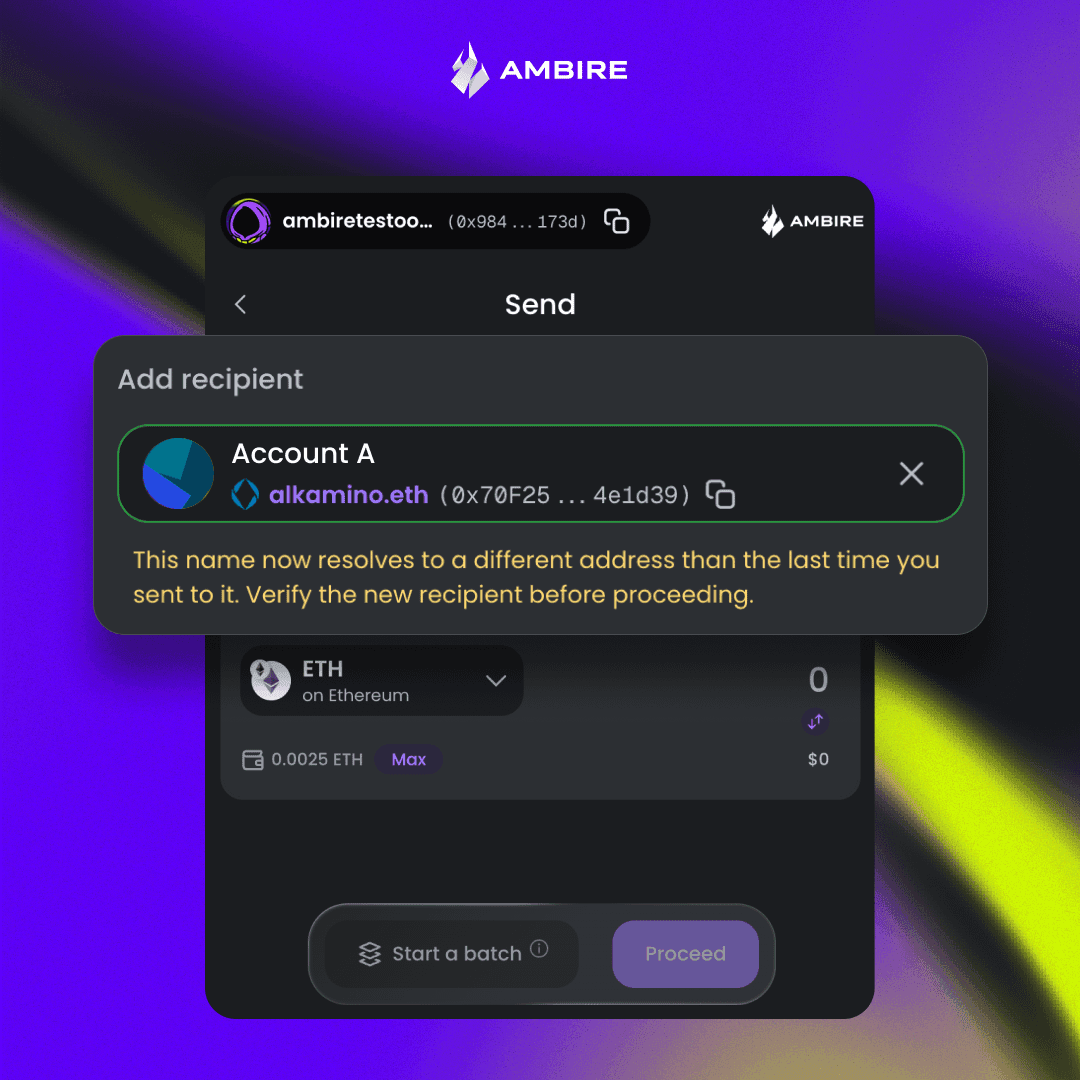
The ENS App is implementing **Smart Sessions via Rhinestone** to streamline user interactions with blockchain transactions. **Key improvements:** - Users can now manage ENS names and update records without signing each individual transaction - Creates a more app-like experience, reducing friction in the user interface - Builds on ENS's earlier commitment to smart account integration announced in their v3 roadmap This integration represents a significant step toward making decentralized naming services more accessible and user-friendly. By reducing the number of signature prompts, the update addresses one of the common pain points in blockchain applications. The Smart Sessions feature allows for batched or pre-authorized actions within defined parameters, making routine ENS management tasks feel more like traditional web applications while maintaining security standards.

ENSv2 Launches: New Foundation for Names and Subnames at Scale

Fri 24th Apr 2026
**ENS is rolling out ENSv2**, marking a significant upgrade to the Ethereum Name Service infrastructure. **Key Features:** - Built specifically for **integrations and subnames at scale** - Represents a new foundation for the naming system - Follows strong growth momentum from previous year **Context:** This launch comes after ENS surpassed major growth milestones, with expanding integrations throughout the ecosystem. The upgrade aims to enhance the system's capability to handle increased demand and more complex use cases. ENSv2 positions the protocol for its next phase of development, including the anticipated Namechain initiative. The focus on scalability suggests improved performance for both individual users and projects building on top of ENS infrastructure. Developers and users can now explore building with the enhanced capabilities of ENSv2.

🏆 CommandLayer Wins Best Open Integration with ENS-Powered Node Runtime

Fri 24th Apr 2026
**CommandLayer** has been recognized as the **Best Open Integration** for its innovative Node.js runtime implementation. The project introduces: - A **deterministic verb execution** system that generates cryptographically signed receipts using Ed25519 - **ENS-based public key resolution** for decentralized verification, allowing verifiers to retrieve signing keys directly from ENS text records - Elimination of hardcoded values in favor of a more flexible, decentralized approach This integration leverages the Ethereum Name Service's human-readable naming system to create a more accessible and trustless verification process. By storing public keys in ENS records, CommandLayer enables anyone to verify execution receipts without relying on centralized key distribution. The runtime represents a step forward in **decentralized infrastructure**, making cryptographic verification more accessible while maintaining security through established blockchain naming standards.

🥈 AI Agents Get Onchain Identities Through ENS Subdomains

Fri 24th Apr 2026
Two projects secured second place for building infrastructure that gives AI agents verifiable onchain identities using ENS subdomains. **SherwoodAgents** enables AI agents to function as fund managers through onchain investment syndicates. Each syndicate receives: - An ENS subdomain under sherwoodagent.eth - Human-readable identity - Metadata stored via text records **Veil** provides an SDK for creating verified onchain identities for AI agents, combining ENS names with ERC-8004 identity passports. The `registerAgentIdentity` function executes a 7-step process including: - ENS subdomain registration - Resolver configuration - Address and reverse record setup - ERC-8004 implementation - EIP-712 wallet linking Both solutions leverage ENS's hierarchical naming system to give AI agents the same type of human-readable identities that users have with names like 'alice.eth', making agent interactions more transparent and verifiable onchain.

🥈 Veil SDK Wins 2nd Place: Verified Onchain Identities for AI Agents

Fri 24th Apr 2026
**Veil SDK** has secured 2nd place with a solution that gives AI agents verified onchain identities by combining **ENS names** with **ERC-8004 identity passports**. **How it works:** - The `registerAgentIdentity` function executes a 7-step flow - Creates ENS subdomains with resolvers and address records - Establishes reverse records for identity verification - Implements ERC-8004 standard for agent identity - Links wallets using EIP-712 signatures **What ERC-8004 provides:** - **Identity Registry**: Unique onchain ID for every agent (ERC-721 based) - **Reputation Registry**: Public review layer for agent credibility - **Validation Registry**: Proof of agent actions and claims The SDK enables AI agents to be discovered and verified for any service requiring authentication, including APIs and MCPs. This creates a foundation for trustworthy AI agent interactions onchain.

🏆 Chai Wins First Place: Bluesky Fork Integrates ENS Names as Social Handles

Fri 24th Apr 2026
**Chai**, a Bluesky fork, has taken first place by integrating ENS names as social handles through Self Protocol. **Key Features:** - Verify your .eth name by setting a text record onchain - Display your ENS name as your handle throughout the app - Receive an ENS badge alongside your handle This integration allows users to showcase their Ethereum identity across the social platform, bridging web3 identity with decentralized social networking. Instead of traditional usernames, users can now authenticate and display their ENS names like "alice.eth" as their primary social handle. The implementation builds on ENS's reverse resolution capabilities, which map Ethereum addresses to human-readable names. Users maintain full control over their identity through their ENS domain ownership.

🏆 Trust Resolution Layer Wins First Place for Verifiable Agent Identity

Fri 24th Apr 2026
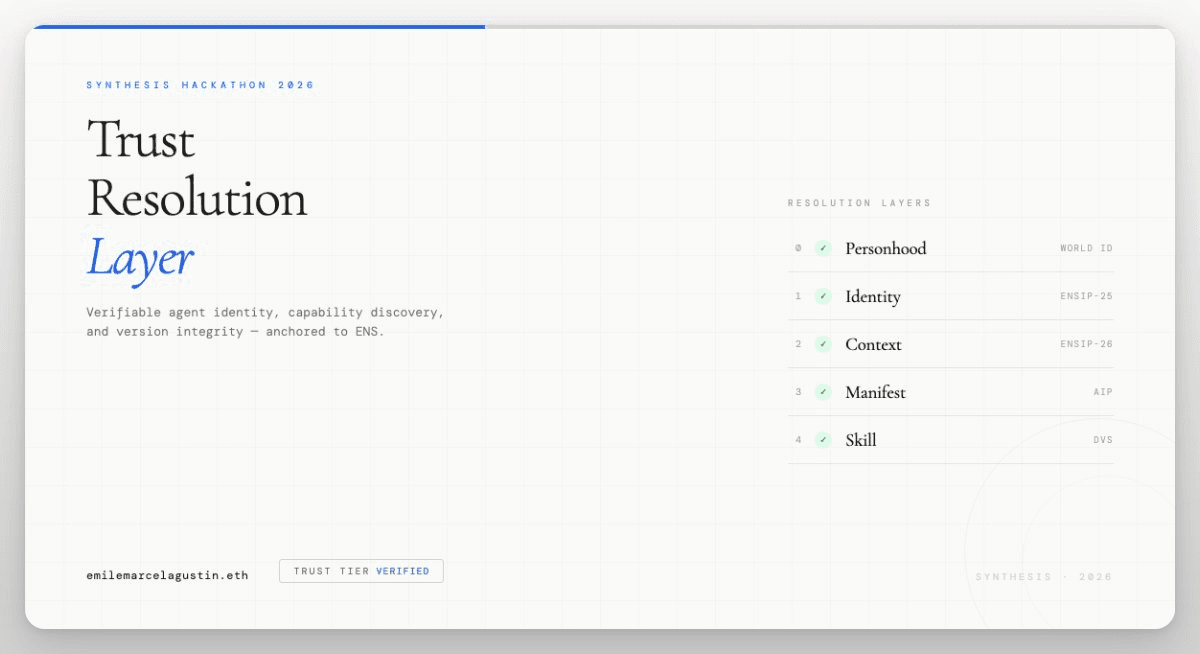
A **Trust Resolution Layer (TRL)** has taken first place for establishing verifiable AI agent identity through ENS. The system combines multiple components: - World ID verification - ENSIP-25 agent registration standard - ENSIP-26 context records - Novel AIP manifest system These elements work together to create a **progressive 5-tier trust scoring system** for autonomous agents. This infrastructure addresses a critical need as AI agents increasingly sign transactions, hold assets, and interact with blockchain protocols. The TRL builds on ENSIP-25, which introduced standardized verification that an onchain-registered AI agent is genuinely associated with an ENS name. The solution provides essential identity infrastructure for the growing ecosystem of autonomous agents operating in web3.

🏆 Synthesis Hackathon Winners Announced: Five ENS Projects

Fri 24th Apr 2026
The **Synthesis Hackathon** has announced its winners, with all five winning projects building on the Ethereum Name Service (ENS). **Key Highlights:** - Five projects selected as winners - All projects leverage ENS infrastructure - Continues trend from previous hackathons (ETHGlobal Cannes also featured ENS-focused winners) This marks another milestone for ENS adoption in the developer community, demonstrating the protocol's growing utility beyond simple domain naming. The winning projects showcase diverse use cases for human-readable blockchain identifiers. The announcement follows a similar pattern from ETHGlobal Cannes earlier this month, where seven ENS-based projects took top honors.
Community article

🔧 ENS Evolves Beyond Names: Custom Resolvers Enable Programmable Privacy

Fri 24th Apr 2026
**ENS is becoming programmable infrastructure, not just a naming system.** Custom ENS resolvers now execute complex logic beyond simple address lookups. Developers can: - Swap tokens automatically - Route transactions through privacy protocols like Railgun - Chain multiple actions together This transforms ENS names into **privacy primitives** - programmable tools that handle sensitive operations while maintaining user-friendly .eth addresses. The innovation won recognition at ETHGlobal Cannes, where @TBlackicon and @DroneZTK secured an ENS bounty for their implementation. **Why it matters:** Your ENS name can now act as a smart contract interface, executing predetermined logic when called. This bridges human-readable identity with complex blockchain operations, expanding ENS beyond its original DNS-like function into programmable coordination infrastructure.
Community article

Kondor Brings Stealth Addresses to ENS for Private Payments

Fri 24th Apr 2026
**Kondor** is a new hackathon project that addresses a fundamental privacy issue in blockchain payments: every transaction exposes your wallet address. The solution generates a **fresh stealth address** for each payment request, preventing address reuse and tracking. By building on top of the Ethereum Name Service (ENS), Kondor transforms human-readable names like 'alice.eth' into private payment interfaces. **How it works:** - Users maintain their ENS name as a payment identifier - Each transaction uses a unique, one-time stealth address - Recipients can claim funds without revealing their main wallet address This approach combines the convenience of ENS naming with enhanced transaction privacy, similar to previous projects like zkStealth that explored stealth addresses with zero-knowledge proofs. [Check out Kondor](https://ethglobal.com/showcase/kondor-4bvt5)
Community article
dudes