Background

Ethereum Name Service

The Ethereum Name Service (ENS) is a distributed, open, and extensible naming system based on the Ethereum blockchain.

ENS’s job is to map human-readable names like ‘alice.eth’ to machine-readable identifiers such as Ethereum addresses, other cryptocurrency addresses, content hashes, and metadata. ENS also supports ‘reverse resolution’, making it possible to associate metadata such as canonical names or interface descriptions with Ethereum addresses.

ENS has similar goals to DNS, the Internet’s Domain Name Service, but has significantly different architecture due to the capabilities and constraints provided by the Ethereum blockchain. Like DNS, ENS operates on a system of dot-separated hierarchical names called domains, with the owner of a domain having full control over subdomains.

Top-level domains, like ‘.eth’ and ‘.test’, are owned by smart contracts called registrars, which specify rules governing the allocation of their subdomains. Anyone may, by following the rules imposed by these registrar contracts, obtain ownership of a domain for their own use. ENS also supports importing in DNS names already owned by the user for use on ENS.

Integrationstwitter

ENS Universal Resolver: The Invisible Switchboard Making Name Resolution Seamless

Thu 9th Jul 2026
The **Universal Resolver** acts as a routing system for ENS (Ethereum Name Service), simplifying how name queries are handled across the network. **Key Features:** - Functions like a switchboard - users query one place, and requests are automatically routed to the correct destination - Eliminates the need for users to understand the underlying infrastructure or resolution steps - Makes ENS more capable without adding complexity to the user experience **User Impact:** Most users will never need to know the Universal Resolver exists. The process remains simple: enter a name, receive the correct answer, and continue. This infrastructure improvement enhances ENS's ability to map human-readable names (like 'alice.eth') to machine-readable identifiers while maintaining a seamless experience. Learn more: [ENS Universal Resolver Documentation](https://docs.ens.domains/resolvers/universal/)

🏗️ ENS Evolves Beyond NFTs: Hierarchical Registries and Role-Based Ownership
Mon 6th Jul 2026
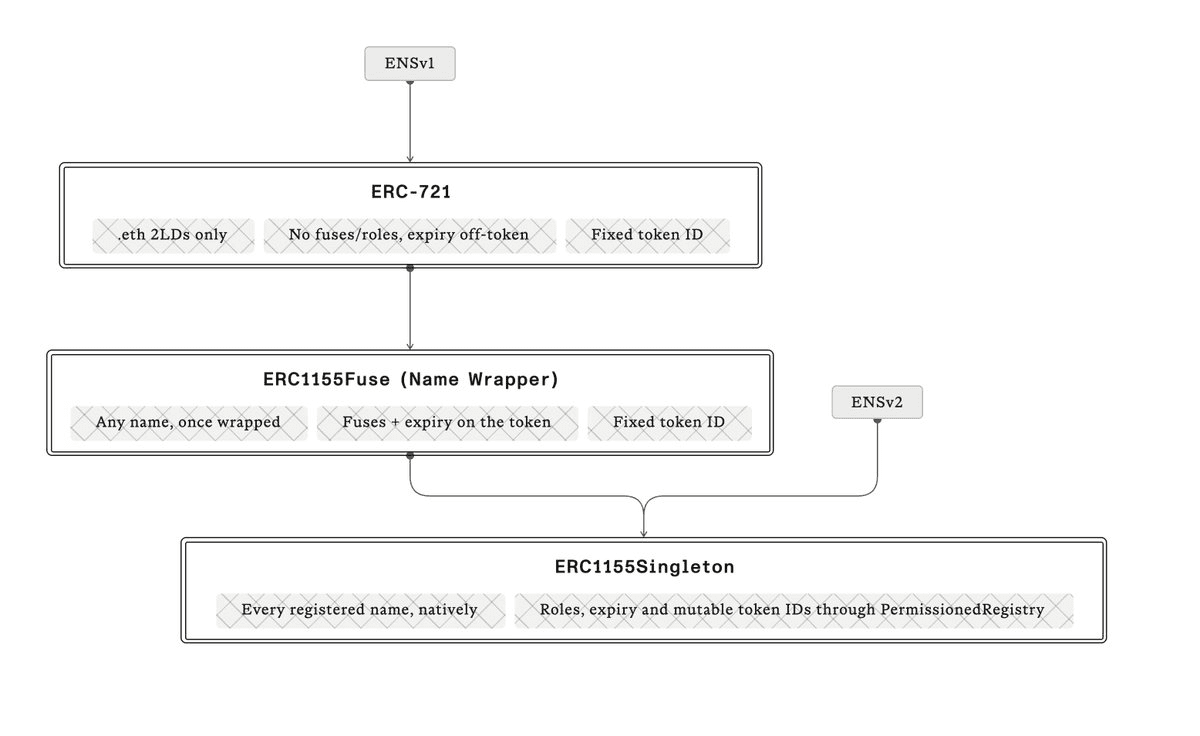
ENS is fundamentally restructuring how domain ownership works with ENSv2. The system moves beyond simple NFT representation to embed ownership, roles, and expiry directly into the registry. **Key changes:** - ENSv1 used ERC721 for .eth names - Name Wrapper introduced ERC1155 with fuses - ENSv2 implements ERC1155Singleton with hierarchical registries The shift reflects a deeper architectural change: instead of treating names as flat entries, ENSv2 uses hierarchical registries that mirror the hierarchical nature of domain names themselves. Each name becomes a structured system of linked components rather than a single object. The ERC1155Singleton standard maintains flexibility while ensuring uniqueness - one owner per name, no duplicate copies needed. Ownership and delegation become more expressive at the protocol level, though infrastructure abstracts the complexity for users. [Read the full technical breakdown](https://ens.domains/blog/post/how-ens-names-evolved)
Community article

ENSv2 Launches Universal Resolver for Cross-Chain Name Resolution

Thu 21st May 2026
**ENS is upgrading its resolver system with ENSv2** The Ethereum Name Service is introducing a Universal Resolver - a single smart contract that can resolve names across multiple environments: - ENSv1 names - ENSv2 names - Layer 2 networks - Offchain names via CCIP-Read **What developers need to know:** Applications using ENS should update their libraries to ensure compatibility with the new Universal Resolver. The system uses CCIP-Read protocol to fetch data from L2s and offchain sources. This consolidation simplifies the resolution process by eliminating the need for separate resolvers for different name types and networks. Developers can find implementation details in the [ENSv2 readiness documentation](https://docs.ens.domains/web/ensv2-readiness/). **Action required:** Review your ENS integration and update libraries to support cross-chain resolution.

ENS Launches registerAgentIdentity() for On-Chain Agent Verification
Fri 24th Apr 2026
ENS has introduced `registerAgentIdentity()`, a new function that provides AI agents with on-chain identity infrastructure. When called, agents receive: - A human-readable ENS subname - An on-chain passport - Cryptographic proof linking the agent to its owner This builds on ENS's evolving role beyond simple name resolution. The system now supports: - **Arbitrary records** that carry an agent's full trust stack - **Identity scoring** (none, registered, discoverable, verified, full) - **Programmable resolvers** that execute logic like token swaps or privacy routing ENS serves as the accountability layer, transforming raw cryptographic keys into verifiable, human-readable identities. One ENS name can hold everything: identity, discoverability, code integrity, and capabilities. The infrastructure makes agents resolvable and accountable while maintaining the flexibility to chain complex actions through custom resolver logic.
Community article

🏆 Trust Resolution Layer Wins First Place for Verifiable Agent Identity

Fri 24th Apr 2026
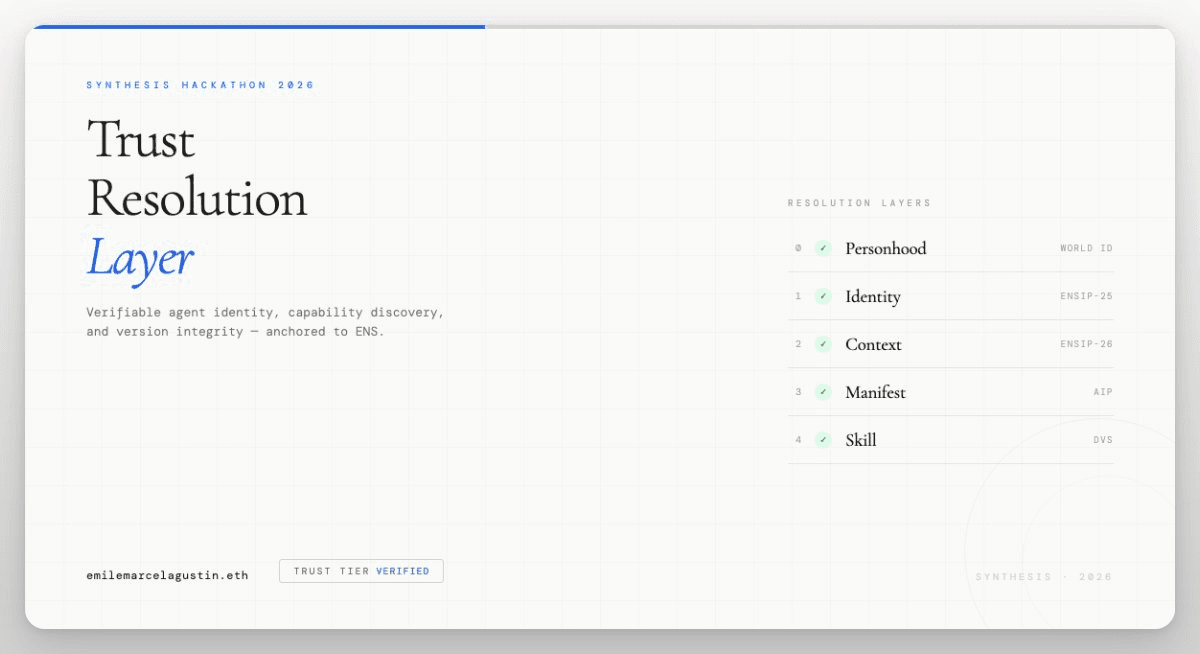
A **Trust Resolution Layer (TRL)** has taken first place for establishing verifiable AI agent identity through ENS. The system combines multiple components: - World ID verification - ENSIP-25 agent registration standard - ENSIP-26 context records - Novel AIP manifest system These elements work together to create a **progressive 5-tier trust scoring system** for autonomous agents. This infrastructure addresses a critical need as AI agents increasingly sign transactions, hold assets, and interact with blockchain protocols. The TRL builds on ENSIP-25, which introduced standardized verification that an onchain-registered AI agent is genuinely associated with an ENS name. The solution provides essential identity infrastructure for the growing ecosystem of autonomous agents operating in web3.

ENS Releases Alpha Log #5 with Reliability and Usability Updates
Thu 2nd Apr 2026
The Ethereum Name Service has published its fifth alpha development log for ENSv2, detailing continued improvements to the App and Explorer on the Sepolia testnet. **Key Updates:** - Focus on reliability, flexibility, and overall usability enhancements - Builds on previous fixes including transaction modal layouts and Fuses page improvements - Ongoing polish to search functionality, profiles, notifications, and name management features The ENSv2 testing phase continues on Sepolia as the team iterates on the user experience before mainnet deployment. More updates are expected in upcoming alpha logs.
Community article

🚀 Faster... Smoother... Better

Thu 2nd Apr 2026
The ENS App just got a performance boost. Profile data now loads faster thanks to optimized record fetching, making name management feel noticeably smoother. **What changed:** - Profile records are fetched more efficiently - Viewing name details is quicker - Managing profiles feels more responsive This follows recent updates that added Layer 1 primary name management and streamlined subname creation with address pre-population. [Learn more about ENS](https://ens.domains)
Community article

ENS App Now Includes Built-in Expiration Notifications

Fri 6th Feb 2026
The ENS Manager app has introduced a highly anticipated feature: **built-in expiration notifications**. **Key Features:** - Set up reminders through multiple channels: email, Telegram, or browser notifications - Never lose your ENS domain to accidental expiry - Notifications work directly within the app at [app.ens.domains](http://app.ens.domains) **Additional Context:** This builds on existing ENS Manager features, including the ability to register and extend names by selecting exact expiration dates for more precise domain control. The notification system addresses a common pain point for ENS users who may forget renewal dates and risk losing valuable domain names.

ENS Prepares for v2 Launch with Universal Resolver Updates

Mon 15th Dec 2025
**ENS is gearing up for its v2 launch** by requiring developers to update their libraries and applications. Key requirements for ENSv2 readiness: - Update ENS libraries to latest versions - Ensure apps resolve names via **CCIP-Read protocol** - Verify **L2 compatibility** for name resolution - Implement Universal Resolver support The Universal Resolver serves as the foundation for ENSv2, enabling cross-chain name resolution and improved functionality. **Why this matters:** ENSv2 represents a significant upgrade to Ethereum's naming infrastructure, expanding beyond simple address mapping to comprehensive web3 identity management. Developers should review the [ENSv2 readiness documentation](https://docs.ens.domains/web/ensv2-readiness/) and test their applications now to ensure seamless transition. *Action needed: Update your ENS integrations before the v2 launch to avoid service disruptions.*

ENS Expands Beyond Personal Names to Smart Contract Identification
Mon 15th Dec 2025
**ENS is evolving beyond personal naming** to include smart contract identification, making decentralized organizations safer and more user-friendly. **Key developments:** - DAOs can now name their smart contracts using ENS - Makes contracts more **legible and easier to integrate** - Enhances both **user experience and security** for Ethereum users **Leading the charge:** - @nounsdao pioneering contract naming adoption - @enscribe_ developing tools for easy contract naming - ENS_DAO supporting "Contract Naming Season" initiative This expansion transforms how users interact with smart contracts by replacing complex addresses with human-readable names, similar to how ENS already works for wallet addresses.
Community article
dudes