frENSday: Shaping the Future of Web3 in Bangkok
frENSday: Shaping the Future of Web3 in Bangkok
🤔 Bangkok's web3 revolution?

ENS announces frENSday, a celebration of web3 innovation on November 11, 2024, in Bangkok. The event will gather 400+ builders, developers, and innovators to explore making web3 more accessible and user-friendly.
Key points:
- Coincides with DevCon to unite the global web3 community
- Full day of presentations and collaborative activities
- Focus on ENSv2 and revolutionizing accessibility
- Emphasis on UX/UI excellence and cutting-edge tools
Event details:
- 10am-7pm, Bangkok or streamed online
- Ticket information coming soon
frENSday aims to shape a more inclusive internet future. Join to make an impact on web3's evolution.
🔧 How ENS Normalization Works Behind the Scenes
ENS has published a technical explainer on how name normalization works in their system. **The Process** Before ENS can resolve a name, it must first understand what that name is. The flow works like this: - User input → normalization → namehash → ENS contracts - Normalization converts valid variations into a single canonical name - It rejects unsafe input before it reaches the smart contracts **Why It Matters** When normalization functions correctly, users shouldn't notice it at all. They simply type a name, and every up-to-date integration agrees on what that name means. This consistency is crucial for a naming system that maps human-readable names to blockchain addresses and other identifiers. The system ensures that different valid variations of the same name are treated identically, while protecting users from potentially malicious or confusing inputs. [Read the full technical explanation](https://ens.domains/blog/post/how-ens-normalization-works)
🔒 ENS Standardizes Name Security
**ENSIP-15** establishes unified rules for handling ENS names across wallets, apps, libraries, and block explorers. The standard addresses critical security gaps that simple lowercase conversion cannot solve: - Look-alike scripts (homograph attacks) - Combining marks and invisible characters - Complex emoji sequences - Zero-width characters - Names that render differently across devices Finalized in 2023, ENSIP-15 provides a shared normalization framework to protect users from spoofing techniques and ensure consistent name interpretation across the ecosystem.
ENS Names Now Support Direct IBAN Banking Integration
Mt Pelerin has integrated IBAN support with ENS names, enabling users to link traditional bank accounts directly to their Ethereum addresses. **Key features:** - Buy, swap, and cash out crypto using your ENS name - Personal IBAN accounts linked to ENS for crypto-fiat transfers - Multi-currency support including euro and Swiss franc IBANs - Transfers processed in your own name This bridges traditional banking with decentralized identity, allowing ENS names to function as both blockchain addresses and banking identifiers.
🏆 Three Teams Win ENS Prizes at ETHGlobal Lisbon
Three projects won ENS prizes at ETHGlobal Lisbon, showcasing diverse applications of the naming protocol: - **Name-as-wallet UX**: Simplified wallet creation and recovery using ENS names - **Agentic mini-apps**: AI agents with onchain identities built on ENS - **Onchain trust graph**: Social trust relationships encoded directly in the namespace The wins follow a series of ENS presentations in Lisbon, where the team demonstrated how names can serve as infrastructure for apps, wallets, smart accounts, and AI agents. At Pragma Lisbon, ENS founder Makoto Inoue outlined a vision for ENS as a coordination layer across the onchain ecosystem. The hackathon results mirror strong ENS adoption at ETHPrague, where 29 of 64 projects (45%) integrated the protocol. All three winning teams treated ENS as foundational infrastructure rather than a simple naming service.
Ambire Adds ENS Address Change Detection for Safer Transactions
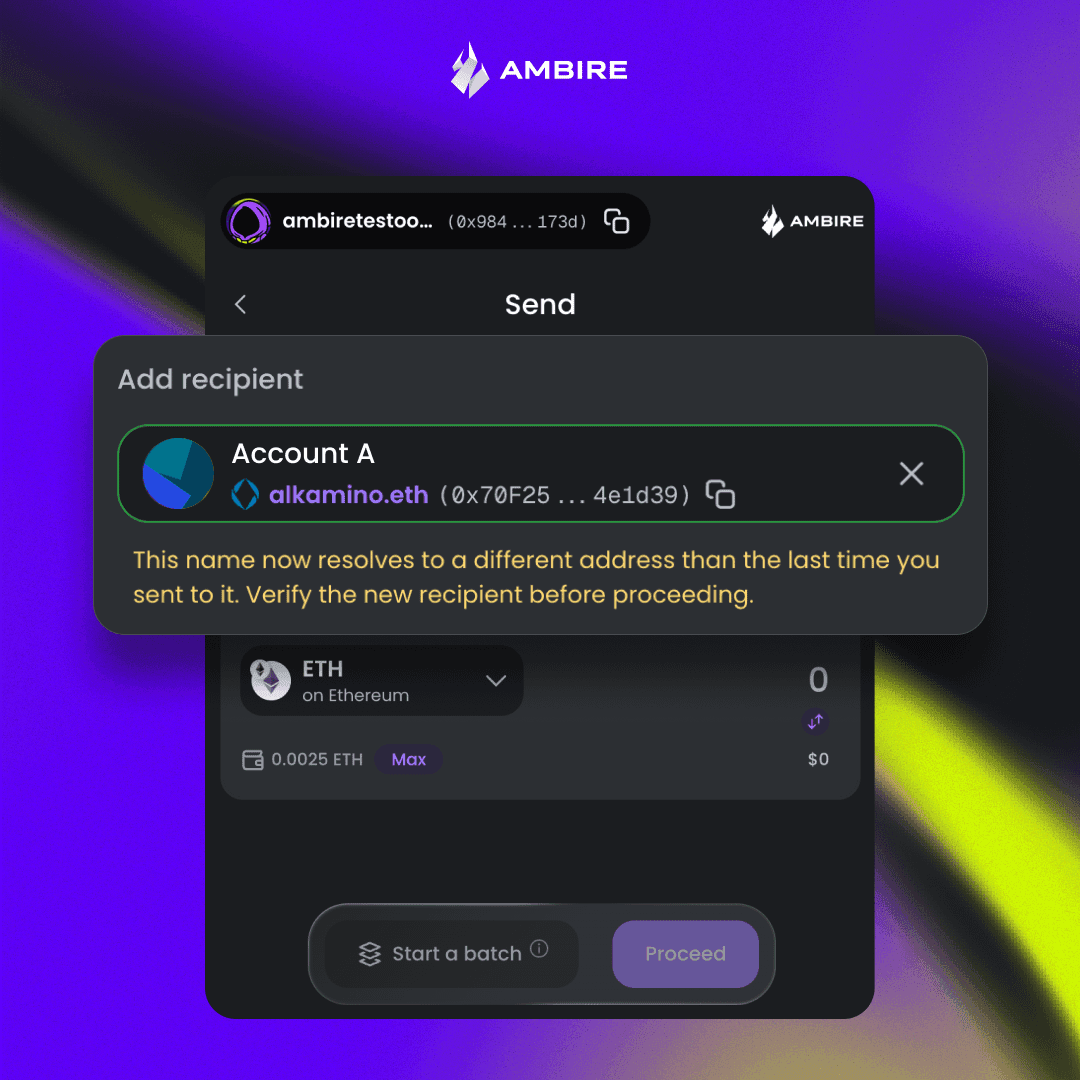
**Ambire** has introduced a new security feature that alerts users when an ENS (Ethereum Name Service) address has changed since their last interaction. **Key Features:** - Notifies users of address changes associated with ENS names - Helps prevent sending funds to unintended recipients - Adds an extra layer of security for ENS-based transactions This update addresses a potential security risk where ENS name ownership could transfer to a different address, potentially leading to misdirected transactions. The feature provides users with confidence when sending value through the platform. [Learn more about the update](https://x.com/ambire/status/2080656789927002540)