Ether.fi Migration Drives OP Mainnet to Record Transaction Volumes
Ether.fi Migration Drives OP Mainnet to Record Transaction Volumes
🚀 Ether.fi breaks records on...


Ether.fi's migration to OP Mainnet continues to break records, with daily spending reaching new highs since moving $220M in total value locked (TVL), 70,000 active cards, and 300,000 accounts to the network.
Key metrics:
- Transaction costs: fractions of a cent per transaction
- Crypto card volume grew 10x in 90 days (March to May)
- $12.7M in March → $128M in May
- OP Mainnet now ranks #2 globally for crypto card volume, ahead of Solana, BSC, and Arbitrum
The low transaction fees are enabling sustainable unit economics at scale, demonstrating that the infrastructure can support high-volume payment activity. OP Mainnet has climbed into the top 15 chains by TVL, with 84% growth in the last 30 days driven primarily by this migration.

Since migrating $220M in TVL, 70,000 active cards, and 300,000 accounts to OP Mainnet, @ether_fi keeps hitting new daily spend highs. At fractions of a cent per transaction, the unit economics work at scale.


OP Mainnet crypto card volume grew 10x in 90 days. $12.7M in March → $128M in May. #2 globally, ahead of Solana, BSC, Arbitrum, and others. The driver? @ether_fi.

OP Labs Shifts to Direct Support Model for OP Stack Production Teams
OP Labs is transitioning away from third-party rollup-as-a-service provider support in favor of a direct relationship model. **Key Changes:** - Legacy support through third-party providers is being phased out - Teams seeking production support now work directly with OP Labs via **OP Enterprise** - Existing OP Enterprise chains continue without disruption This consolidation creates a single, clear support channel between development teams and the builders of the OP Stack. Teams can establish direct relationships with OP Labs for their production needs. [Read the full announcement](https://www.optimism.io/blog/a-more-direct-model-for-production-support-on-the-op-stack)
Ether.fi Launches on OP Mainnet
**Ether.fi has officially gone live on OP Mainnet**, bringing its liquid staking protocol to Optimism's Layer 2 network. **Key highlights:** - Users can now access ether.fi's staking services with faster transactions and lower fees on Optimism - The integration expands ether.fi's reach beyond Ethereum mainnet - Leverages Optimism's scalability for improved user experience This deployment marks another step in ether.fi's multi-chain expansion strategy, offering stakers more options for where they manage their ETH positions. [Read the full case study](https://www.optimism.io/case-studies/etherfi)
OP Mainnet Launches Reserved Blockspace with Stake-Based Ordering
**Reserved blockspace is now live on OP Mainnet**, introducing a stake-based ordering experiment that changes how transactions are prioritized. **Key points:** - The new system allows users to reserve blockspace based on their stake - This represents a shift from traditional gas-based transaction ordering - The experiment aims to improve transaction predictability and reduce MEV This launch follows months of development and testing, with the team monitoring performance metrics closely. [Read the full technical breakdown](https://www.optimism.io/blog/reserved-blockspace)
Ethereum Congestion Creates Two-Tier Transaction System
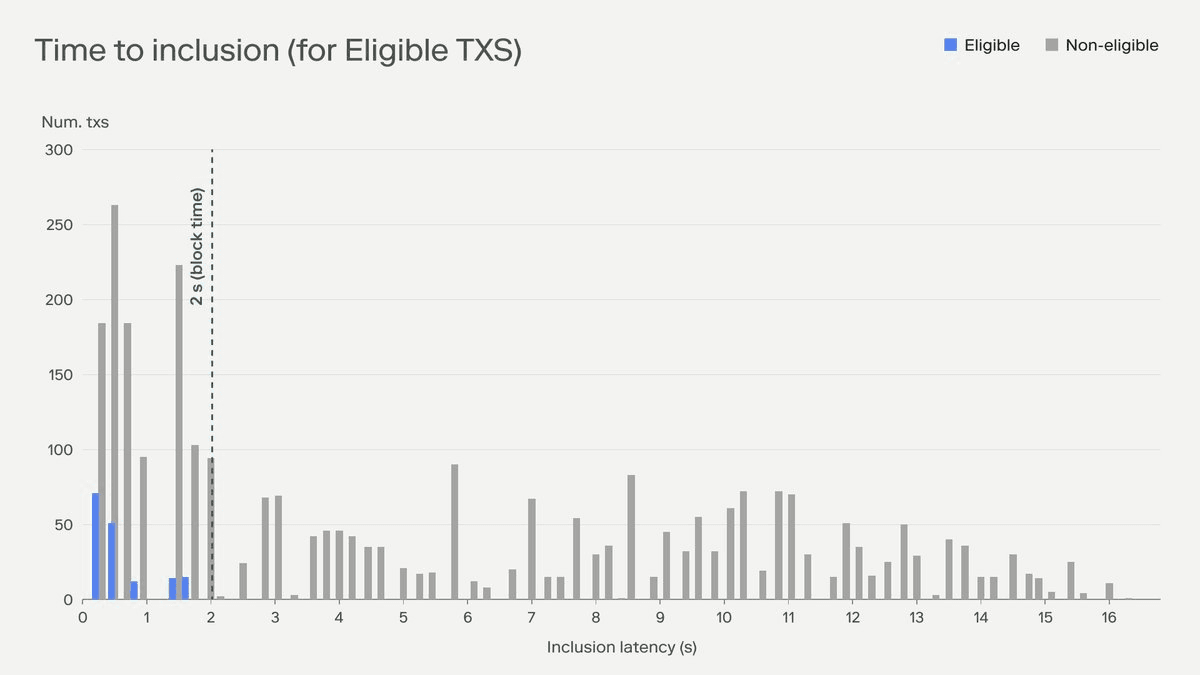
**Network congestion is creating a stark divide in Ethereum transaction processing.** Under sustained network load, eligible transactions continue to receive predictable inclusion times, while non-eligible transactions are experiencing delays exceeding 10 seconds. This two-tier system highlights the growing importance of transaction eligibility criteria during periods of high network activity. **Key implications:** - Eligible transactions maintain consistent processing times - Non-eligible transactions face significantly longer wait times (10+ seconds) - Network congestion reveals infrastructure priorities The pattern suggests Ethereum's infrastructure is prioritizing certain transaction types to maintain network stability during peak usage periods.