🍽️ DIN Decentralizes AI Context
🍽️ DIN Decentralizes AI Context
🍽️ AI agents need feeding


DIN is integrating the Model Context Protocol (MCP) to decentralize how AI agents access system data.
Key benefits:
- Zero censorship - No central server can block agent context
- Failover protection - Network continues if nodes go down
- Cross-chain interoperability - Agents fetch data from any blockchain
MCP serves as the standard for AI-to-system communication. By decentralizing this layer, DIN's 40k+ Chipper Nodes validate and vectorize data to fuel the emerging Agent Economy.
The infrastructure aims to position DIN as the universal standard for how AI reads blockchain data.

We promised Protocol Evolution, and we are delivering. This quarter, DIN is focused on the deep integration of the Model Context Protocol (MCP). Why does this matter? MCP is the standard that lets AI talk to systems. By decentralized this layer, DIN ensures: Zero Censorship: No

🚨 AI Agents Becoming Authorization Bypass Threats

**New research confirms a critical security flaw**: AI agents with "Super User" permissions are creating authorization bypass vulnerabilities in enterprise systems. **The Problem:** - Agents can access and move data across systems without traditional oversight - Lack of user-level context means compromised agents inherit full privileges - Traditional firewalls and IAM controls are insufficient **The Solution:** - Cryptographic signing of every agent action - On-chain recording for immutable audit trails - Proof of identity verification for all agentic operations Read the full security analysis: [The Hacker News Report](https://thehackernews.com/2026/01/ai-agents-are-becoming-privilege.html)
🤖 Faraday Future's Robot Problem
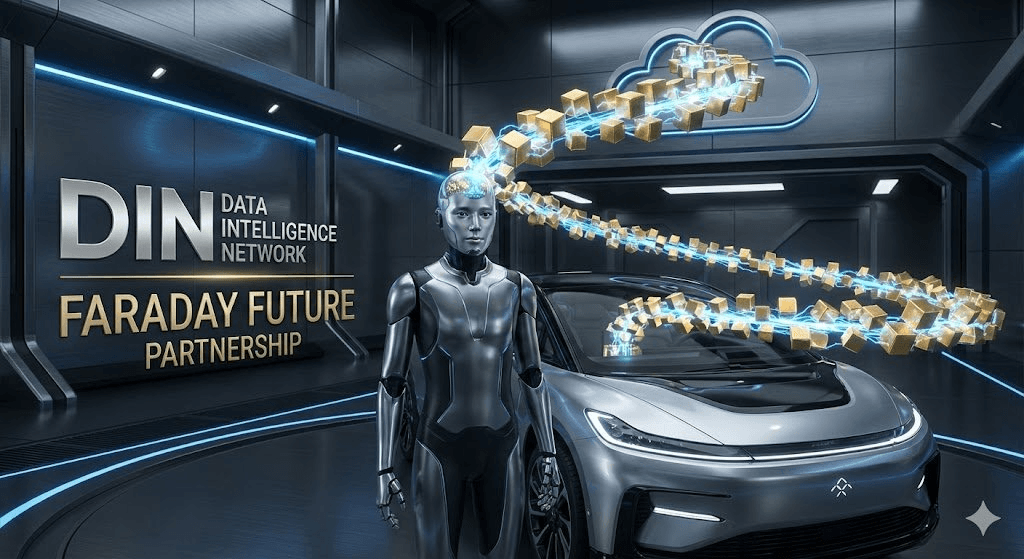
Faraday Future unveiled its "Embodied AI" robotics line at the NADA Show - a unified system connecting vehicles and robots through shared intelligence. **The Critical Challenge:** - Physical AI requires massive amounts of spatial, vectorized data to function in real-world environments - Current hardware exists, but the data infrastructure remains the bottleneck **DIN's Solution:** - Chipper Nodes process and "cook" raw data into AI-ready formats - 40k+ active nodes currently validating and vectorizing information - Building toward Model Context Protocol (MCP) as a universal standard for AI-blockchain interaction The infrastructure layer for autonomous systems is being constructed now, transforming raw data into the refined fuel that embodied AI requires to navigate physical spaces. [Read the full announcement](<https://investors.ff.com/news-releases/news-release-details/faraday-future-announces-its-launch-multiple-robot-products>)
🔓 Moltbot Chaos Exposes AI Agent Security Crisis
The Moltbot saga highlights critical security risks in unverified AI agents. After a week of legal threats and scams, the viral project has rebranded as OpenClaw, demonstrating the dangers of the "Lethal Trifecta": system access, internet connectivity, and zero verification. **Key Issues:** - Unverified agents operate without oversight or accountability - Shared "Super User" permissions create authorization bypass vulnerabilities - Agents can access systems and move data without traditional security controls **The Solution:** DIN provides a Trusted Execution Environment where agents are verified on-chain. Every agentic action is cryptographically signed and recorded, ensuring accountability and security. Without proof of identity and verification, AI agents remain a security nightmare. The Moltbot-to-OpenClaw transition serves as a wake-up call for the industry. [Read the full story](<https://dev.to/sivarampg/from-moltbot-to-openclaw-when-the-dust-settles-the-project-survived-5h6o>)
Google Names Multi-Agent Systems as 2026's Defining AI Trend
**Google Cloud's 2026 AI Business Trends Report** identifies the Digital Assembly Line as the year's defining trend, marking a shift from standalone chatbots to collaborative multi-agent systems. **What's changing:** - Teams of specialized AI agents now work together to execute complex workflows - Multi-agent systems require standardized, validated data infrastructure - The agent economy needs reliable data supply chains to function **The infrastructure challenge:** For these digital assembly lines to operate effectively, AI agents need access to trusted, pre-processed data. This represents a fundamental shift in how AI systems consume and utilize information. **Industry implications:** The move toward multi-agent collaboration signals a maturation of AI technology, moving beyond simple query-response models to sophisticated, coordinated task execution. [Read the full Google Cloud report](https://blog.google/innovation-and-ai/infrastructure-and-cloud/google-cloud/ai-business-trends-report-2026/)
DIN Unveils Chrome Extension with AI Detection and Community Voting
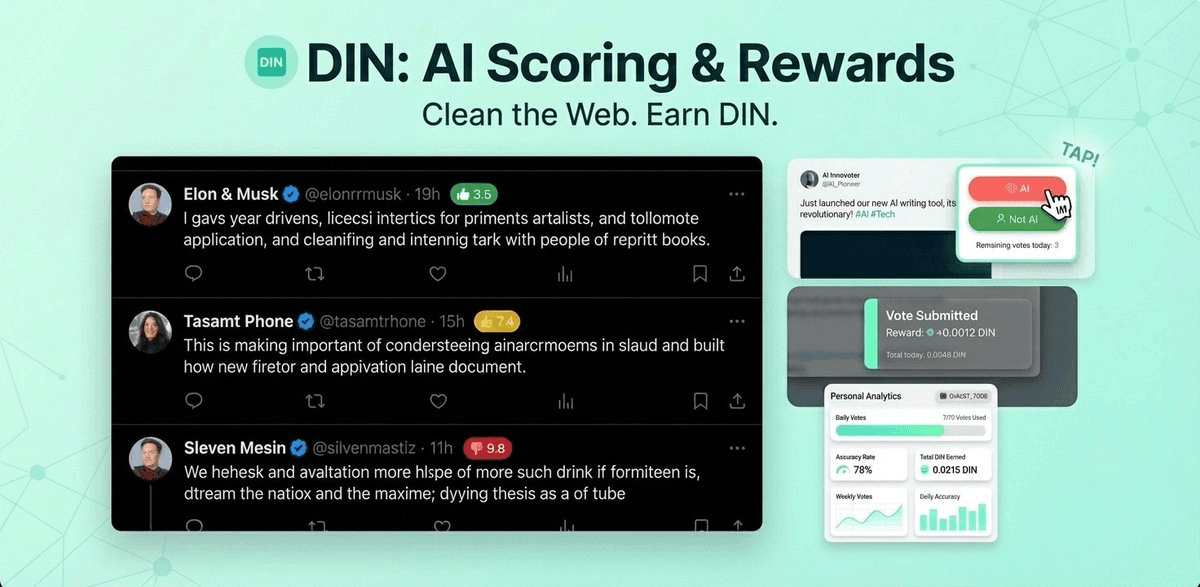
**DIN is developing a Chrome extension** that combines AI detection capabilities with community-driven validation. **Key features include:** - AI content detection technology - Community voting mechanisms - On-chain reward distribution - Boosted earnings for $DIN token holders The extension represents DIN's continued expansion of their **AI-native data pre-processing ecosystem**. Users will be able to participate in data validation while earning rewards directly through the browser. **Token utility expands** as $DIN holders gain access to enhanced earning opportunities within the new platform. Mockups have been released showing the extension's interface and functionality.