🚨 AI Agents Becoming Authorization Bypass Threats
🚨 AI Agents Becoming Authorization Bypass Threats
🚨 Who Approved This Agent


New research confirms a critical security flaw: AI agents with "Super User" permissions are creating authorization bypass vulnerabilities in enterprise systems.
The Problem:
- Agents can access and move data across systems without traditional oversight
- Lack of user-level context means compromised agents inherit full privileges
- Traditional firewalls and IAM controls are insufficient
The Solution:
- Cryptographic signing of every agent action
- On-chain recording for immutable audit trails
- Proof of identity architecture to verify agent authorization
Read the full security analysis: The Hacker News Report

Security Alert from the @TheHackersNews: "Who Approved This Agent?" ⚠️ New research confirms that AI Agents are becoming major Authorization Bypass paths in the enterprise. Because agents often share "Super User" permissions, they can touch systems and move data without

Security Warning: Your AI Agent might be your biggest insider threat. New analysis from @TheHackersNews reveals a critical flaw in 2026 enterprise architecture: Agentic Authorization Bypass. Organizations are deploying "Super Agents" with broad access to HR, IT, and Finance
Industry Insight: The dangers of "Raw Data" for AI Agents. A recent report from @TheHackersNews highlights "Indirect Prompt Injection"—where AI models are tricked by malicious commands hidden in unverified web pages. This is the critical flaw in the current Agent Economy:
Security Alert: The "Brain" is fine. The "Supply Chain" is under attack. A critical report from @TheHackersNews (Jan 15) exposes the reality of 2026: Model Security is the wrong frame. The real threat is Workflow Security. Attackers aren't hacking the AI models anymore; they
The verdict for 2026 is in: The era of the "Chatbot" is over. We have entered the era of the Digital Assembly Line. According to the latest Google Cloud 2026 Report, the primary unit of productivity is no longer the human-in-the-loop, but the Multi-Agent System (MAS). We aren't

Google just named the defining trend of 2026: "The Digital Assembly Line." The era of the solitary Chatbot is over. According to the new Google Cloud report, the future is Multi-Agent Systems—teams of specialized AI agents collaborating to execute complex workflows from start
🤖 Musk Doubles Down
**Elon Musk confirms Tesla and xAI will continue purchasing Nvidia AI chips** as demand for AI infrastructure accelerates. **Key developments:** - Tesla and xAI maintaining Nvidia GPU procurement for AI training and inference - Samsung Electronics announces $73+ billion investment to compete in AI chip sector - Follows xAI's previous commitment to build 500MW AI data center in Saudi Arabia using Nvidia hardware The moves underscore the intensifying competition for AI computing resources as major tech players expand their infrastructure capabilities.
🐋 Bitcoin OG Dumps $71.57M in ETH While Whales Accumulate
A Bitcoin whale who acquired 5,000 BTC at $332 twelve years ago has sold another 1,000 BTC worth $71.57M, continuing a pattern of major liquidations. **Key Developments:** - Whale wallets actively accumulating ETH with major withdrawals tracked from Bitget and OKX in the last 24 hours - SlowMist Cos identified critical security vulnerability on Coinbase Commerce's Withdraw page that directly requests user private keys - The selling whale originally paid $1.66M for 5,000 BTC, now valued at $356M total **Market Context:** This follows a broader trend of Bitcoin whales diversifying into Ethereum and stablecoins. Recent data shows Bitcoin wallets holding 1K+ BTC decreased 1.61% over two weeks, while Ethereum wallets with 10K+ ETH increased 8.00%. The contrasting whale behavior between crypto's top two assets may signal shifting market dynamics and potential impact on Bitcoin's long-term dominance. [Source](https://twitter.com/TheBlockCo/status/2034455237277134921)
🚨 SEC Declares ALGO a Commodity as Middle East Tensions Spike
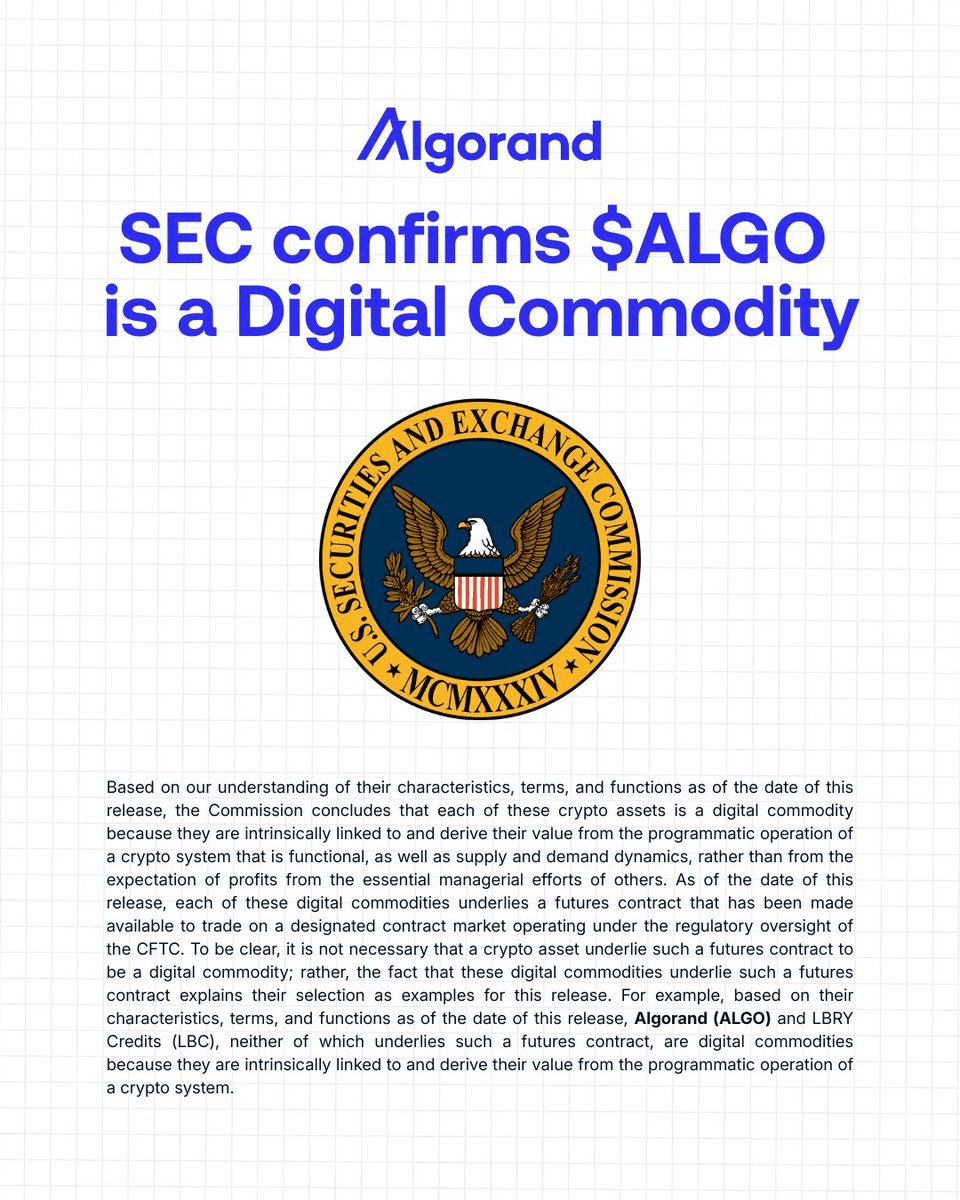
**SEC Confirms Algorand's Status** The SEC has officially classified $ALGO as a digital commodity, not a security. This marks a significant regulatory milestone for the Algorand ecosystem. **Geopolitical Tensions Rise** - Iran launched fresh missiles toward Israel - UAE's Fujairah oil port suspended loadings - Strait of Hormuz bypass routes now under threat These developments highlight growing instability in a critical global energy corridor, with potential ripple effects across markets.
🤝 Microsoft vs Amazon: $50B OpenAI Deal Sparks Legal Threat
**Microsoft considers legal action** against Amazon over a reported $50 billion cloud infrastructure deal with OpenAI, according to the Financial Times. The dispute highlights growing tensions in the AI infrastructure space. **Key developments:** - Microsoft evaluating potential lawsuit over Amazon-OpenAI partnership - Deal reportedly worth $50 billion for cloud services - Comes as competition intensifies for AI computing resources **Meanwhile in China:** - Multiple Chinese companies received approval to purchase Nvidia's H200 AI chips - Nvidia preparing specialized Groq AI chips for the Chinese market - Signals continued demand for advanced AI hardware despite export restrictions The Amazon-OpenAI agreement could reshape cloud computing dynamics, particularly given Microsoft's existing partnership with OpenAI. The legal consideration suggests Microsoft views the deal as potentially threatening to its competitive position in the AI infrastructure market.
🔒 Ethereum Gets Faster
**Vitalik Buterin introduced a new fast confirmation rule for Ethereum**, enabling users to receive non-revert guarantees for transactions more quickly. This development aims to improve transaction settlement speed while maintaining security. In parallel regulatory news, the **SEC and CFTC delivered landmark clarity on cryptocurrency regulation**, marking a significant step forward for the industry's regulatory framework. **Key developments:** - New Ethereum confirmation rule balances speed with security - Regulatory agencies provide clearer guidelines for crypto operations Read more: [Forbes coverage](https://x.com/wublockchain/status/2034111402886189518)