DIN Unveils Chrome Extension with AI Detection and Community Voting
DIN Unveils Chrome Extension with AI Detection and Community Voting
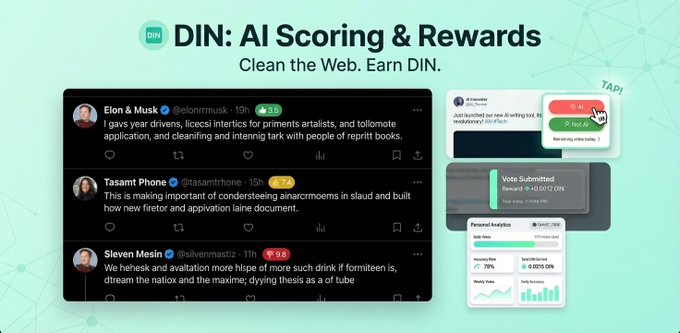
🔍 DIN Chrome Extension


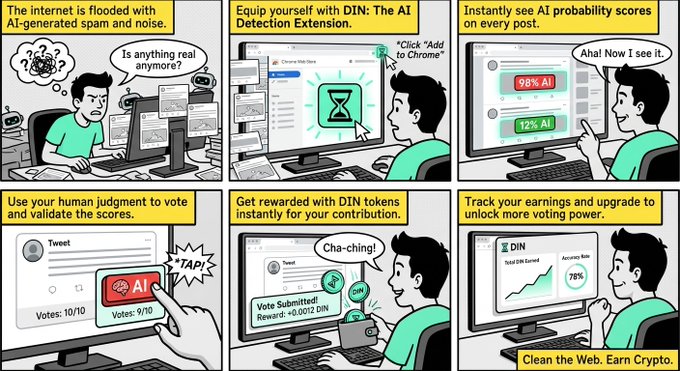
DIN is developing a Chrome extension that combines AI detection capabilities with community-driven validation.
Key features include:
- AI content detection technology
- Community voting mechanisms
- On-chain reward distribution
- Boosted earnings for $DIN token holders
The extension represents DIN's continued expansion of their AI-native data pre-processing ecosystem. Users will be able to participate in data validation while earning rewards directly through the browser.
Token utility expands as $DIN holders gain access to enhanced earning opportunities within the new platform.
Mockups have been released showing the extension's interface and functionality.
A sneak peek at what we’re building: The DIN Chrome extension — AI detection + community voting + on-chain rewards. Hold $DIN for boosted earnings. Mockups below.

The devs are cooking. Something major is heating up in the DIN kitchen. Get ready to clean the web and earn ?
DIN Launches Telegram Trading Bot for Cross-Exchange Market Making
**DIN introduces XEMM strategy automation via Telegram** DIN has released a Telegram-native trading bot that simplifies cross-exchange market making (XEMM). The strategy works by: - Buying $DIN at lower prices on one exchange - Selling $DIN at higher prices on another exchange - Maintaining balanced token exposure while capturing price spreads The bot enables users to configure and execute XEMM strategies between exchanges like MEXC and KuCoin directly within Telegram. Users can set up exchange connections, select trading pairs, define order levels, adjust profitability parameters, and implement risk controls through a guided workflow. The platform aims to make advanced trading infrastructure accessible to everyday users without requiring complex technical knowledge.
🤖 DIN Doubles Down on AI Trading Tools

DIN continues development on two AI-powered trading products despite challenging market conditions: - **OpinionPro**: A prediction market trading bot built with Opinion Labs, now live and available for testing - **Alpha Zen**: A quantitative trading assistant currently in optimization phase, with multiple versions developed but backtesting results still being refined The team emphasizes these products will enhance $DIN token utility over time. They're asking their community to maintain confidence as they focus on long-term product development rather than short-term price action. **Previous context**: In September 2025, DIN announced Alpha Zen's internal testing phase and a collaboration with an AI company on a data co-building dApp. The team also warned about a security breach affecting a team member's Telegram account.
🤖 Musk Doubles Down
**Elon Musk confirms Tesla and xAI will continue purchasing Nvidia AI chips** as demand for AI infrastructure accelerates. **Key developments:** - Tesla and xAI maintaining Nvidia GPU procurement for AI training and inference - Samsung Electronics announces $73+ billion investment to compete in AI chip sector - Follows xAI's previous commitment to build 500MW AI data center in Saudi Arabia using Nvidia hardware The moves underscore the intensifying competition for AI computing resources as major tech players expand their infrastructure capabilities.
🐋 Bitcoin OG Dumps $71.57M in ETH While Whales Accumulate
A Bitcoin whale who acquired 5,000 BTC at $332 twelve years ago has sold another 1,000 BTC worth $71.57M, continuing a pattern of major liquidations. **Key Developments:** - Whale wallets actively accumulating ETH with major withdrawals tracked from Bitget and OKX in the last 24 hours - SlowMist Cos identified critical security vulnerability on Coinbase Commerce's Withdraw page that directly requests user private keys - The selling whale originally paid $1.66M for 5,000 BTC, now valued at $356M total **Market Context:** This follows a broader trend of Bitcoin whales diversifying into Ethereum and stablecoins. Recent data shows Bitcoin wallets holding 1K+ BTC decreased 1.61% over two weeks, while Ethereum wallets with 10K+ ETH increased 8.00%. The contrasting whale behavior between crypto's top two assets may signal shifting market dynamics and potential impact on Bitcoin's long-term dominance. [Source](https://twitter.com/TheBlockCo/status/2034455237277134921)
🚨 SEC Declares ALGO a Commodity as Middle East Tensions Spike
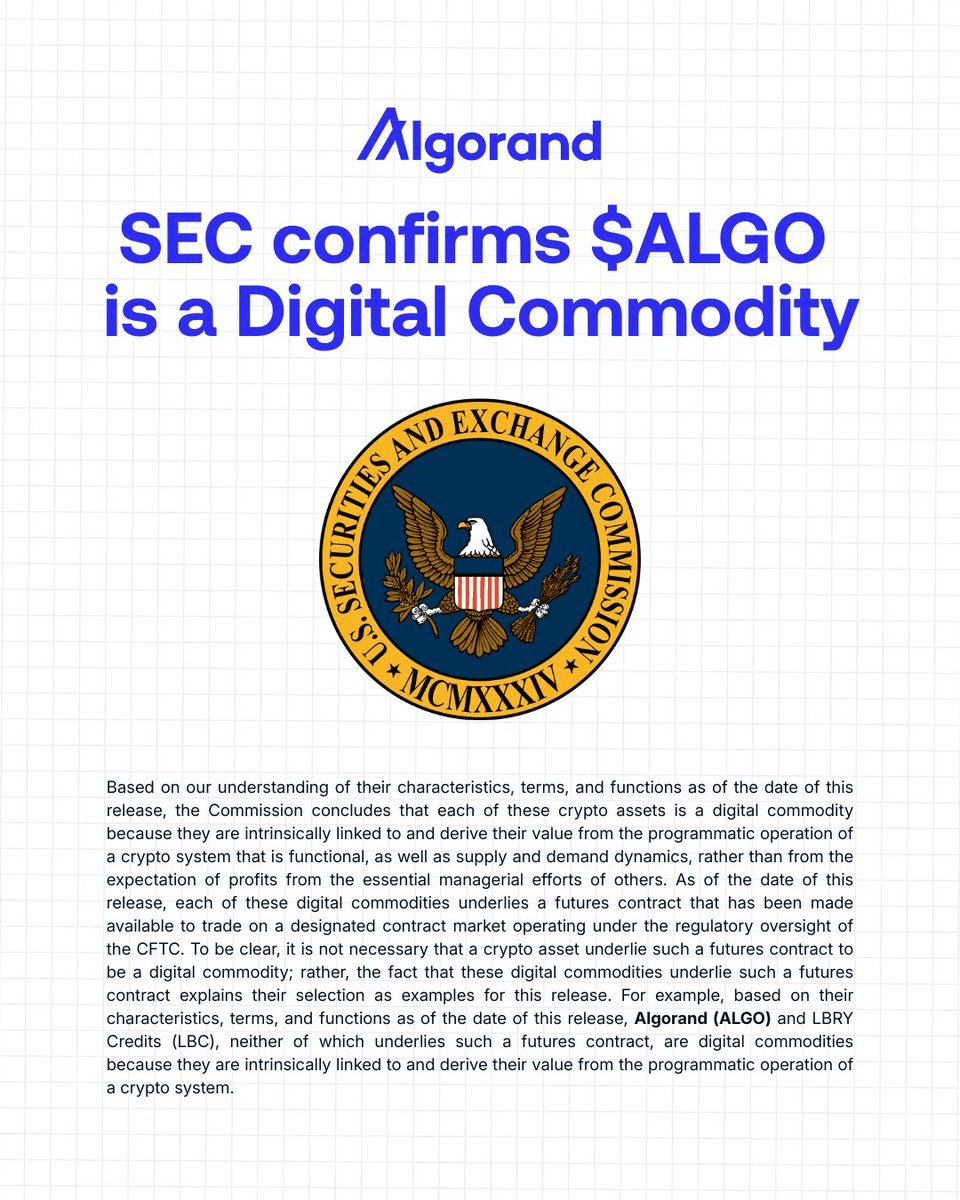
**SEC Confirms Algorand's Status** The SEC has officially classified $ALGO as a digital commodity, not a security. This marks a significant regulatory milestone for the Algorand ecosystem. **Geopolitical Tensions Rise** - Iran launched fresh missiles toward Israel - UAE's Fujairah oil port suspended loadings - Strait of Hormuz bypass routes now under threat These developments highlight growing instability in a critical global energy corridor, with potential ripple effects across markets.