Circle's USYC Becomes World's Largest Tokenized Money Market Fund
Circle's USYC Becomes World's Largest Tokenized Money Market Fund
🏆 USYC takes the crown


Circle's USYC has achieved a significant milestone by becoming the world's largest tokenized money market fund. This development follows the fund surpassing $2 billion in assets under management just days earlier.
Key Points:
- USYC now holds the top position among tokenized money market funds globally
- The fund recently crossed the $2 billion AUM threshold on March 10, 2026
- Circle positions this as validation of their role as a leading internet financial platform
- The growth signals broader adoption of onchain cash and collateral instruments
USYC offers yield-bearing collateral with near-instant redemptions and is already integrated into DeFi protocols. The fund is available as collateral on Aave's Horizon RWA market, demonstrating practical utility in decentralized finance applications.
The rapid growth from $2 billion to market leadership in just two days reflects accelerating institutional interest in tokenized traditional finance products. This trend suggests that onchain versions of conventional financial instruments are gaining traction in global markets.

USYC has passed $2 billion in assets under management as industry adoption of tokenized money market funds expands.

USYC is now the world’s largest tokenized money market fund. This milestone underscores trust in Circle as one of the world’s leading internet financial platform companies and delivers clear signal on the increasing adoption of onchain cash and collateral primitives in global

🌐 AI Agents Need Frictionless Cross-Border Payments
**The Challenge of Autonomous Transactions** Circles CTO Li Fan highlighted a critical infrastructure gap at SXSW: while international calls became nearly free, cross-border payments remain expensive and slow. **Why This Matters Now** - AI agents will soon conduct autonomous transactions at massive scale - Current financial rails weren't designed for machine-to-machine payments - The velocity of money is expected to increase dramatically **What Needs to Change** The agentic economy requires: - Infrastructure built for internet-scale autonomous transactions - Reduced friction in cross-border money movement - New economic systems combining AI, stablecoins, and blockchains As AI agents begin transacting independently, the financial system must evolve to match the speed and efficiency already achieved in digital communications.
WheelX Enables Cross-Chain Stablecoin Activity Across 50+ Networks
**WheelX**, a Circle Alliance Program member, is facilitating cross-chain stablecoin operations across more than 50 blockchain networks. **Key Metrics:** - 45,000+ deployment transactions - 2,700+ swaps on Arc Testnet - Supporting stablecoin utility expansion across multiple chains The platform focuses on enabling seamless stablecoin movement and activity across different blockchain ecosystems, contributing to broader stablecoin adoption and interoperability. Learn more about the [Circle Alliance Program](https://www.circle.com/alliance-program).
The Evolution of Value Movement and Work in Web3
**The Convergence of Value and Work** Jeremy Allaire explores a fundamental shift happening in the digital economy: the parallel evolution of how value transfers and how work is organized. **Key Insights:** - Value movement and work structures are no longer separate systems—they're becoming interconnected - This convergence is reshaping traditional business models and organizational structures - Understanding this relationship is critical for navigating the next phase of digital transformation The connection between these two forces represents a foundational change in how we think about economic activity and collaboration in decentralized systems.
Circle Nanopayments Solves Sub-Cent Transaction Problem with Offchain Aggregation
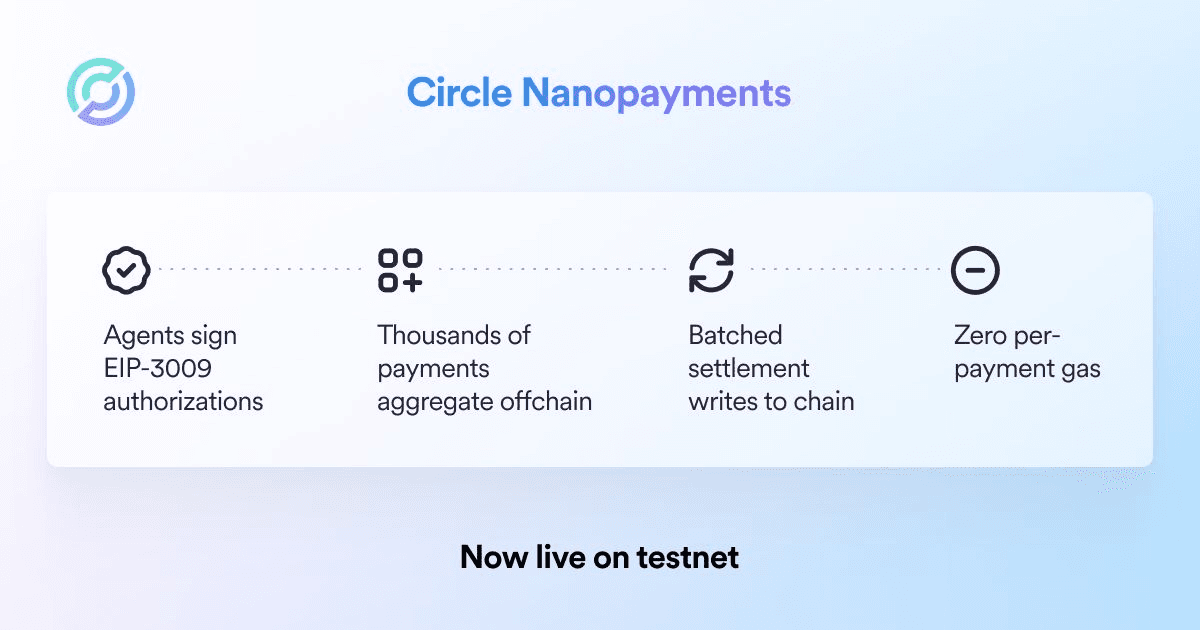
**Circle Nanopayments** addresses a critical infrastructure gap for AI agent transactions by eliminating per-payment gas costs. **The Problem:** - Sub-cent payments fail when competing in traditional mempools - AI agents need to transact at fractions of a cent per API call, inference, or compute cycle - Traditional blockchain rails can't support this volume economically **The Solution:** - Agents sign **EIP-3009 authorizations** - Thousands of payments aggregate offchain - Batched settlement writes to chain - Zero gas cost per individual payment - Near-instant confirmation with onchain finality **Technical Details:** - Enables gas-free USDC transfers as small as **$0.000001** - Built on Circle Gateway - x402 compatible for agentic scale - Currently live on testnet This infrastructure supports emerging use cases like pay-per-call APIs, real-time compute billing, and machine-to-machine payments. By moving aggregation offchain while maintaining onchain settlement, Circle creates a financial rail designed specifically for autonomous agent economic activity. Learn more: [Circle Nanopayments](http://www.circle.com/blog/a-deep-dive-into-circle-nanopayments-gas-free-usdc-transfers)
AI Agents Could Fundamentally Reshape Corporate Organization and Economic Coordination
**Agentic AI is poised to transform economic coordination**, according to remarks at the Economic Club of New York. **Key implications:** - AI agents acting independently could lead to more efficient organizational structures - New corporate operating models may emerge as coordination mechanisms evolve - This represents a shift from AI as a tool to AI as an active economic participant The technology's ability to coordinate economic activity autonomously suggests we're entering a new phase where AI doesn't just assist but fundamentally changes how organizations function and make decisions.