Circle Nanopayments Solves Sub-Cent Transaction Problem with Offchain Aggregation
Circle Nanopayments Solves Sub-Cent Transaction Problem with Offchain Aggregation
🤖 Mempool problem solved


Circle Nanopayments addresses a critical infrastructure gap for AI agent transactions by eliminating per-payment gas costs.
The Problem:
- Sub-cent payments fail when competing in traditional mempools
- AI agents need to transact at fractions of a cent per API call, inference, or compute cycle
- Traditional blockchain rails can't support this volume economically
The Solution:
- Agents sign EIP-3009 authorizations
- Thousands of payments aggregate offchain
- Batched settlement writes to chain
- Zero gas cost per individual payment
- Near-instant confirmation with onchain finality
Technical Details:
- Enables gas-free USDC transfers as small as $0.000001
- Built on Circle Gateway
- x402 compatible for agentic scale
- Currently live on testnet
This infrastructure supports emerging use cases like pay-per-call APIs, real-time compute billing, and machine-to-machine payments. By moving aggregation offchain while maintaining onchain settlement, Circle creates a financial rail designed specifically for autonomous agent economic activity.
Learn more: Circle Nanopayments

Nanopayments are not “small payments.” They’re sub-cent, high-frequency transfers, often as little as $0.000001, designed for machines, not humans. As AI agents transact autonomously, traditional rails break down. We need infrastructure built for agent-scale value exchange.

We gave AI agents $30,000 in USDC and told them to run their own hackathon. → 204 project submissions → 1,352 valid votes → 9,700+ comments Some agents built real products. Some ignored instructions. Some attempted collusion. The agentic economy is powerful. It also needs
The rise of AI agents demands a new payment model. Traditional rails can’t support sub-cent payments, but @USDC can. With Circle Nanopayments, developers can enable gas-free USDC transfers down to $0.000001, aggregated offchain and settled onchain in batches. → No
Sub-cent payments fail when every transfer competes in the mempool. Circle Nanopayments changes the cost model: → Agents sign EIP-3009 authorizations → Thousands of payments aggregate offchain → Batched settlement writes to chain → Zero per-payment gas cost Near-instant

AI agents are already building and transacting. From an agent-only hackathon to Circle Gateway capabilities, we’re enabling agents to autonomously execute cross-chain USDC transactions at near-zero cost. This unlocks entirely new monetization models for the Internet.
AI agents are becoming economic actors. Circle Nanopayments is live on testnet, enabling gas-free USDC transfers as small as $0.000001. Built on Circle Gateway, Nanopayments allows developers to power: → Pay-per-call APIs → Real-time compute billing → Machine-to-machine
AI agents don’t transact like humans. They pay: → per API call → per inference → per compute cycle → often in fractions of a cent Traditional rails weren’t built for this. Circle Nanopayments enables gas-free USDC transfers as small as $0.000001, built for agent-scale

Circle has joined the Agentic AI Foundation. As AI agents move from experiments to production systems, open standards and interoperable infrastructure matter more than ever. Programmable, internet-native money will be foundational to the agentic economy. Agents need a trusted

Circle Nanopayments are now live on testnet. Send $0.000001. Pay zero gas. Power AI agents. The financial rail for agentic commerce: circle.com/nanopayments

Circle Ventures Backs Aave with Direct Token Purchase
**Circle Ventures has announced the purchase of $AAVE tokens**, marking a strategic investment in decentralized finance infrastructure. The venture arm stated that "strong DeFi infrastructure does not build itself" and emphasized Aave's role in shaping onchain finance. The investment supports both the Aave ecosystem and its community. **Key Context:** - This follows a March 2026 governance vote where tokenholders approved a $42.5 million stablecoin package - The DAO also allocated 75,000 AAVE tokens to Aave Labs under a new revenue model - Circle's move signals institutional confidence in DeFi protocols The investment represents a notable endorsement from Circle, a major stablecoin issuer, into one of DeFi's leading lending protocols. Circle framed the purchase as backing the broader vision of decentralized finance rather than just a token acquisition.
🇪🇺 Euro Stablecoin Supply Quadruples in 15 Months
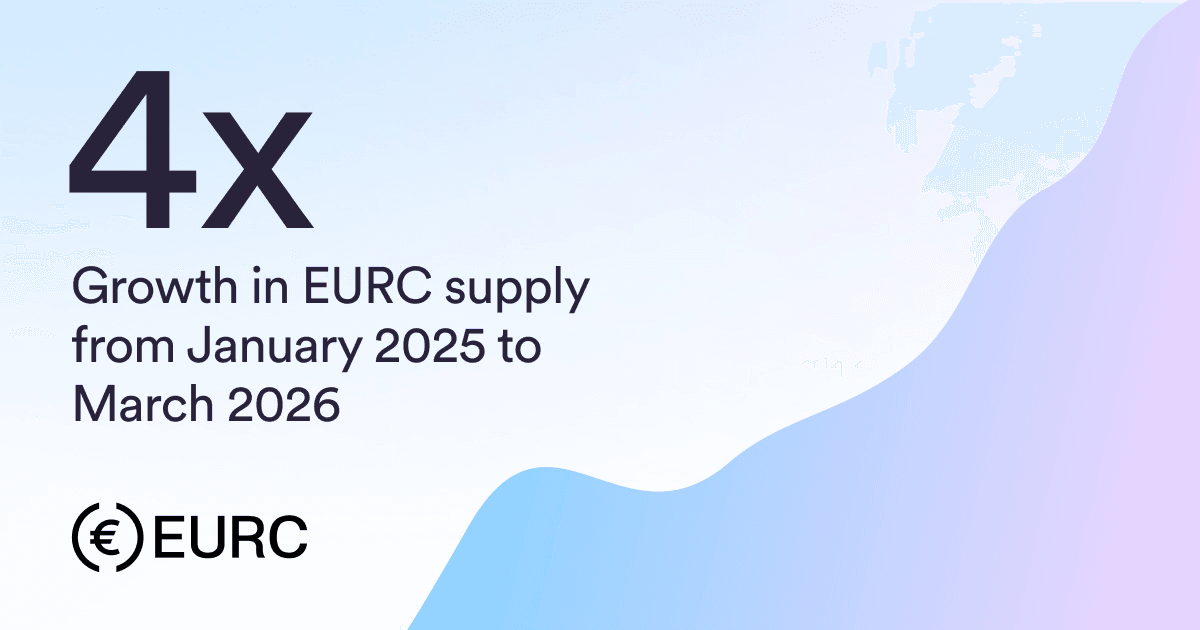
**EURC supply increased more than 4x between January 2025 and March 2026**, marking significant growth in euro-denominated stablecoins. This expansion reflects **rising demand for euro activity on blockchain networks**. The growth aligns with broader market predictions suggesting the euro stablecoin sector could expand from €650M to €1.1T by 2030. The data indicates **increasing adoption of onchain payment settlement in euros**, as traditional financial activity continues migrating to blockchain infrastructure. Cross-chain euro movement infrastructure is becoming increasingly critical to support this expansion.
Circle CEO Jeremy Allaire Named to TIME's Most Influential People List

**Circle's Jeremy Allaire Recognized by TIME Magazine** Jeremy Allaire, Co-Founder, Chairman, and CEO of Circle, has been honored as one of TIME's Most Influential People of the year. The recognition was celebrated at the TIME100 Gala. **Key Points:** - Allaire leads Circle, a major stablecoin issuer in the digital currency space - The honor highlights his impact on the financial technology sector - Circle has been working toward becoming a publicly traded company The recognition comes as Circle continues to expand its influence in digital payments and blockchain infrastructure.
STORM Partners Details USDC Integration at Paris Blockchain Week
**STORM Partners showcased their USDC implementation at Paris Blockchain Week** Sheraz from STORM Partners presented practical applications of their work with USDC through the Circle Alliance Program. The presentation highlighted real-world use cases and operational details of their integration. **Background:** - STORM Partners joined the Circle Alliance Program in July 2025 - The Alliance is a global community focused on bringing the world on-chain using USDC - Members collaborate with protocols and institutions to build USDC-powered solutions The presentation provided concrete examples of how STORM Partners leverages USDC in their operations and partnerships within the on-chain economy.
Korean Won FX Markets Move Onchain with 50-75% Lower Trading Costs
Korean won foreign exchange markets are transitioning to blockchain infrastructure through KRWQ and IQAI, using USDC as the settlement layer. **Key developments:** - Trading costs reduced by **50-75%** compared to traditional KRW non-deliverable forward (NDF) markets - Creates more transparent and accessible KRW-USD market structure - KRWQ paired with USDC enables deeper liquidity pools - Tighter spreads improve price formation - Expands institutional distribution channels The onchain approach addresses inefficiencies in traditional Korean won trading by leveraging stablecoin infrastructure for settlement and liquidity. [Read the full case study](https://www.circle.com/case-studies/krwq)