zkSync
14645 followers · 10 stories
An Ethereum zkRollup Layer 2 with the mission of accelerating the mass adoption of crypto for personal sovereignty.
14645 followers · 10 stories
An Ethereum zkRollup Layer 2 with the mission of accelerating the mass adoption of crypto for personal sovereignty.

ZKsync has introduced Airbender Prime, which it describes as the first Ethereum prover to demonstrate real-time proof generation on a single GPU — and now promotes it as "Ethereum's fastest prover." In an evaluation, one NVIDIA RTX PRO 6000 Blackwell proved 99% of 7,200 consecutive Ethereum mainnet blocks in under 10 seconds each (all under 12 seconds), including witness preparation.
Built for post-quantum security, Airbender Prime uses hash-based STARKs combining GKR sumcheck, WHIR polynomial commitments and BLAKE2s hashing, with L1 proofs using Keccak-256-based commitments instead of BN254 pairings. It is based on the open RISC-V standard and pairs real-time proving with a standalone verifier for independent verification. ZKsync framed the prover as a building block for Ethereum's ZK-centric roadmap. Full details in the announcement.
GRVT, a crypto derivatives exchange, said it settles on ZKsync, calling it "the infrastructure under everything we're building." The venue framed speed as solved and said verification is next, signaling continued reliance on ZKsync's ZK-rollup stack for its trading settlement.

ZKsync's Prividium platform is expanding to Japan through a partnership with NexBridge, a Japanese digital financial infrastructure company. The two will bring Prividium to Japanese financial institutions and jointly develop use cases matched to local regulatory requirements.
Prividium is ZKsync's DLT platform for financial institutions, following the recent open-sourcing of its permissioning engine and Deutsche Bundesbank's self-hosted deployment in Germany.
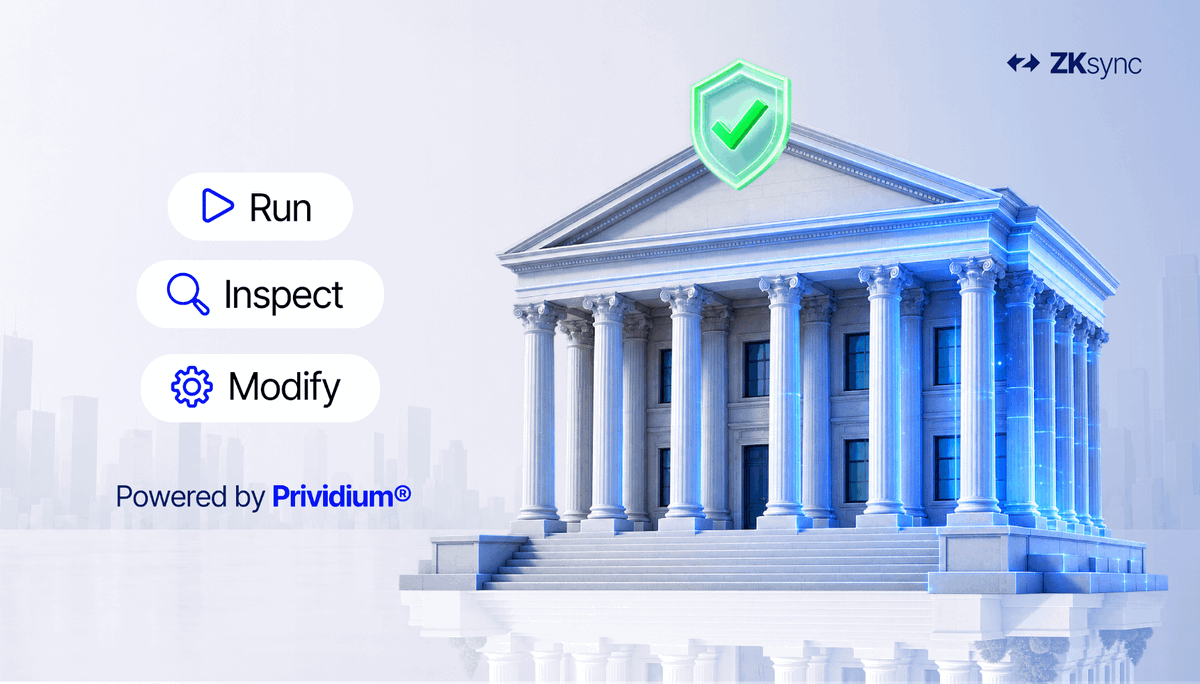
ZKsync (Matter Labs) open-sourced Prividium's permissioning engine — the core that governs roles and access in its DLT platform for financial institutions — so institutions can run a permissioned chain from public code in their own environment. Deutsche Bundesbank, Germany's national central bank, is the first institution to deploy the open-source engine self-hosted, with both sides continuing work on the platform's architecture.
The release builds on ZKsync's Pontes protocol for tokenized settlement in central bank money, which the team framed as confirmation that tokenized central-bank settlement is becoming Europe's direction of travel. Announcing the move, ZKsync also pointed to the argument from the Hidden Forces podcast that for central banks, something open and decentralized can be trusted more than something closed.
In a release the ZKsync team flagged as significant for U.S. financial markets, the SEC set out conditions for onchain trading of tokenized listed equities. ZKsync highlighted three conditions that stand out: participants must be permissioned, the smart contracts must be public and auditable, and they must be deployed onchain.

ADIChain (@ADIChain_) announced a partnership with QCC and UAC to launch the Gulf's first blockchain-verified Digital Skill Card. The card will let anyone verify a professional qualification in seconds onchain.
The initiative, announced via the ZKsync network, is aimed at credential verification for professional qualifications across the Gulf region.

Memento (@Memento_Bc) introduced Confido, an institutional-grade ZK privacy solution for private transfers on Ethereum with built-in compliance. The product is aimed at letting institutions move funds privately while still meeting regulatory requirements.
The announcement, shared via the ZKsync network, positions Confido as a way to "break the trace" without breaking compliance obligations.

ZKsync announced security upgrades that will see all Boojum/EraVM chains deprecate the legacy execution environment over the next six months, with each chain setting its own timeline. The move is framed as hardening EraVM against the lower cost of finding vulnerabilities in an AI-driven landscape, while its successor, ZKsync Atlas, is built from the ground up for this environment (Atlas chains are unaffected).
Key points:

AbstractChain launched Builder XP, a new program that recognizes projects for their impact and contributions to the chain. It's designed to surface and reward builders who meaningfully advance the Abstract ecosystem.

Grvt Earn has integrated Ondo's USDY, bringing tokenized U.S. Treasuries onchain and letting users earn traditional-style yield on ZKsync. The move pairs Grvt's trading platform with tokenized deposits, part of a broader push toward a fully tokenized "fat application" ecosystem powered by ZKsync tech.
Block production on ZKsync Lite (the original v1.0 payments rollup launched in 2020) permanently ceased, with remaining assets recoverable via the L1 claim contract.
The ZKsync governance system launched on mainnet, consisting of three on-chain bodies — Token Assembly, Security Council, and Guardians — enabling token holders to vote on protocol proposals.
ZKsync distributed 3.675 billion ZK tokens (17.5% of total supply) to 695,232 eligible wallets in the protocol's long-awaited token launch and airdrop.
The v24 protocol upgrade transformed ZKsync from a single ZK-rollup into an Elastic Chain — a network of interoperable ZK Chains with native cross-chain connectivity.
zkSync Era became the first zkEVM open to all users on Ethereum mainnet, with projects including Uniswap, Sushi, Maker, and Curve deploying on day one.
Co-led by Blockchain Capital and Dragonfly, with participation from a16z, Variant, and Lightspeed, the $200M fundraise brought total funding to $458M to scale the zkSync ecosystem.
The first phase of zkSync 2.0 — the first zkEVM on Ethereum mainnet — went live with the end-to-end ZK-rollup system, restricted to the Matter Labs team for stress testing.
The Series B round was led by Andreessen Horowitz with participation from Placeholder, Dragonfly, 1kx, Blockchain.com, Crypto.com, and Consensys to advance zkSync 2.0 development.
Matter Labs released zkSync v1.0, a trustless ZK-rollup Layer 2 for scalable low-cost payments, becoming one of the first ZK-rollups live on Ethereum.