Brave
Join over 60M users with our private browser, search, Web3 access & more. It only takes 60 seconds to switch.
Join over 60M users with our private browser, search, Web3 access & more. It only takes 60 seconds to switch.
New research from Citizen Lab uncovers "AdFection," a zero-click spyware attack delivered through targeted ads — simply viewing an ad can be enough to infect a device. The report implicates Discover-Tech, whose ads appeared across 120,000 websites and 75,000 apps from March to June 2026 and delivered spyware to at least 45 devices at Al Jazeera between 2024 and 2025.
Brave amplified the findings on X, noting the ads can identify or track users whenever they load. Google has since cut off Discover-Tech's access to its ad platforms and IAB Europe suspended it from its vendor list, but Brave argues these actions don't fix the systemic vulnerabilities — third-party code running from ads and data-rich ad auctions — that enabled the spyware to spread.
Brave announced that Leo chats with the open-weight GLM 5.3 Flash model are now end-to-end encrypted and run inside attested, NVIDIA-backed Trusted Execution Environments (TEEs) operated by NEAR AI. The browser encrypts each prompt on-device using Oblivious HTTP (OHTTP), so only the attested TEE can decrypt it — neither Brave nor NEAR AI can read chats, and history stays on-device.
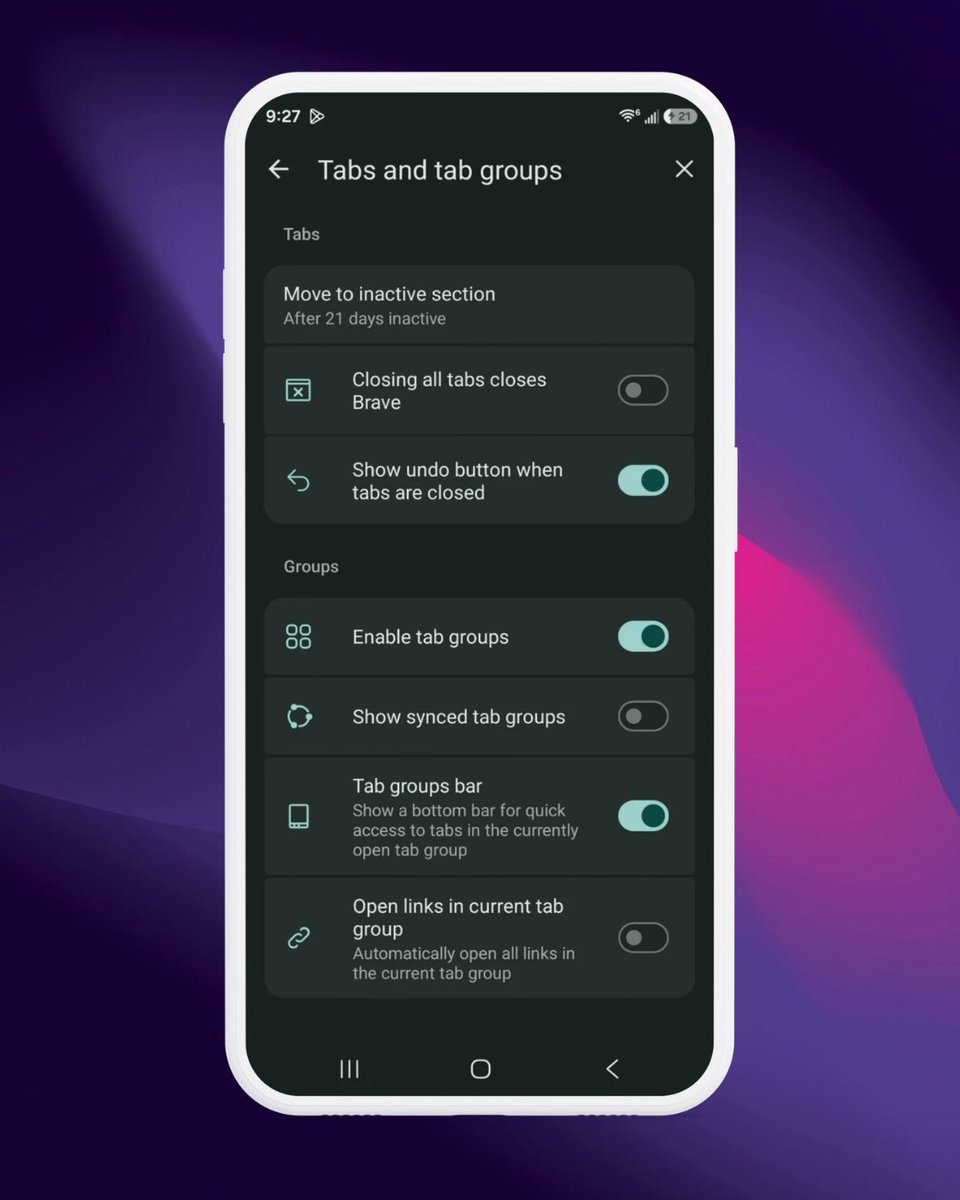
Brave v1.96 on Android adds new controls for tab groups under Settings > Tabs and Tab groups. Users who dislike the feature can now disable it entirely, while those who keep it get new customization options in the same menu.
NEAR Protocol posted a recap of its partnership with Brave, stating that Brave Wallet chooses NEAR Intents and Brave Leo chooses NEAR AI, under the tagline "Brave chooses NEAR." Brave retweeted the post, which links to Brave's blog posts detailing both integrations.
The tweets recap integrations announced over recent releases rather than introducing new features.
Brave is joining as a core sponsor for Breakpoint 2026, Solana's flagship conference, set for November 15-17 at Olympia London — the event's first edition in the UK. The announcement came via a post from Solana Spaces on X, which Brave retweeted.

Brave News can now be opened directly in the browser's Sidebar. Users click the newspaper icon in the sidebar to pull up their custom, private news feed at any time without navigating to the New Tab Page.

Brave's desktop update (v1.96) now shows math equation answers directly in the address bar suggestions when Brave Search is the default search engine. Typing an equation into the browser bar returns the calculated result alongside the suggestion, and the same calculations appear when searching on search.brave.com.
Brave replied to a user report on X saying a fix would be out in a few hours, linking to a new commit in the EasyList filter-list repository. The commit, "Update Playables," adds a rule to custom-lists/youtube-playables.txt that hides YouTube's "Playables" horizontal card list on youtube.com.
The change extends the existing filter that removes YouTube's Playables section for users running Brave's content-filtering lists. It's a small filter update rather than a browser release, and addresses the specific rendering case the user flagged.
Brave v1.95 for Android adds dynamic color support, letting the browser's theme match the device's color palette. Users can enable it under Settings > Appearance > Dynamic colors.
Brave v1.95 on desktop adds the ability to share Leo conversations with others via a generated link. Shared conversations are encrypted and can only be decrypted by the recipient through the link — Brave says only the sharer and the person given the link can read the content.
Brave made Brave Search the default search engine for Brave browser users in the United States, Canada, and the United Kingdom.
Brave launched Brave Search in beta, a private search engine built on its own independent index rather than Bing or Google.
Brave announced the acquisition of Tailcat, an independent search engine developed by the former Cliqz team, which became the foundation of Brave Search.
After more than four years of development, Brave officially launched version 1.0 of its browser for Windows, macOS, Linux, Android, and iOS, bringing it out of beta.
Brave announced a $1 million BAT token giveaway to browser users, rolling out its Brave Rewards system that pays users in BAT for viewing ads and lets them tip publishers.
Brave held an initial coin offering for its Ethereum-based Basic Attention Token, selling out in under 30 seconds and raising approximately $35 million.
Brave launched its privacy-focused, ad-blocking browser for Mac, Windows, iOS, and Android, positioning it as a browser that blocks ads and trackers by default.
Brave Software was incorporated on May 28, 2015 by JavaScript creator and ex-Mozilla CEO Brendan Eich and engineer Brian Bondy.
346 followers · 24 stories