DIA DAO | Open-Source Oracles for Web3
Welcome!
🤔 What is the DIA DAO? Open, decentralised work: a framework to enable the DIA community to support the growth and development of DIA while earning rewards along the way.
👌 What are the benefits of joining DIA DAO? Contributors earn ETH and “XP”. Additionally, DIA tokens are an extra layer of reward to enable participation in governance and other on-site utilities.
Integrations
Why Traditional Market Oracles Fail at Pricing Institutional Crypto Assets
Thu 12th Mar 2026
**The core problem:** Institutional crypto assets don't behave like liquid trading tokens, yet we're trying to price them with tools built for markets.
Traditional market oracles struggle because:
- **Fragmented pricing sources** - On-chain oracles, CEXs, and AMMs each have different latency and manipulation risks
- **Wrapped asset complexity** - Is stETH priced as ETH plus yield, or separately? Context matters
- **Cross-chain inconsistency** - Same token trades at different prices across Ethereum, Arbitrum, and Solana
- **Illiquidity traps** - Long-tail tokens in tiny pools are easily manipulated
The institutional challenge runs deeper: rotating capital between yield markets often requires 2-3 separate transactions (withdraw, bridge, deposit), creating friction that causes institutions to miss optimal opportunities.
**The proposed solution:** Intrinsic valuation that works architecturally rather than just tweaking parameters. This means multi-source aggregation, context-aware pricing for wrappers and LP positions, and reliability filters to exclude manipulable pools.
Without solving asset pricing fundamentally, institutional DeFi remains stuck with partial market exposure and high operational overhead.
Institutional DeFi Infrastructure Layer Takes Shape with Verifiable Data and Automated Risk
Mon 2nd Mar 2026
The foundation for institutional-grade DeFi is materializing through three key components:
- **Verifiable price feeds** providing transparent, source-to-contract data
- **Programmable risk ratings** that enable machine-readable compliance
- **Transparent onchain execution** for auditable transactions
The critical shift: risk data is moving from passive monitoring to **automated enforcement**. This allows institutional capital to deploy at scale with built-in compliance guardrails.
Recent developments include the REACT/USD price feed launch on Base, demonstrating how verifiable market data can trigger automated contract logic in real-time.
This infrastructure addresses a fundamental weakness in current DeFi: reliance on opaque price feeds creates systemic risk. With 20,000+ assets covered across 60+ chains, the emphasis is on complete transparency where developers can verify every data point rather than trusting black-box aggregators.
The convergence of these elements creates the technical foundation needed for institutional participation in decentralized finance.
DIA Unveils Visual Rebrand and New Website
Thu 26th Feb 2026
DIA has launched a comprehensive visual rebrand alongside a new website, marking a strategic shift in its positioning within the DeFi ecosystem.
**Key Updates:**
- New visual identity and website now live at [diadata.org](https://www.diadata.org/)
- Rebrand reflects DIA's evolving vision for decentralized finance
- Full strategic rationale detailed in official [blog post](https://www.diadata.org/blog/post/a-new-dia-for-a-new-defi/)
The rebrand represents DIA's response to the changing DeFi landscape and positions the oracle platform for its next phase of development.
[Explore the new DIA](https://www.diadata.org/)
Ondo Tokenized Stocks Now Accepted as DeFi Collateral on Morpho
Mon 9th Feb 2026
**Major DeFi Integration for Traditional Assets**
Ondo's tokenized US stocks and ETFs can now be used as collateral on Morpho, marking a significant bridge between traditional finance and Ethereum DeFi.
**Key Details:**
- Integration powered by Morpho lending protocol with risk management by Gauntlet
- Chainlink serves as the official data oracle for institutional-grade pricing
- Includes tokenized versions of popular assets like QQQ and TSLA
- First time tokenized stocks available as collateral on Ethereum DeFi
**Broader Context:**
This follows MetaMask's recent integration of Ondo Finance, which brought tokenized equities, ETFs, and commodities directly into the wallet interface.
The combination of deep traditional finance liquidity and reliable oracle data enables these tokenized stocks to power lending, borrowing, and structured products onchain. Initial implementations include vaults on Euler Finance with security provided by Chainlink and risk management by Sentora.
**Why It Matters:**
This development represents a practical step toward making traditional financial assets productive within decentralized finance protocols, potentially opening new use cases for both crypto-native users and traditional investors exploring onchain opportunities.
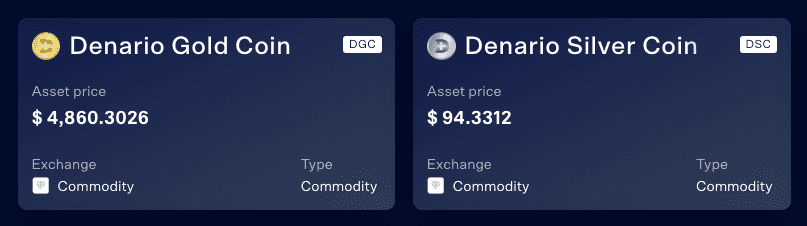
🪙 DIA Launches Production Oracle Feeds for Denario's Tokenized Silver and Gold
Thu 15th Jan 2026
**DIA has deployed live oracle feeds for Denario's commodity-backed tokens**, marking a significant milestone in real-world asset (RWA) infrastructure.
**Key developments:**
- Production-ready price feeds now support Denario's tokenized silver and gold across DeFi protocols
- Enables auditable commodity pricing for onchain settlement systems
- Partnership initiated in early 2025, now reaching full deployment with transparent, verifiable oracle design
The integration provides **reliable pricing infrastructure** for precious metal tokens, allowing seamless integration across DeFi lending, collateralization, and institutional platforms requiring verifiable commodity data.
DIA's oracle infrastructure delivers **complete transparency** from data source to smart contract, with every price calculation verifiable onchain—critical for regulated, commodity-backed token operations.
[Read full details](https://www.diadata.org/blog/post/denario-rwa-oracle-tokenized-silver-gold/)
🪙 Swiss-Backed Digital Gold and Silver Tokens Launch with Full Physical Redemption Rights
Thu 22nd Jan 2026
**Denario Swiss has launched $DSC and $DGC**, tokenized precious metals representing one ounce each of 999.9-purity silver and gold.
**Key features:**
- Physical assets stored in insured Swiss duty-free warehouses
- Full commodity backing with no coverage limits (unlike CHF 100,000-capped bank deposits)
- Physical redemption rights available to holders at any time
- Digital co-ownership model for precious metal investments
**DIA partnership:**
DIA provides high-fidelity price feeds for $DSC on Polygon, reporting real-time silver market values across EUR, USD, and CHF. This enables secure transactions and DeFi integrations.
The collaboration bridges traditional commodities with decentralized finance, allowing users to access precious metals through decentralized applications.
[View price feeds](https://www.diadata.org/app/rwa/)
🏗️ DIA's RWA Oracle Infrastructure Goes Multi-Chain
Thu 15th Jan 2026
**Multi-chain expansion complete**
DIA's xReal oracle suite deployed across five major blockchains: Avalanche, Plume, Base, XRPL, and Polygon. The infrastructure now supports real-world asset protocols with verifiable pricing data.
**Active integrations**
- KlimaDAO and Azos Finance using DIA oracles for collateral pricing
- Coverage includes equities, bonds, commodities, and FX rates
- Trustless verification layer for on-chain RWA protocols
The deployment follows the broader trend of tokenized RWAs reaching $28B on-chain, with DIA positioning its oracle infrastructure as purpose-built for this asset class.
🛡️ DeFi Security Gap
Thu 4th Dec 2025
**DeFi infrastructure maturity questioned** after B+ rated Balancer pool exploitation
**Key discussion points from Infra Gardens Buenos Aires:**
- Defense-in-depth security mechanisms
- Bridged asset risk management
- Insurance adoption challenges
- Stack security responsibility gaps
**Expert panel featured:**
- @dillonhanson12 (DIA)
- @PhilippZentner (LiFi Protocol)
- @MerlinEgalite (Morpho Labs)
- @nsuri_ (Wormhole)
- @jgorzny (Zircuit L2)
Despite infrastructure improvements, **security vulnerabilities persist** in rated protocols, highlighting ongoing institutional hesitation around DeFi adoption.
Ethereum's Fusaka Upgrade Goes Live
Thu 4th Dec 2025
**Ethereum's Fusaka upgrade is now active**, marking another milestone in the network's evolution.
The upgrade focuses on three key principles:
- **Open** development and accessibility
- **Unbiased** network operations
- **Secure scaling** solutions
This latest implementation continues Ethereum's roadmap of incremental improvements to enhance network performance and security. The Fusaka upgrade represents ongoing efforts to optimize the blockchain's infrastructure while maintaining decentralization.
The upgrade's emphasis on secure scaling addresses one of Ethereum's primary challenges - processing more transactions without compromising security or decentralization.
🚀 Ethereum's Fusaka Upgrade Goes Live Tomorrow
Thu 4th Dec 2025
**Ethereum's Fusaka upgrade launches tomorrow**, bringing the biggest infrastructure improvement for Layer 2 scaling yet.
**Key Changes:**
- **PeerDAS technology** - Validators only need to store 1/8th of blob data instead of everything
- **Blob capacity expansion** - More space for L2 transaction data at lower costs
- **Gas limit increase** - From 45M to 60M, with potential for 150M
- **Hardware requirements stay manageable** through data sampling
**Impact for Users:**
- **Lower L2 fees** as rollups like Arbitrum, Optimism, and Base can batch more transactions
- **Better UX** with preconfirmations and hardware wallet support
- **Passkey integration** for Ethereum accounts
**For L2s and L3s:**
The data bottleneck that has constrained rollup economics gets significantly relieved. Cheaper data posting costs translate directly into reduced user fees.
This upgrade represents the infrastructure foundation that makes Ethereum's rollup-centric roadmap viable at scale.