ZKsync's Prividium: Ethereum-Secured Blockchain for Institutional Privacy
ZKsync's Prividium: Ethereum-Secured Blockchain for Institutional Privacy
🏦 Banks get privacy


ZKsync introduces Prividium, an Ethereum-secured blockchain platform designed specifically for institutional needs.
Key Features:
- Privacy-first architecture with cryptographic enforcement rather than trust-based systems
- Built-in compliance through role-based access controls and ZK proofs
- Full data control for enterprises while maintaining Ethereum connectivity
Use Cases:
- Tokenized deposits for regulated institutions
- Real-time cross-border payments (~1s settlement)
- Corporate treasury automation with programmable workflows
- Intraday repo and secured financing
Prividium addresses what public stablecoins and legacy rails cannot: enabling financial institutions to issue digital money on private, enterprise-controlled chains while preserving their business model.
Tokenized deposits solve what public stablecoins and legacy rails cannot. Prividiums enable regulated Institutions issue tokenized deposits on private, enterprise-controlled Chains solving for real use cases like real-time cross-border payments.

Read the full @Delphi_Digital report on ZKsync's Institutional adoption 👇 members.delphidigital.io/reports/zksync…
Privacy in Finance should be enforced by mathematics, not managed by trust. Prividium is the only blockchain platform purpose-built for Institutions that demand privacy, compliance, and full control of their data while still being natively connected to Ethereum.

Learn how Prividiums modernize Corporate Treasury by replacing fragmented accounts and batch settlement with unified, programmable, real-time liquidity. zksync.io/treasury-manag…
Built-in Compliance Prividiums combine role-based access controls with ZK proofs empowering Institutions to come onchain in a secure, private and compliant way. Controlled disclosures enable compliance to be demonstrated without exposing confidential business data.

Future-Proof Treasury Management From consolidated corporate wallets to automated Treasury workflows, Prividiums modernize Corporate Treasury by replacing fragmented accounts and batch settlement with unified, programmable, real-time liquidity.

Beyond Public vs Private Chains Imagine a financial system where payments settle in seconds, liquidity moves without friction, data stays private and regulators retain the visibility they need. Citi, Deutsche Bank and 30+ institutions joined us to to explore Prividiums.
Intraday Repo & Secured Financing Current systems suffer from: ❌ Batch settlement windows, intermediaries, and reconciliation breaks Tokenized deposits enable: ✅ Real-time collateral + cash settlement ✅ Instant repledging ✅ Role-based access
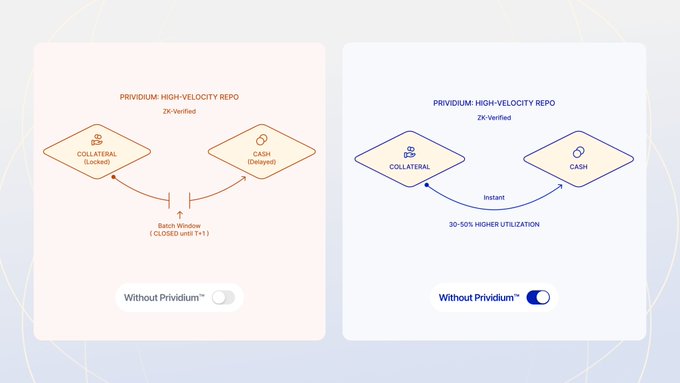
Learn how Prividiums bring tokenized deposits on private, composable rails 👇 zksync.io/tokenized-depo…
Read how ZKsync transforms Treasury into a real-time strategic asset 👇 zksync.io/treasury-manag…

Learn how Financial Institutions are preserving their business model and expand their revenue streams by adopting tokenized deposits on Prividiums. zksync.io/tokenized-depo…
Corporate Treasury Automation ❌ Treasury teams still operate on fragmented systems and batch cycles. Prividiums enable: ✅ Programmable treasury wallets ✅ Automated liquidity flows ✅ Real-time global visibility

Read more about our full suite of solutions, from cross-border payments to tokenized deposits, here 👇 zksync.io/intraday-repo
Prividiums enable tokenized deposits with: ✔️ Safety & Trust ✔️ Programmability ✔️ Speed ✔️ Compliance & Privacy ✔️ Interoperability

Tokenized deposits aren’t just digital money. They’re the foundation for programmable, institutional-grade financial infrastructure. Learn more about our Tokenized Deposits solutions: zksync.io/tokenized-depo…
Tokenized Deposits Financial institutions want digital money that preserves their business model. Prividiums enable them to issue tokenized deposits on private, enterprise-controlled chains delivering privacy, compliance, programmability, and Ethereum-grade settlement.

Corporate Treasury is slow and expensive. Traditional rails depend on cut-off times, SWIFT messaging and T+1 settlement. Prividiums enable next-gen Treasury management with: Atomic swaps across banks Fungible balances regardless of issuer RT reconciliation & net settlement

Prividium is the only platform purpose-built for Institutions that demand privacy, compliance and control of their data. 🔐 Privacy with public proofs 🧾 Built-in compliance 🏢 Enterprise control 🌏 Direct connectivity Private where it matters. Connected where it counts.
Tokenized deposits is the WhatsApp moment for institutional money. Prividiums enable regulated Institutions move money across borders with near-instant settlement, onchain compliance and zero data exposure on public networks.

Learn more on how Prividiums offer Institutions user-level privacy, compliance, cross-chain connectivity, and Ethereum-grade security out of the box. zksync.io/prividium
Learn how Prividiums enable the transition from fragmented accounts to real-time and programmable Treasury. zksync.io/treasury-manag…
Corporate Treasury is fragmented, slow and expensive. Treasury infrastructure wasn't built for global, real-time business. Prividiums enable programmable Treasury management so that corporations can consolidate their global operations in real-time with near-instant transfers.

Treating privacy and compliance as opposites is an outdated assumption. Modern cryptography allows both to coexist. Prividiums were built to enable this future: private onchain infrastructure where compliance is enforced cryptographically. x.com/TziokasV/statu…

x.com/i/article/2012…
🏦 The Bank Stack of Ethereum ZKsync and @phylaxsystems introduce institutional architecture for private execution, compliant money, and instant settlement on @ethereum. x.com/zksync/status/…

x.com/i/article/2024…
Learn why Prividium is the only Ethereum-secured blockchain platform purpose-built for institutions that demand privacy, compliance, and full control of their data. zksync.io/prividium
ZKsync enables this transition by providing both the infrastructure and solutions for secure, scalable, and private institutional settlement. This is the “WhatsApp moment” for regulated digital money. zksync.io/tokenized-depo…
Cryptographic privacy > Trust-based privacy Privacy in Finance should be enforced by mathematics, not managed by trust.

From Corporate Treasury automation to Intraday Repo, tokenized deposits solve what public stablecoins and legacy rails cannot. Read how Prividiums bring them in private and composable rails. zksync.io/tokenized-depo…
Real-Time Cross-Border Payments Today: ❌ Slow, costly, and dependent on intermediaries With tokenized deposits on Prividiums: ✅ Near real-time settlement (~1s) ✅ No intermediaries ✅ Institution-grade privacy

Corporate Treasury is a critical business function which still operates on slow, expensive and fragmented infrastructure. Large enterprises maintain >500 bank accounts globally costing $5–15M/year just to maintain them. Prividiums enable real-time and programmable Treasury.

Financial institutions are seeking digital forms of money that integrate with their existing operating frameworks and preserve their business model. 🧵This is why tokenized deposits are emerging as the next evolution of institutional money:
Prividium™ The only blockchain platform purpose-built for institutions that demand privacy, compliance, and full control of their data.

From consolidated Corporate wallets to automated Treasury workflows, this is how ZKsync transforms Corporate Treasury 👇 zksync.io/treasury-manag…
🔐 ZKsync is purpose-built for Institutions At @TheTieIO panel, @Ozhar highlighted how ZK tech delivers privacy and execution integrity enabling Institutions to come onchain safely and compliantly. x.com/zksync/status/…
"Banks ask the most intense security questions. Security on protocol level is paramount because Institutions need to protect against invalid transactions." @Ozhar, VP Business Development, on @TheTieIO panel explaining how ZK tech enables both privacy and execution integrity.

The Prividium Breakthrough "Prividium offers a pre-configured, turnkey solution bridging the gap to Enterprise readiness by baking in essential requirements (privacy, compliance, and permissioned access) from Day 1."

The future of Finance will run on instant settlement. Stablecoins are already transforming payments and tokenized deposits will soon enable Institutions to issue regulated digital money that moves in real time across markets and borders. @gluk64 on @TokenizedPod 👇
Tokenized deposits are bank-issued digital deposits that live on blockchain rails. But banks still need infrastructure designed for them. This is where ZKsync's Prividiums come in. They enable private, enterprise-controlled tokenized deposits secured by @Ethereum.
It's time for Treasury Management to come onchain. ZKsync enables Enterprises to transform Corporate Treasury into a real-time strategic asset with programmable workflows and enhanced working capital performance. While staying private and compliant.

Learn more about the future on Treasury management on private and compliant onchain rails 👇 zksync.io/treasury-manag…
Financial institutions need digital money that: ▪️Preserves the bank's business model ▪️Settles instantly ▪️Maintains privacy ▪️Works across networks This is where tokenized deposits come in.

ZKsync Speaker to Discuss Tokenized Deposits at DC Blockchain Summit

**ZKsync representative @gluk64 will speak at the Digital Chamber's DC Blockchain Summit on March 18.** - **Topic**: The role of tokenized deposits in next-generation financial markets - **Focus**: Bridging policy and banking infrastructure - **Time**: 1:35 PM - **Location**: Washington, D.C. The presentation addresses privacy, compliance, and institutional adoption in the evolving landscape of digital finance.
GenLayer Launches Programmable Trust Infrastructure for Automated Financial Disputes
**GenLayer has launched a programmable trust infrastructure** designed to resolve disputes in automated financial markets. As financial institutions increasingly automate execution, they face a critical gap: **neutral mechanisms for dispute resolution**. GenLayer addresses this with what they call the "next layer of digital markets." **Key features:** - Autonomous escrow services - Real-time prediction markets - Internet Court operating at machine speed **Technical foundation:** - Built by GenLayer - Powered by zkSync's scalable and secure infrastructure The platform aims to provide **programmable trust** that can keep pace with automated financial systems, filling the dispute resolution void in rapidly digitizing markets.
ZKsync: Institutional Crypto Adoption Hinges on Bottom-Line Impact
ZKsync is positioning itself as infrastructure for institutional crypto adoption, with a clear focus on business value rather than speculation. **Key Points:** - Institutional adoption requires demonstrable impact on company bottom lines - Two pathways: efficiency gains or business growth - ZKsync offers enterprises scalability and privacy while maintaining Ethereum liquidity access - Platform enables institutions to enter crypto "on their own terms" The Layer 2 solution is building what it calls "Incorruptible Financial Infrastructure" - a framework designed to help traditional enterprises compete in the digital asset economy without compromising on operational requirements. This approach marks a shift from hype-driven narratives to practical business cases for blockchain adoption.
Banks Face Stablecoin Dilemma: Public Options Fall Short of Regulatory Needs
Financial institutions are caught between inadequate options for digital payments. **Public stablecoins lack the regulatory compliance** needed for traditional banks, while **legacy payment systems remain slow and costly**. Closed permissioned ledgers create isolated silos that don't solve interoperability challenges. **The core problem:** - Public stablecoins aren't designed for regulated institutions - Traditional payment rails are inefficient - Private blockchain networks operate in isolation This gap highlights the need for infrastructure that bridges regulatory requirements with blockchain efficiency. Banks require solutions that combine compliance frameworks with the speed and cost benefits of digital assets, without sacrificing connectivity to the broader financial system.