Banks Face Stablecoin Dilemma: Public Options Fall Short of Regulatory Needs
Banks Face Stablecoin Dilemma: Public Options Fall Short of Regulatory Needs
🏦 Banks' Stablecoin Problem

Financial institutions are caught between inadequate options for digital payments. Public stablecoins lack the regulatory compliance needed for traditional banks, while legacy payment systems remain slow and costly. Closed permissioned ledgers create isolated silos that don't solve interoperability challenges.
The core problem:
- Public stablecoins aren't designed for regulated institutions
- Traditional payment rails are inefficient
- Private blockchain networks operate in isolation
This gap highlights the need for infrastructure that bridges regulatory requirements with blockchain efficiency. Banks require solutions that combine compliance frameworks with the speed and cost benefits of digital assets, without sacrificing connectivity to the broader financial system.

Today’s options don’t fully work for banks: 🚫 Public stablecoins → not built for regulated institutions 🚫 Legacy payment rails → slow and expensive 🚫 Closed permissioned ledgers → isolated silos Institutions need something different.
ZKsync Speaker to Discuss Tokenized Deposits at DC Blockchain Summit

**ZKsync representative @gluk64 will speak at the Digital Chamber's DC Blockchain Summit on March 18.** - **Topic**: The role of tokenized deposits in next-generation financial markets - **Focus**: Bridging policy and banking infrastructure - **Time**: 1:35 PM - **Location**: Washington, D.C. The presentation addresses privacy, compliance, and institutional adoption in the evolving landscape of digital finance.
GenLayer Launches Programmable Trust Infrastructure for Automated Financial Disputes
**GenLayer has launched a programmable trust infrastructure** designed to resolve disputes in automated financial markets. As financial institutions increasingly automate execution, they face a critical gap: **neutral mechanisms for dispute resolution**. GenLayer addresses this with what they call the "next layer of digital markets." **Key features:** - Autonomous escrow services - Real-time prediction markets - Internet Court operating at machine speed **Technical foundation:** - Built by GenLayer - Powered by zkSync's scalable and secure infrastructure The platform aims to provide **programmable trust** that can keep pace with automated financial systems, filling the dispute resolution void in rapidly digitizing markets.
ZKsync's Prividium: Ethereum-Secured Blockchain for Institutional Privacy
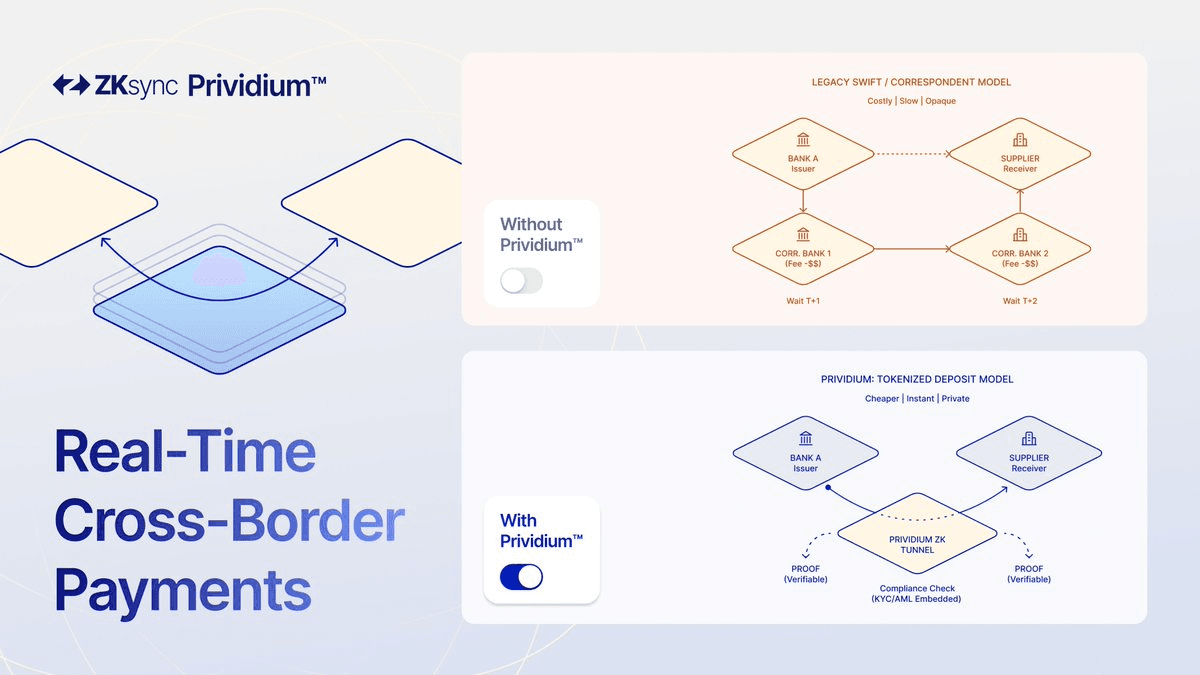
**ZKsync introduces Prividium**, an Ethereum-secured blockchain platform designed specifically for institutional needs. **Key Features:** - **Privacy-first architecture** with cryptographic enforcement rather than trust-based systems - **Built-in compliance** through role-based access controls and ZK proofs - **Full data control** for enterprises while maintaining Ethereum connectivity **Use Cases:** - Tokenized deposits for regulated institutions - Real-time cross-border payments (~1s settlement) - Corporate treasury automation with programmable workflows - Intraday repo and secured financing Prividium addresses what public stablecoins and legacy rails cannot: enabling financial institutions to issue digital money on private, enterprise-controlled chains while preserving their business model. [Learn more about Prividium](https://www.zksync.io/prividium)
ZKsync: Institutional Crypto Adoption Hinges on Bottom-Line Impact
ZKsync is positioning itself as infrastructure for institutional crypto adoption, with a clear focus on business value rather than speculation. **Key Points:** - Institutional adoption requires demonstrable impact on company bottom lines - Two pathways: efficiency gains or business growth - ZKsync offers enterprises scalability and privacy while maintaining Ethereum liquidity access - Platform enables institutions to enter crypto "on their own terms" The Layer 2 solution is building what it calls "Incorruptible Financial Infrastructure" - a framework designed to help traditional enterprises compete in the digital asset economy without compromising on operational requirements. This approach marks a shift from hype-driven narratives to practical business cases for blockchain adoption.