Tweet by @ensdomains on human readable addresses in crypto
Tweet by @ensdomains on human readable addresses in crypto

ENS highlights the importance of human readable addresses in crypto, emphasizing that non-human readable addresses are a drawback in user experience that web2 never faced. They advocate for naming systems like ENS to address this issue, stating that human readable identifiers are essential for humanity to function. The tweet also criticizes the use of hex as inhumane. #nomorehex #ens

Non human readable addresses are one of the worst UX things that crypto has brought to us that web2 never had. Naming systems like ENS were made to combat this. Human readable identifiers is a requirement for humanity to function. And hex is not humane. #nomorehex #ens

5 minutes ago, a victim lost $1.04 million by copying the wrong address from a contaminated transfer history.

The Reverse Record Issue 7: Human Naming, ENS Evolution, and Universal Resolver
**The Reverse Record Issue #7** explores fundamental aspects of ENS naming systems. **Key Topics:** - Why humans instinctively name everything and how this applies to blockchain identities - The evolution of ENS names from simple identifiers to complex systems - Technical deep-dive into the Universal Resolver and its behind-the-scenes functionality - Latest developer updates from the ENS ecosystem - Community highlights and ecosystem developments The issue provides both philosophical context on human naming conventions and technical insights into ENS infrastructure improvements.
ENSv2 Launches Universal Resolver for Cross-Chain Name Resolution
**ENS is upgrading its resolver system with ENSv2** The Ethereum Name Service is introducing a Universal Resolver - a single smart contract that can resolve names across multiple environments: - ENSv1 names - ENSv2 names - Layer 2 networks - Offchain names via CCIP-Read **What developers need to know:** Applications using ENS should update their libraries to ensure compatibility with the new Universal Resolver. The system uses CCIP-Read protocol to fetch data from L2s and offchain sources. This consolidation simplifies the resolution process by eliminating the need for separate resolvers for different name types and networks. Developers can find implementation details in the [ENSv2 readiness documentation](https://docs.ens.domains/web/ensv2-readiness/). **Action required:** Review your ENS integration and update libraries to support cross-chain resolution.
ENS Launches registerAgentIdentity() for On-Chain Agent Verification
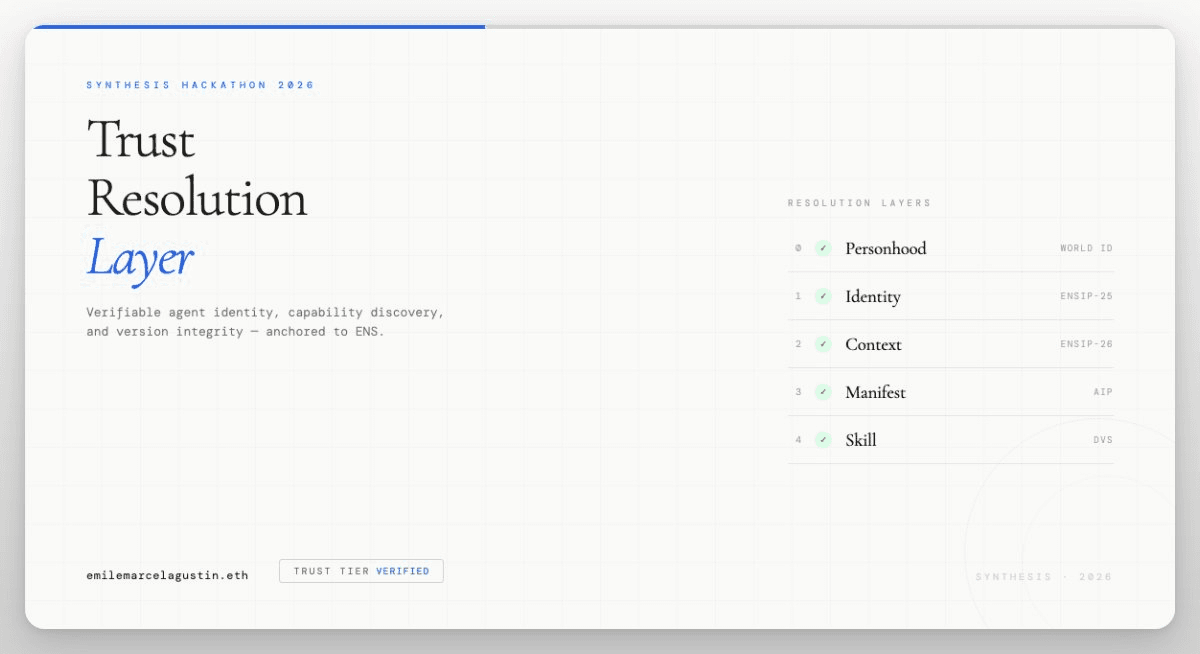
ENS has introduced `registerAgentIdentity()`, a new function that provides AI agents with on-chain identity infrastructure. When called, agents receive: - A human-readable ENS subname - An on-chain passport - Cryptographic proof linking the agent to its owner This builds on ENS's evolving role beyond simple name resolution. The system now supports: - **Arbitrary records** that carry an agent's full trust stack - **Identity scoring** (none, registered, discoverable, verified, full) - **Programmable resolvers** that execute logic like token swaps or privacy routing ENS serves as the accountability layer, transforming raw cryptographic keys into verifiable, human-readable identities. One ENS name can hold everything: identity, discoverability, code integrity, and capabilities. The infrastructure makes agents resolvable and accountable while maintaining the flexibility to chain complex actions through custom resolver logic.
🏆 Trust Resolution Layer Wins First Place for Verifiable Agent Identity
A **Trust Resolution Layer (TRL)** has taken first place for establishing verifiable AI agent identity through ENS. The system combines multiple components: - World ID verification - ENSIP-25 agent registration standard - ENSIP-26 context records - Novel AIP manifest system These elements work together to create a **progressive 5-tier trust scoring system** for autonomous agents. This infrastructure addresses a critical need as AI agents increasingly sign transactions, hold assets, and interact with blockchain protocols. The TRL builds on ENSIP-25, which introduced standardized verification that an onchain-registered AI agent is genuinely associated with an ENS name. The solution provides essential identity infrastructure for the growing ecosystem of autonomous agents operating in web3.
ENS Releases Alpha Log #5 with Reliability and Usability Updates
The Ethereum Name Service has published its fifth alpha development log for ENSv2, detailing continued improvements to the App and Explorer on the Sepolia testnet. **Key Updates:** - Focus on reliability, flexibility, and overall usability enhancements - Builds on previous fixes including transaction modal layouts and Fuses page improvements - Ongoing polish to search functionality, profiles, notifications, and name management features The ENSv2 testing phase continues on Sepolia as the team iterates on the user experience before mainnet deployment. More updates are expected in upcoming alpha logs.