ENS Names Evolve Into Hierarchical Systems With ENSv2
ENS Names Evolve Into Hierarchical Systems With ENSv2
🏗️ ENS names just got modular


ENS names are fundamentally changing. ENSv2 replaces the single-object model with hierarchical registries that allow different parts of a namespace to branch into their own permissions, logic, and resolution systems.
Key changes:
- Names are no longer single entries with one owner and resolver
- Each name can now have its own registry and permission structure
- Different namespace segments can operate independently with custom logic
- The hierarchy becomes physically represented through the structure itself
This architectural shift makes ownership and delegation more expressive while ENS infrastructure handles the complexity. Names become structured systems built from linked parts rather than isolated setups.
The update maintains backward compatibility - existing subnames, CCIP-Read names, and imported DNS names continue working while gaining access to more powerful permissioning capabilities.

Is the Resolver changing? Yes. ENSv2 introduces a Universal Resolver: a single contract capable of resolving ENSv1, ENSv2, L2, and offchain names through CCIP-Read.
ENSv2 makes ownership and delegation more expressive under the hood, while ENS infrastructure abstracts away the complexity. Names are no longer single entries. They’re structured systems built from linked parts. Read more: ens.domains/blog/post/name…
ENS names can carry arbitrary records, making them the perfect vessel for an agent's full trust stack. One name holds everything: identity, discoverability, code integrity, capabilities. Query it and you get a score back: none, registered, discoverable, verified, full. That's

What’s actually changing with subnames in ENSv2? ENSv2 replaces the old flat registry model with a hierarchical registry system. Instead of everything living in one shared registry, each name gets its own registry and permission structure.
ENS names are no longer just single objects with one owner and one resolver. ENSv2 introduces hierarchical registries that let different parts of a namespace branch into their own permissions, logic, and resolution systems. Dive deeper: ens.domains/blog/post/name…

One of the biggest ENSv2 questions we’ve seen is about subnames. What happens to names like .base, .uni, imported DNS names, and CCIP-Read names? Here’s what changes, and what doesn’t 🧵

ENS is no longer a niche tool for crypto power users. Millions of names now exist across ecosystems, wallets, apps, and DNS integrations. ENSv2 is designed to support that kind of scale without losing the openness that made ENS useful in the first place.
Call registerAgentIdentity() and your agent gets a subname, an on-chain passport, and cryptographic proof linking to its owner. ENS is the anchor that makes it human-readable and resolvable. That's ENS as the entry point for agent identity.

ENSv2 replaces a flat registry with a hierarchy of linked registries, making ownership and delegation explicit onchain. Learn more: ens.domains/blog/post/name…
ENSv2 is coming, and with it, one big question: What happens to my name? Here’s everything you need to know about the upgrade 🧵

The tl;dr? ↪ Existing subnames keep working ↪ CCIP-Read names keep working ↪ Imported DNS names keep working ↪ ENSv2 introduces more powerful permissioning and delegation for subnames Keep an eye out for more FAQs on ENSv2!
ENSv2 is coming. A new foundation for names, built for integrations and subnames at scale. What will you build?
One of the most requested ENSv2 features is simpler payments. So can I buy ENS names with stablecoins? Yes. ENSv2 will support buying names with USD-denominated stablecoins (like USDC) from any EVM chain.

ENSv2 makes namespaces far more scalable. Instead of every ENS name maintaining its own isolated setup, registries can now be shared across many identities.
In ENSv2, the hierarchy becomes explicit. You open the eth vault and find every .eth name inside it. Open nick, and you can find sub nested within. The relationship between names is no longer implied. It is physically represented through the structure itself.
One thing became pretty clear this weekend: Agents need identity, discovery, permissions, reputation, coordination, and interoperable naming. A lot of builders reached for ENS to provide that foundation.
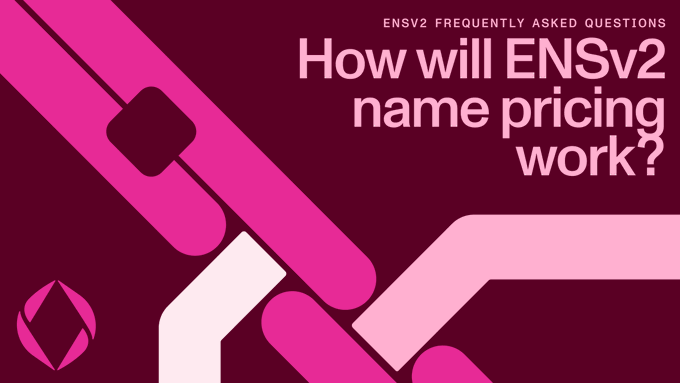
How will ENSv2 name pricing work? ENSv2 will make name pricing more predictable by setting registration and renewal costs in USD and supporting payment with stablecoins.
ICANN Study Group Examines Integration Between Traditional and Alternative Naming Systems
ICANN has launched a technical study group to examine integrations between generic Top-Level Domains (gTLDs) and alternative naming systems. This development comes as ICANN prepares to open its next round of gTLD applications in April 2026. **Key Points:** - The study group will explore technical aspects of how traditional domain systems can work with blockchain-based naming alternatives - ENS is actively preparing for the gTLD expansion by protecting its brand and exploring partnerships with registries - The initiative represents a potential bridge between conventional internet infrastructure and decentralized naming systems This technical examination could influence how blockchain-based naming services interact with the broader internet naming infrastructure as both systems continue to evolve. Learn more: [ICANN Blog Post](https://www.icann.org/en/blogs/details/gtld-integrations-with-alternative-naming-systems-technical-study-group-underway-09-06-2026-en)
ENS Joins ICANN Technical Study Group to Shape Future of Internet Naming
The Ethereum Name Service (ENS) has secured representation on ICANN's Technical Study Group through lead developer Nick Johnson, who is one of seven members selected for the initiative. **Key Points:** - The study group will assess how blockchain-based naming systems and the traditional Domain Name System (DNS) can work together securely - This marks a significant step in bridging web3 naming infrastructure with established internet protocols - ENS's participation gives the decentralized naming community a voice in shaping future standards **Background:** ENS operates similarly to DNS but uses Ethereum blockchain technology to map human-readable names (like 'alice.eth') to cryptocurrency addresses and other identifiers. The system already supports importing existing DNS names, making this collaboration a natural evolution. The inclusion of ENS in ICANN's technical discussions signals growing recognition of blockchain naming systems within traditional internet governance structures.
ENS Shifts Focus: Organizations and Institutions Drive Next Adoption Wave

The Ethereum Name Service is entering a new phase of growth, moving beyond individual users to target organizations, applications, and institutions. **Key developments:** - ENS is positioning onchain identity as public infrastructure - Organizations are beginning to integrate ENS into their operations - Cross-platform adoption enables portable identities across wallets and applications - Users can maintain a single name across different ecosystems and payment networks This shift represents a maturation of the ENS ecosystem, as the naming service evolves from a tool for crypto-native individuals to infrastructure for mainstream institutions. The focus on organizational adoption could significantly expand ENS's reach and utility. Read the full announcement: [ENS Blog](https://ens.domains/blog/post/onchain-identity-is-becoming-public-infrastructure)
Turkey's Government Adopts ENS for Official Digital Identity
**Turkey makes blockchain infrastructure move** The Republic of Turkey's Directorate of Communications registered **cbiletisim.eth** as its official decentralized identity through the Ethereum Name Service (ENS). **Key details:** - First government entity to establish an official onchain identity using ENS - Part of broader initiatives in AI, blockchain infrastructure, and digital sovereignty - Featured at Turkey's Directorate of Communications in Ankara - Represents a shift toward governments adopting blockchain-based systems The move demonstrates how traditional government institutions are exploring decentralized naming systems for official digital presence. ENS maps human-readable names to blockchain addresses, similar to how DNS works for traditional internet domains. [Official announcement](https://www.iletisim.gov.tr/english/duyurular/detay/press-release-digital-transformation-breakthrough-building-the-future-of-our-communication-ecosystem-via-ai-and-blockchain-technologies)
ENSv2 Launches Universal Resolver for Cross-Chain Name Resolution
**ENS is upgrading its resolver system with ENSv2** The Ethereum Name Service is introducing a Universal Resolver - a single smart contract that can resolve names across multiple environments: - ENSv1 names - ENSv2 names - Layer 2 networks - Offchain names via CCIP-Read **What developers need to know:** Applications using ENS should update their libraries to ensure compatibility with the new Universal Resolver. The system uses CCIP-Read protocol to fetch data from L2s and offchain sources. This consolidation simplifies the resolution process by eliminating the need for separate resolvers for different name types and networks. Developers can find implementation details in the [ENSv2 readiness documentation](https://docs.ens.domains/web/ensv2-readiness/). **Action required:** Review your ENS integration and update libraries to support cross-chain resolution.