Risk Management: TradFi vs DeFi Quantitative Analysis
Risk Management: TradFi vs DeFi Quantitative Analysis
🎯 Risk decoded differently

Finance fundamentally centers on risk management - but the approaches differ drastically between traditional and decentralized systems.
TradFi relies on authority-based governance, using established regulatory frameworks and institutional oversight to manage risk through centralized decision-making.
DeFi encodes risk directly into smart contract systems, creating transparent, algorithmic approaches that operate without traditional intermediaries.
A new quantitative analysis breaks down:
- Risk assessment methodologies in both systems
- Mathematical frameworks governing each approach
- Potential convergence points for the future
The comparison reveals how institutional trust and compliance expertise from TradFi could blend with DeFi's transparency and efficiency to create hybrid risk management solutions.

Finance has always revolved around one thing: risk. TradFi governs it through authority, DeFi encodes it into systems. Our latest blog breaks down the quantitative frameworks behind both, and where they may be heading. 👇 blogs.kerneldao.com/blog/tradition…
🏁 Final Epoch Alert: Arbitrum DRIP Season 1 Ends
**Last Call for ARB Rewards** Arbitrum DRIP Season 1 has entered its final epoch, marking the last opportunity for users to earn additional ARB token rewards. **Key Details:** - Final epoch now active for DRIP Season 1 - Users can stake rsETH across supported protocols - Extra ARB incentives available during this closing period **Background Context:** rsETH has shown strong performance on Arbitrum, recently becoming the #2 ETH derivative by market cap on the network. The DRIP program has run through multiple epochs, with this final phase concluding Season 1. Participants can explore available opportunities at [arbitrumdrip.com/opportunities](https://arbitrumdrip.com/opportunities).
rsETH E-Mode on Aave: $1.1B Liquidity, 14x Leverage, 9% Rewards Now Live
**Major capital efficiency unlock for rsETH holders on Aave v3 Core market:** - **E-Mode activation** enables rsETH <> ETH loops at up to **93% LTV** (previously capped at lower ratios) - **14x leverage** now possible in one click via Contango integration - **~$1.1B ETH liquidity** available to borrow on Core market - Current conditions deliver **~9% rewards** on leveraged ETH exposure - rsETH supply on Aave Core crossed **$1B**, making it the **#8 largest asset** on the platform **Key improvements:** - Tighter loops with less idle capital - Competitive borrow rates even near utilization kink - One-click execution removes manual looping friction - Cross-chain expansion: $65M+ supply on Avalanche and Base markets **Risk reminder:** Higher leverage amplifies both returns and liquidation risk. E-Mode works best for correlated assets but requires active position management. [Start looping on Aave](https://app.aave.com/reserve-overview/?underlyingAsset=0xa1290d69c65a6fe4df752f95823fae25cb99e5a7&marketName=proto_mainnet_v3)
🌱 What's next?
**New Vaults Launch on Silo Finance** KelpDAO's agETH and hgETH tokens can now be used as collateral on Silo Finance. Users can: - Leverage agETH and hgETH holdings to borrow ETH - Access improved loan-to-value ratios - Benefit from more efficient borrowing terms This integration expands liquidity options for liquid restaking token holders, allowing them to unlock capital without selling their positions.
Krunch by Kelp: Monthly Newsletter on Stablecoin Infrastructure and On-Chain Credit
Kelp has launched **Krunch**, a monthly newsletter focused on institutional developments in crypto infrastructure. The newsletter covers three main areas: - Institutional stablecoin infrastructure - Real-world asset (RWA) convergence - Evolution of on-chain credit markets Krunch aims to deliver signal over noise, providing substantive insights without promotional content. Readers can subscribe to receive the newsletter directly via [Kelp's website](https://kerneldao.com/kelp/#:~:text=Stay%20updated%20with%20Kelp).
Stablecoins shift from speculation to settlement infrastructure
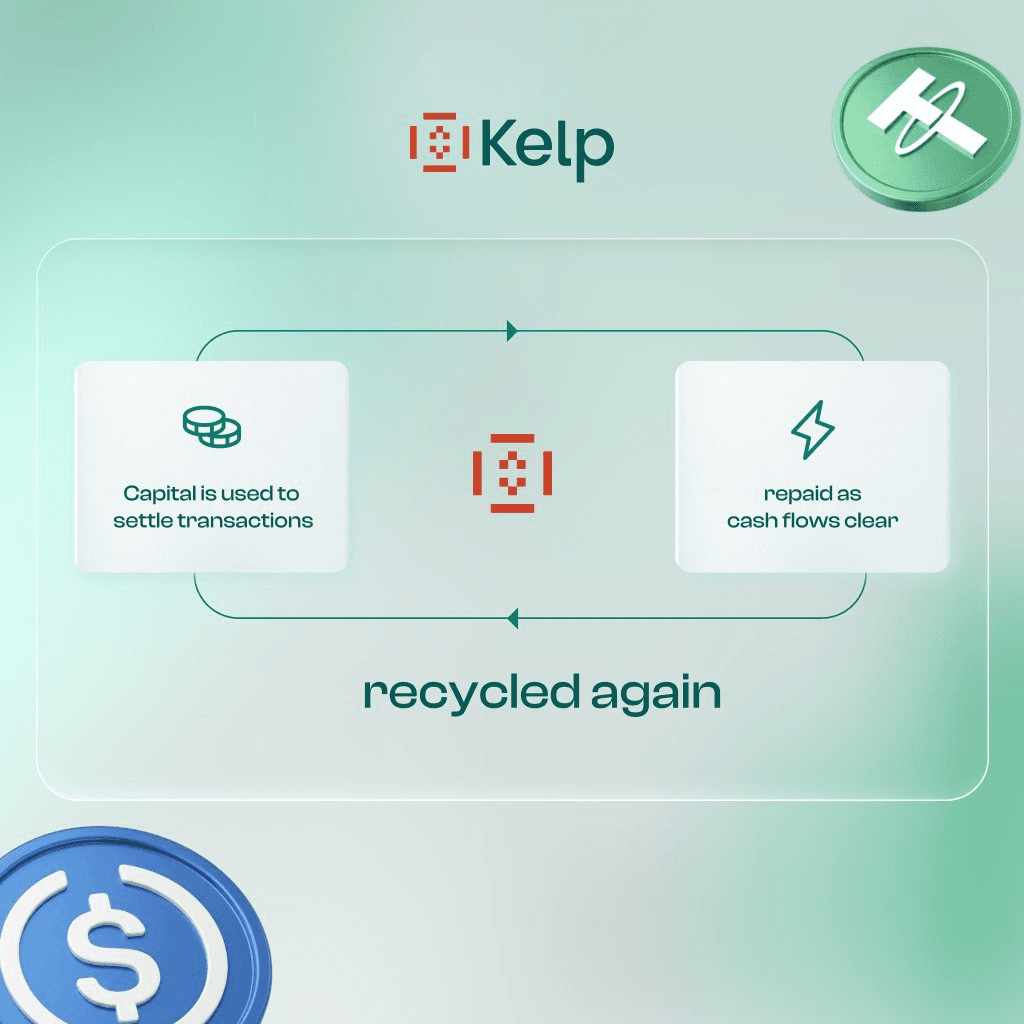
**The infrastructure shift is here.** Stablecoins are moving from speculative assets to payment rails. Circle's USDC now integrates with Visa and Mastercard, while Galaxy Digital forecasts stablecoins will surpass ACH payment volume in 2026. **Institutions are deploying capital.** BlackRock, Franklin Templeton, and JPMorgan have moved tokenized funds into production. Standard Chartered's CEO expects most transactions to eventually settle on blockchain. **Real-world credit is connecting to on-chain liquidity.** Tala's $50M USDC facility serves 13M users in emerging markets. Huma Finance has processed $8B linking stablecoin liquidity to payment flows. **The opportunity: $9-11T locked in settlement buffers.** Global payment systems move $200T+ annually, but capital sits idle in receivables and settlement delays. **KUSD targets this gap.** Kelp's stablecoin earns from real-world repayments tied to payment flows and trade finance—not DeFi emissions or speculation. Returns come from actual capital movement through working capital cycles. Short-term, settlement-native credit with on-chain transparency.