Ocean Network Offers Pay-Per-Use GPU Access for Llama 4
Ocean Network Offers Pay-Per-Use GPU Access for Llama 4
🔧 Run Llama 4

Ocean Network now provides on-demand GPU access for running Llama 4 through a straightforward workflow:
- Select GPU resources via Ocean Network Dashboard
- Pay only for actual execution time using escrow-secured payments
- Integrate directly into your IDE through Ocean Orchestrator
The platform addresses common infrastructure challenges in AI development, including idle enterprise GPU capacity and limited developer access to compute resources. Users can browse available compute by specifications and duration, with NVIDIA H200 GPUs available starting at $2.16/hr.

If you're building multi-agent systems, you've probably already noticed how fast orchestration overhead compounds. KV cache grows, inference concurrency spikes, and suddenly GPU memory and bandwidth become a problem. Why does that happen? Running planner, retrieval, memory, and
What if running a GPU job felt like running a local script? Here's how it actually works: 1. Pick your compute environment inside the Ocean Network Dashboard, browsing live benchmarked nodes by GPU/CPU, RAM, disk, and duration. 2. Fund the job in $USDC through escrow-secured
NVIDIA H200s are becoming one of the best GPUs for multi-agent AI workloads. Agent systems create massive KV cache pressure, parallel reasoning demand, and long-context memory strain across multiple active inference streams. That's exactly where H200s shine, with 141GB HBM3e
An NVIDIA H200 has 141GB of HBM3e memory and rents for roughly $2.16/hr on Ocean Network (@ONcompute), with jobs running up to 12 hours. In that time, a small team can run a serious LoRA/QLoRA fine-tune of Llama 3.1 70B on proprietary data, experiment with different training
The most transformative tech of the decade is being built on the most broken infrastructure model imaginable, with 3 core problems: 1. Enterprises overprovisioned GPUs during the AI boom, and ~95% of that compute now sits idle. 2. Developers on the other side can't get on-demand
With the advent of Ocean Network (@ONcompute), the distance between idea and execution is narrowing. Being able to provision global GPU resources on demand from a unified dashboard changes the speed of iteration. More iteration cycles, more robust AI systems.

Embeddings at scale are mostly a solved problem. Waiting around for GPU infrastructure setup so you can run them is not. You're generating embeddings on a 50k-document dataset. Locally, it ties up your machine for hours. A cloud instance adds another 30 minutes of setup before
Here is the cheapest way to run Llama 4 in 2026: Pick your GPU on Ocean Network (@ONcompute), pay only for execution time with payment secured in escrow, and take that setup straight into your IDE through Ocean Orchestrator. Start here: docs.oncompute.ai/ocean-orchestr…
NVIDIA H200 GPUs Now Available on Ocean Network at $2.16/Hour
**Ocean Network launches premium NVIDIA H200 GPU access** Ocean Network has made NVIDIA H200 GPUs available through their dashboard at $2.16 per hour. The service includes: - **Pay-per-use pricing** with escrow-protected payments - **Free compute credits** for testing - **Remote execution** on global nodes - **Direct IDE integration** via Ocean Orchestrator The platform addresses common cloud computing pain points by charging only for actual execution time. If a node fails, no charges apply. If code fails, users pay only for compute actually used. Key features include: - Pre-qualified, benchmarked nodes - Containerized job execution - Real-time monitoring and logs - Fast recovery when nodes go offline Users can launch AI workloads directly from VS Code, Cursor, Antigravity, or Windsurf editors without managing infrastructure or dealing with idle billing. [Try Ocean Network Dashboard](https://dashboard.oncompute.ai/) [Read Documentation](https://docs.oncompute.ai/ocean-orchestrator/using-ocean-orchestrator-with-ocean-dashboard)
Lunor AI Launches $1,500 Travel Data Annotation Challenge
**Lunor AI** has launched the **TripFit Tags** data annotation challenge, running until March 10 with a prize pool of **1,500 USDC**. **How it works:** - Read travel listings and review their details - Categorize each listing by traveler type: Solo, Couple, Family, or Group - Help train smarter travel search systems The challenge offers straightforward tasks that contribute to improving travel recommendation algorithms. Participants label data that will enhance how travel platforms match listings to user preferences. [Learn more about the challenge](https://twitter.com/lunor_ai)
Ocean Nodes Launch Decentralized GPU Network for AI Training
Ocean Protocol has launched Ocean Nodes, a decentralized computing infrastructure designed for AI and machine learning workloads. **Key features:** - Builders can access geographically distributed compute to train, fine-tune, and run models without centralized cloud providers - Ocean C2D (Compute-to-Data) keeps data and algorithms sealed inside containers—compute executes remotely, only outputs are returned - GPU owners can monetize idle hardware by contributing capacity to the network - Jobs run in isolated, containerized environments The infrastructure aims to create a sovereign compute layer for AI that is open and distributed, addressing the growing demand for GPU resources as AI workloads scale. [Learn more about Ocean Nodes](https://docs.oceanprotocol.com/developers/ocean-node)
Ocean Protocol Adds Free Compute Feature to VS Code Extension to Prevent Image Generation Scaling Issues
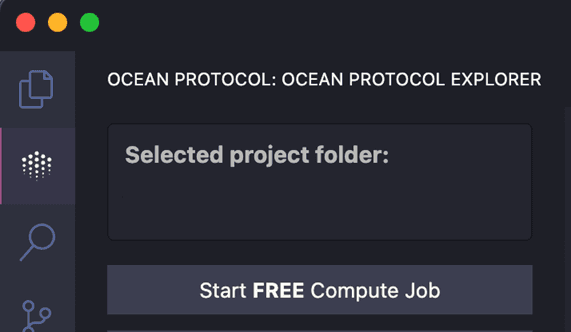
Ocean Protocol has introduced a **Free Compute feature** to their VS Code extension to address image generation failures during rapid scaling. The new feature allows users to: - Start with small, fixed-seed baselines - Lock their settings for consistency - Save both configurations and outputs - Maintain stable, repeatable runs This approach helps developers **experiment and scale at their own pace** while avoiding common pitfalls that occur when scaling too quickly. Users receive **7,200 seconds of free compute time** to test the feature and get started with their projects. The extension continues Ocean's mission to provide seamless AI development tools that combine compute power, privacy, and algorithms directly within developers' preferred IDE environment.
🏛️ European Parliament Speeches Decoded

**CivicLens annotation challenge completed** with 206 contributors analyzing European Parliament speeches for political discourse patterns. **Key achievements:** - Labeled speeches for stance, claims, tone, topic, and ideology - Partnership with @lunor_ai delivered high-quality political data - Results provide insights into political discourse analysis The challenge focused on creating datasets to help AI models detect market-moving political statements more effectively. [Read full details](https://blog.oceanprotocol.com/annotators-hub-civiclens-turning-speeches-into-signals-e27041c3972c)