Institutions Eye Blockchain Infrastructure Ownership as RWA Market Hits $15B
Institutions Eye Blockchain Infrastructure Ownership as RWA Market Hits $15B
🏦 Institutions Ready to Own Blockchain?


The real-world asset (RWA) market has reached $15 billion, demonstrating genuine institutional appetite for onchain settlement.
The focus is shifting from institutions simply using blockchain infrastructure to potentially operating their own networks. These discussions are already underway, with the necessary infrastructure now available.
This evolution follows earlier industry conversations about stablecoin use cases and institutional settlement networks, suggesting a maturation of institutional blockchain adoption beyond basic usage.

$15B in RWAs proves institutional demand for onchain settlement is real. Now the question shifts: when do institutions moving billions graduate from using blockchain to running their own? We're in those conversations now. The infrastructure is ready.

Ethereum’s RWA Market Cap Just Surpassed $15B 📈 Up ~200% year-over-year. This is measurable capital migration. The Ethereum ecosystem has quietly become the primary settlement layer for tokenized real-world assets from treasuries to credit products. $15B in RWAs means: ➠

Ethereum Blob Space at 30% Utilization Creates Builder Opportunity
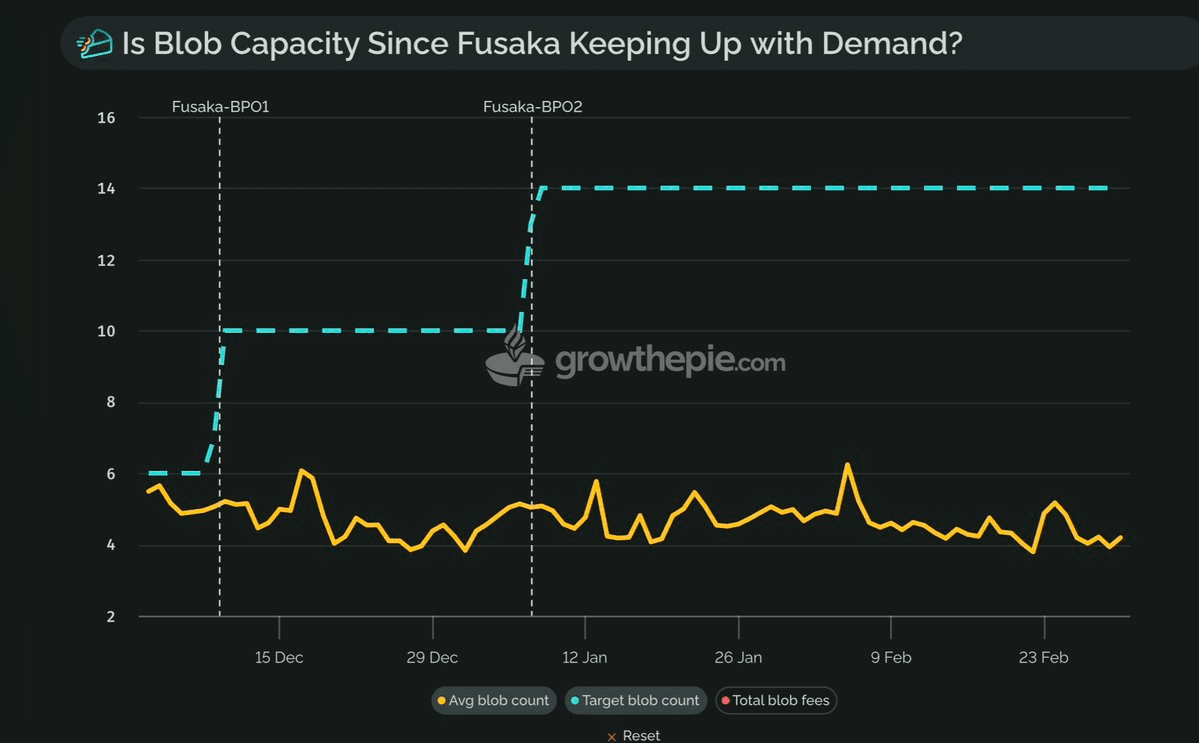
Ethereum's blob space is currently at 30% utilization, leaving significant capacity available for developers. **Key Points:** - 70% of blob space remains unused, creating favorable conditions for launching new chains - Low scaling costs on Ethereum present an opportune moment for builders - OP Stack chains can be deployed with ample headroom for growth The current low utilization indicates that Ethereum's scaling infrastructure has room to accommodate new projects without congestion or high fees.
Why Blockchain Performance Benchmarks Miss the Mark
**Synthetic blockchain benchmarks don't reflect reality**, according to @karl_dot_tech's latest analysis. **Key problems with current testing:** - Metrics are easily manipulated - Generic tests fail specialized chains - Real-world performance differs significantly The issue echoes earlier warnings about misleading TPS claims, where projects tout millions of transactions per second without considering security or decentralization trade-offs. [Watch the full breakdown](link)
ZK Proofs: Unlocking Privacy and Scalability for Users and Institutions
**Zero-knowledge proofs are gaining attention for their practical applications in crypto.** At the Scaling Summit, Succinct Labs discussed how ZK technology addresses real-world needs: - **Privacy**: Transactions remain anonymous while maintaining verification - **Efficiency**: Data compression into cryptographic proofs enables better scalability - **Trust**: Verify data integrity without exposing sensitive information ZK proofs are being implemented across finance, identity management, and voting systems. The technology powers Layer 2 rollups and privacy-focused applications, with projects like Zcash demonstrating renewed interest in the space.
Startale Group and SBI Holdings Launch JPYSC Trust Bank-Backed Stablecoin
**Startale Group and SBI Holdings have launched JPYSC**, a trust bank-backed stablecoin designed to bring more users onchain. **Why it matters:** - Trust bank-backed stablecoins provide critical infrastructure for blockchain adoption - Represents a significant step in Japan's regulated stablecoin ecosystem - Builds on previous collaboration between Chainlink and SBI Group from August 2025 **Background:** This launch follows SBI Group's ongoing efforts to advance tokenized assets and stablecoins in Japan, previously partnering with Chainlink to develop secure, scalable blockchain solutions.