GENIUS Act Shifts Banking Focus from Theory to Implementation
GENIUS Act Shifts Banking Focus from Theory to Implementation
🏦 Banks Ask How


Following the passage of the GENIUS Act, financial institutions have moved beyond theoretical discussions about blockchain technology. Banks are now actively working on practical implementation strategies.
Key Development:
- Conversations with banks have fundamentally changed from "if" to "how" regarding blockchain integration
- Financial institutions are now asking: "How do we actually leverage this technology?"
- The shift represents a concrete move toward onchain finance adoption
This marks a significant milestone in the relationship between traditional finance and decentralized technology, with regulatory clarity enabling real-world deployment.

Since the GENIUS Act passed, conversations with banks and financial institutions shifted from theory to implementation. "How do we actually leverage this technology?" @KashRazzaghi at @ParisBlockWeek
Arc Blockchain Built with Post-Quantum Signatures from Launch
**Existing blockchains face significant challenges** in migrating to post-quantum cryptography due to coordination complexities across their networks. **Arc takes a different approach** - according to @jerallaire, the blockchain is being built with post-quantum signatures integrated from day one, avoiding future migration headaches. **Why this matters:** - Traditional blockchains must coordinate massive network upgrades to implement quantum-resistant cryptography - Migration requires consensus among validators, developers, and users - Arc's native post-quantum design eliminates this coordination problem This follows broader industry trends, with major L1 blockchains ramping up post-quantum security initiatives as quantum computing advances threaten existing signature schemes.
🤖 AI Agents Get USDC Payment Powers

**BlockRun Integrates USDC for AI Agent Payments** Circle Alliance Program member BlockRun is enabling AI agents to make autonomous payments using USDC. The integration uses x402 protocol for discovery and payment settlement. **Key Features:** - AI agents can discover and access services independently - Pay-per-request model using wallet-authenticated USDC - Enables machine-to-machine micropayments This builds on Circle's broader vision of USDC as infrastructure for agentic transactions, including work with Google on Agent2Agent protocols. [Learn more about Circle Alliance Program](https://www.circle.com/alliance-program)
Circle Marks One Year Since NYSE IPO, Eyes Agentic Economy Infrastructure
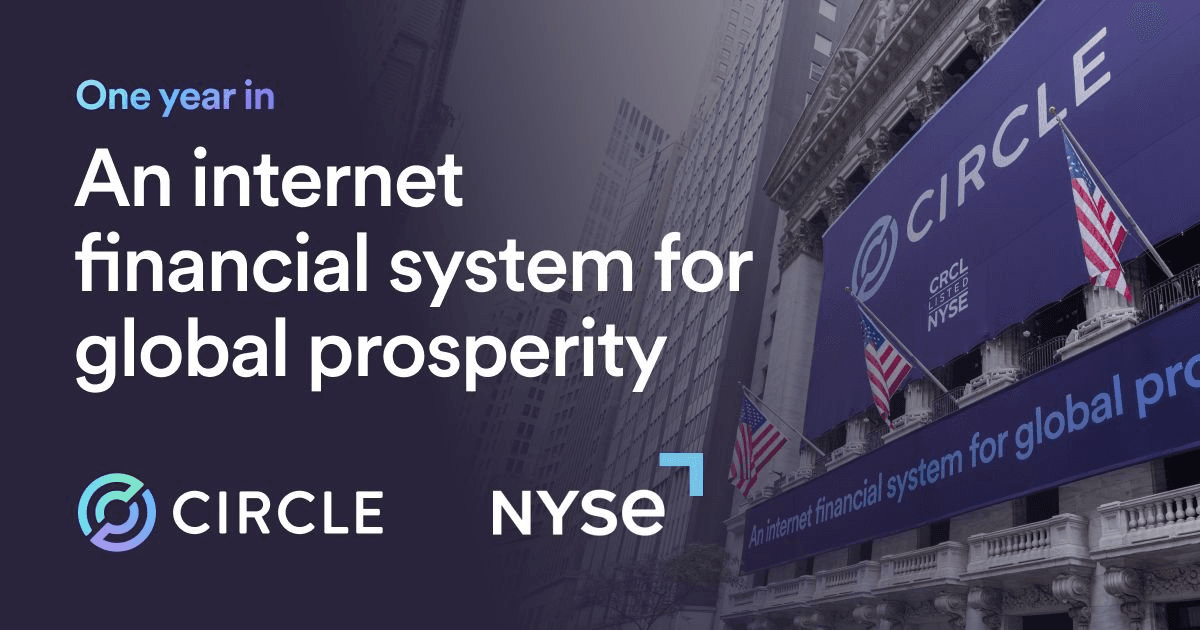
**One Year Post-IPO** Circle celebrated its first anniversary as a publicly traded company on the NYSE, marking June 5, 2025 as a milestone IPO. **Strategic Focus Areas** - Digital dollars and global payments infrastructure - Platform development for the "agentic economy" - Onchain economic coordination at scale for businesses and autonomous agents **Full-Stack Approach** The company continues building what it calls an "internet financial system" through: - Blockchain infrastructure (Arc) - Digital assets (USDC stablecoin) - Applications like Circle Payments Network Circle's vision centers on enabling money to move like information across open networks, positioning stablecoins as critical infrastructure as AI accelerates the shift toward always-on payment systems.
UQPAY Joins Circle Payments Network for Cross-Border Payment Infrastructure
**UQPAY has integrated with Circle Payments Network (CPN)** to strengthen its Global Account infrastructure and streamline cross-border payment operations. **Key capabilities enabled through CPN:** - Multi-market payouts - Foreign exchange execution - Cross-border fund management The integration allows UQPAY to leverage CPN's expanding network of local currency payout corridors across Asia, the Middle East, Europe, and the United States. CPN currently operates through partners in India, Singapore, the Philippines, UAE, EU, and US. The partnership aims to provide businesses with more connected and flexible global money movement solutions through a single network integration.
Circle Launches cirBTC: Institutional Bitcoin Collateral on Ethereum
Circle has launched **cirBTC** on Ethereum, bringing institutional-grade Bitcoin collateral to DeFi markets. The new token offers **1:1 BTC-backed collateral** with the same transparency and infrastructure standards Circle established with USDC. cirBTC aims to serve institutional DeFi markets with neutrality and Circle's proven infrastructure. Circle, a publicly traded stablecoin issuer, positions cirBTC as its wrapped Bitcoin alternative. The company announced that **Arc is next** in their product roadmap.