🚀 Faster... Smoother... Better
🚀 Faster... Smoother... Better
🚀 Faster... Smoother... Better


The ENS App just got a performance boost. Profile data now loads faster thanks to optimized record fetching, making name management feel noticeably smoother.
What changed:
- Profile records are fetched more efficiently
- Viewing name details is quicker
- Managing profiles feels more responsive
This follows recent updates that added Layer 1 primary name management and streamlined subname creation with address pre-population.

The ENS App received several important name management updates. You can now set or reset your primary name directly on Layer 1, and subname creation has been streamlined with address pre-population to reduce manual setup.

Ambire Adds ENS Address Change Detection for Safer Transactions
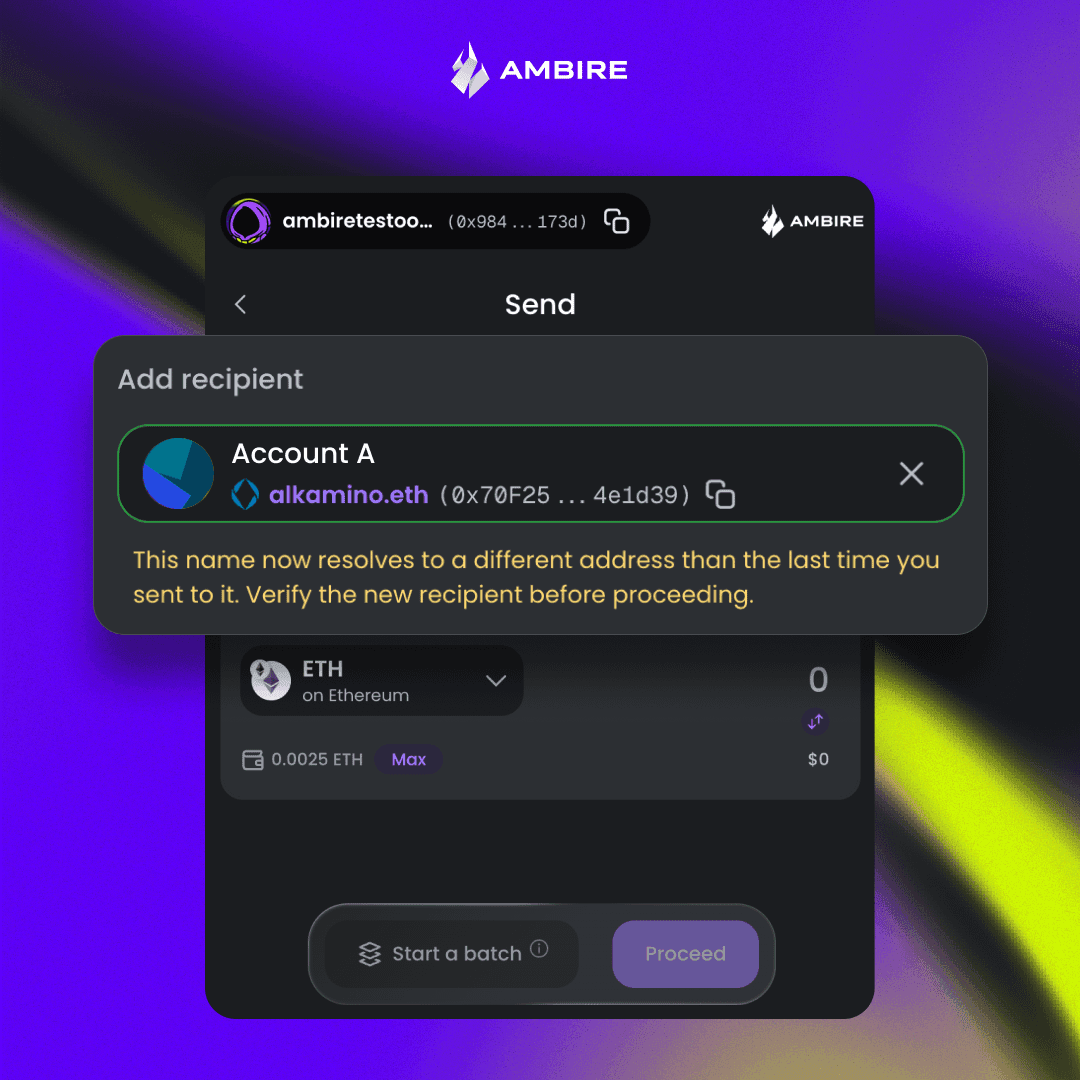
**Ambire** has introduced a new security feature that alerts users when an ENS (Ethereum Name Service) address has changed since their last interaction. **Key Features:** - Notifies users of address changes associated with ENS names - Helps prevent sending funds to unintended recipients - Adds an extra layer of security for ENS-based transactions This update addresses a potential security risk where ENS name ownership could transfer to a different address, potentially leading to misdirected transactions. The feature provides users with confidence when sending value through the platform. [Learn more about the update](https://x.com/ambire/status/2080656789927002540)
ENS DAO Activates New Eight-Member Security Council with Two-Year Veto Authority
ENS DAO has approved a new Security Council that will operate for the next two years. The council consists of eight members with authority to cancel malicious proposals after they pass but before execution. **Key Details:** - Operates through a 5-of-8 multisig structure - Requires at least five members to agree before canceling any proposal - Authority expires after two years unless extended by ENS DAO vote - Designed as a safeguard against malicious governance proposals The activation proposal has now passed, establishing this oversight mechanism for the Ethereum Name Service's decentralized governance. Read the full details about the mandate, safeguards, and council members: [ENS Security Council announcement](https://ens.domains/blog/post/introducing-the-newest-ens-security-council)
ENS Announces Eight New Council Members
The Ethereum Name Service has appointed eight new council members: - **Nick Johnson** (@nicksdjohnson) - **Hudson Jameson** (@hudsonjameson) - **Pablo Sabbatella** (@PabloSabbatella) - **Colton Liberacki** (@Coltron_eth) - **Kevin Gaspar** (@ValidatorETH) - **Alex Van de Sande** (@avsa) - **Griff Green** (@griffgreen) - **Alex Netto** (@alextnetto) The announcement marks a governance expansion for ENS, the Ethereum-based naming system that maps human-readable names to blockchain addresses.
ENSv2 Launches Universal Resolver for Cross-Chain Name Resolution
**ENS is upgrading its resolver system with ENSv2** The Ethereum Name Service is introducing a Universal Resolver - a single smart contract that can resolve names across multiple environments: - ENSv1 names - ENSv2 names - Layer 2 networks - Offchain names via CCIP-Read **What developers need to know:** Applications using ENS should update their libraries to ensure compatibility with the new Universal Resolver. The system uses CCIP-Read protocol to fetch data from L2s and offchain sources. This consolidation simplifies the resolution process by eliminating the need for separate resolvers for different name types and networks. Developers can find implementation details in the [ENSv2 readiness documentation](https://docs.ens.domains/web/ensv2-readiness/). **Action required:** Review your ENS integration and update libraries to support cross-chain resolution.
ENS Launches registerAgentIdentity() for On-Chain Agent Verification
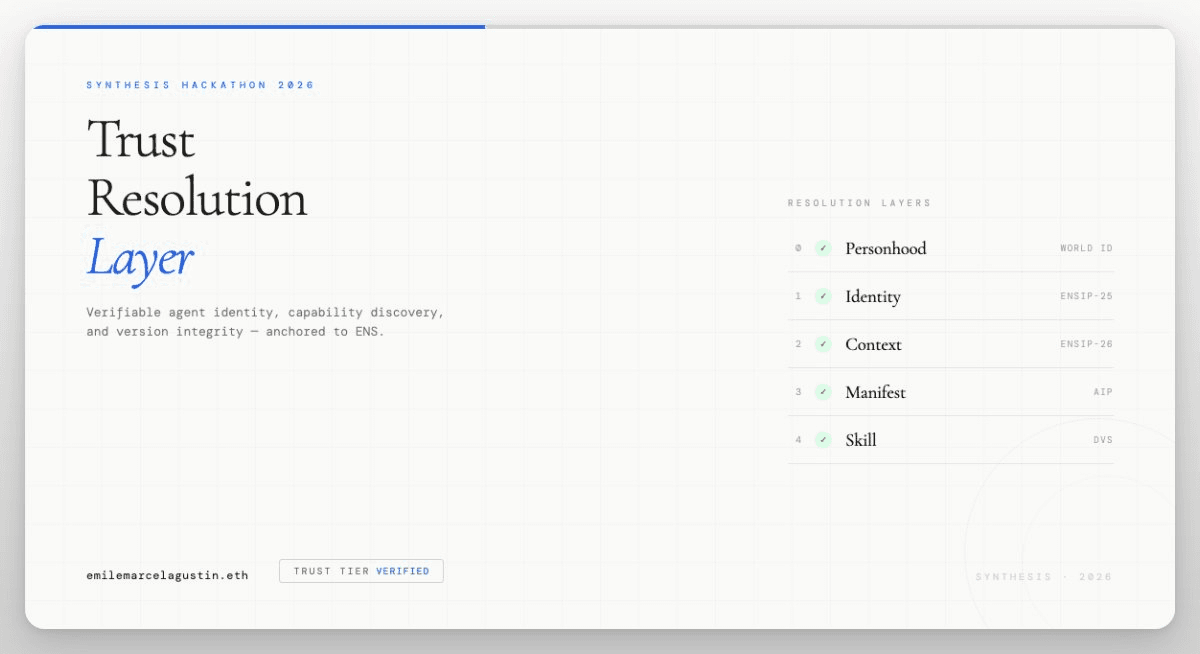
ENS has introduced `registerAgentIdentity()`, a new function that provides AI agents with on-chain identity infrastructure. When called, agents receive: - A human-readable ENS subname - An on-chain passport - Cryptographic proof linking the agent to its owner This builds on ENS's evolving role beyond simple name resolution. The system now supports: - **Arbitrary records** that carry an agent's full trust stack - **Identity scoring** (none, registered, discoverable, verified, full) - **Programmable resolvers** that execute logic like token swaps or privacy routing ENS serves as the accountability layer, transforming raw cryptographic keys into verifiable, human-readable identities. One ENS name can hold everything: identity, discoverability, code integrity, and capabilities. The infrastructure makes agents resolvable and accountable while maintaining the flexibility to chain complex actions through custom resolver logic.