🤝 ERC-8004 Brings Open Identity Standard to Ethereum Mainnet for AI Agents
🤝 ERC-8004 Brings Open Identity Standard to Ethereum Mainnet for AI Agents
🤝 Agents get IDs


ERC-8004 has launched on Ethereum mainnet, establishing a foundation for autonomous agent identity through ENS.
The standard addresses a core infrastructure need: agents require persistent, verifiable identities to function across different systems. ERC-8004 makes agents discoverable, verifiable, and composable within the ENS namespace.
Why this matters:
- Trust frameworks, payment rails (x402), and agent registries can develop independently
- All systems can consistently reference the same agent over time
- Identity becomes shared infrastructure rather than siloed per application
The approach treats identity as foundational layer - similar to how DNS works for the internet, but built on Ethereum's capabilities and constraints.
Read the full technical details: ENS AI Agent ERC-8004

New standards are converging around this assumption: identity is shared infrastructure. Trust frameworks (ERC-8004), payment rails (x402), and agent registries can evolve independently, but they all rely on being able to consistently refer to the same agent over time. Full post
Open agent standards need open identity. ERC-8004 launching on Ethereum mainnet is a big step toward making autonomous agents discoverable, verifiable, and composable across the ENS namespace. 🤝

ERC-8004 is now live on mainnet. 5 months ago, we wrote the specs for the Trustless Agents standard. Since then, over 10k agents registered on testnet. Today, we’re releasing it on Ethereum Mainnet. Welcome to the 8004 Genesis Month. Here’s everything you need to know 👇

ENS Confirms 2026 Launch for ENSv2 with Enhanced L2 Integration
**ENS is moving forward with ENSv2 deployment in 2026**, incorporating key improvements to Layer 2 interoperability and user experience. **Key developments:** - ENSv2 will launch this year as planned, with most engineering resources focused on core features - New architecture enables **cross-chain stablecoin purchases** and single-step registration - L2 integration learnings are being applied to simplify multi-chain functionality for end users **Technical improvements:** - Shift from flat registry to **hierarchical system** where each name has its own registry - Enables flexible ownership models and fine-grained permissions - New ENS Explorer provides full transparency across historical data and ENS versions - Redesigned dashboard offers clearer view of names, settings, and activity **User impact:** - Upgrading to ENSv2 will be simpler than previous migrations - System remains built on Ethereum's decentralized foundation - Enhanced multi-chain support while maintaining backwards compatibility The update represents a significant architectural evolution while preserving ENS's core commitment to decentralization and user control.
🚀 ENS App and Explorer Enter Public Alpha Testing
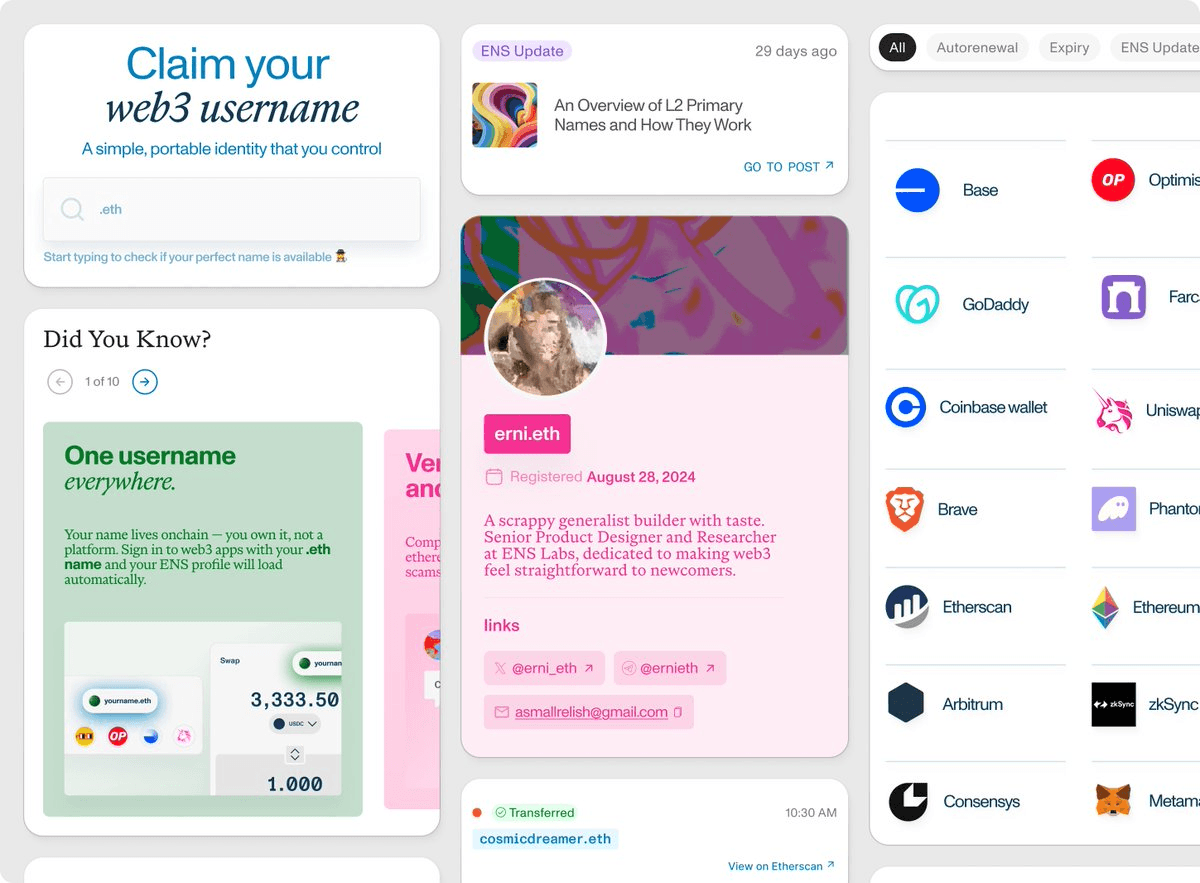
The Ethereum Name Service has launched public alpha versions of two new platforms: - **ENS App** ([app.ens.dev](http://app.ens.dev)): Streamlined interface for everyday users to register names and manage their web3 identity - **ENS Explorer** ([explorer.ens.dev](http://explorer.ens.dev)): Advanced tool for ecosystem builders requiring precise ownership controls These platforms represent ENS's evolution from simple address replacement to comprehensive identity infrastructure for web3. Both tools will officially launch alongside ENSv2. The team conducted in-person user testing at Devconnect in Buenos Aires and is continuing to gather feedback during the alpha phase. **Try the alpha versions today** and help shape the future of web3 identity management.
ENS Commits to Ethereum-Only Deployment for Version 2 Upgrade
**ENS Doubles Down on Ethereum** The Ethereum Name Service has announced that ENSv2 will deploy exclusively on Ethereum, rejecting multi-chain expansion. **Key Points:** - ENSv2 will remain solely on Ethereum's mainnet - The upgrade process for existing names will be simplified compared to previous versions - ENS cites Ethereum's decentralization and security as core reasons for the decision - No plans for deployment on Layer 2s or alternative chains This decision reinforces ENS's commitment to building on what they consider the most secure and decentralized blockchain infrastructure available. The team emphasizes that the upgrade path will be more straightforward for users than past transitions. [Read the full announcement](https://ens.domains/blog/post/ens-staying-on-ethereum)
ENS App Now Includes Built-in Expiration Notifications
The ENS Manager app has introduced a highly anticipated feature: **built-in expiration notifications**. **Key Features:** - Set up reminders through multiple channels: email, Telegram, or browser notifications - Never lose your ENS domain to accidental expiry - Notifications work directly within the app at [app.ens.domains](http://app.ens.domains) **Additional Context:** This builds on existing ENS Manager features, including the ability to register and extend names by selecting exact expiration dates for more precise domain control. The notification system addresses a common pain point for ENS users who may forget renewal dates and risk losing valuable domain names.
ENS Prepares for v2 Launch with Universal Resolver Updates
**ENS is gearing up for its v2 launch** by requiring developers to update their libraries and applications. Key requirements for ENSv2 readiness: - Update ENS libraries to latest versions - Ensure apps resolve names via **CCIP-Read protocol** - Verify **L2 compatibility** for name resolution - Implement Universal Resolver support The Universal Resolver serves as the foundation for ENSv2, enabling cross-chain name resolution and improved functionality. **Why this matters:** ENSv2 represents a significant upgrade to Ethereum's naming infrastructure, expanding beyond simple address mapping to comprehensive web3 identity management. Developers should review the [ENSv2 readiness documentation](https://docs.ens.domains/web/ensv2-readiness/) and test their applications now to ensure seamless transition. *Action needed: Update your ENS integrations before the v2 launch to avoid service disruptions.*