ENS Dominates ETHPrague: 45% of Projects Built on Naming Protocol
ENS Dominates ETHPrague: 45% of Projects Built on Naming Protocol
🏆 45% chose ENS


ETHPrague Results
ETHPrague concluded with 64 projects delivered over the weekend. ENS integration reached a new high:
- 29 projects built on ENS (45% of all submissions)
- 4 teams won prizes across two ENS-specific tracks
This follows ETHGlobal Open Agents the previous week, where 177 of 468 projects (38%) integrated ENS.
What This Means
The increasing adoption rate—from 38% to 45%—shows developers are prioritizing human-readable naming in their applications. ENS provides the infrastructure for mapping readable names like 'alice.eth' to blockchain addresses and other identifiers.
The protocol's presence at consecutive hackathons demonstrates its position as essential infrastructure for Ethereum development.

ETHPrague wrapped this weekend. 64 projects shipped. 29 built on ENS, over 45% of the hackathon. Four teams won across our two ENS prize tracks ↓

ETHGlobal Open Agents wrapped this weekend. 468 projects shipped. 177 built on ENS, nearly 38% of the hackathon. Six teams won across our two ENS prize tracks ↓

ENSv2 Introduces Shared Registries for Scalable Namespace Management
**ENSv2 brings a major architectural shift to namespace scalability.** Instead of requiring each ENS name to maintain its own isolated registry setup, the new version allows registries to be shared across multiple identities. **Key improvement:** - Shared registries reduce overhead and enable more efficient namespace management at scale - Builds on ENSv2's hierarchical architecture where names are structured systems rather than single entries **Context:** This follows ENSv2's move from a flat registry model to a hierarchical system of linked registries. The upgrade maintains backward compatibility with existing subnames, CCIP-Read names, and imported DNS names while introducing more powerful permissioning and delegation capabilities. The change supports ENS's evolution from a niche crypto tool to infrastructure serving millions of names across ecosystems, wallets, and applications. [Learn more about ENSv2's architecture](https://ens.domains/blog/post/names-are-no-longer-single-objects)
🏆 ETHesis Wins Runner-Up for AI Agent Integration with Onchain Research Funding
**ETHesis** secured second place in the Best ENS Integration for AI Agents category at a recent competition. The project addresses research funding transparency by enabling: - Researchers to launch **tokenized research ventures** - Communities to **fund projects directly onchain** - Autonomous auditor agents to **verify milestone completion** through ENS-linked attestations ETHesis joins a growing ecosystem of ENS-native AI agent projects, including first-place winner **ACL** (which uses ENS for agentic commerce discovery) and **Siren** (third place, focusing on ENS identity verification). The competition highlighted diverse use cases: from **EthTwin's** voice-first crypto interface to **Brainpedia's** knowledge network and **ENSign's** passkey-controlled smart accounts—all leveraging ENS as core infrastructure for agent coordination and identity.
ENS Splits Into Two Apps: Management and Protocol Explorer
**ENS launches dual-app architecture with ENSv2** The Ethereum Name Service has restructured its interface into two separate applications, both currently in alpha testing on Sepolia: - **App**: Handles name management and user experience - **Explorer**: Provides deeper protocol-level visibility and data The original ENS application remains functional during the transition. This split architecture becomes possible through ENSv2, which enables the new dual-app experience. Both applications are accepting user testing and feedback on the Sepolia testnet before mainnet deployment.
ENS Launches registerAgentIdentity() for On-Chain Agent Verification
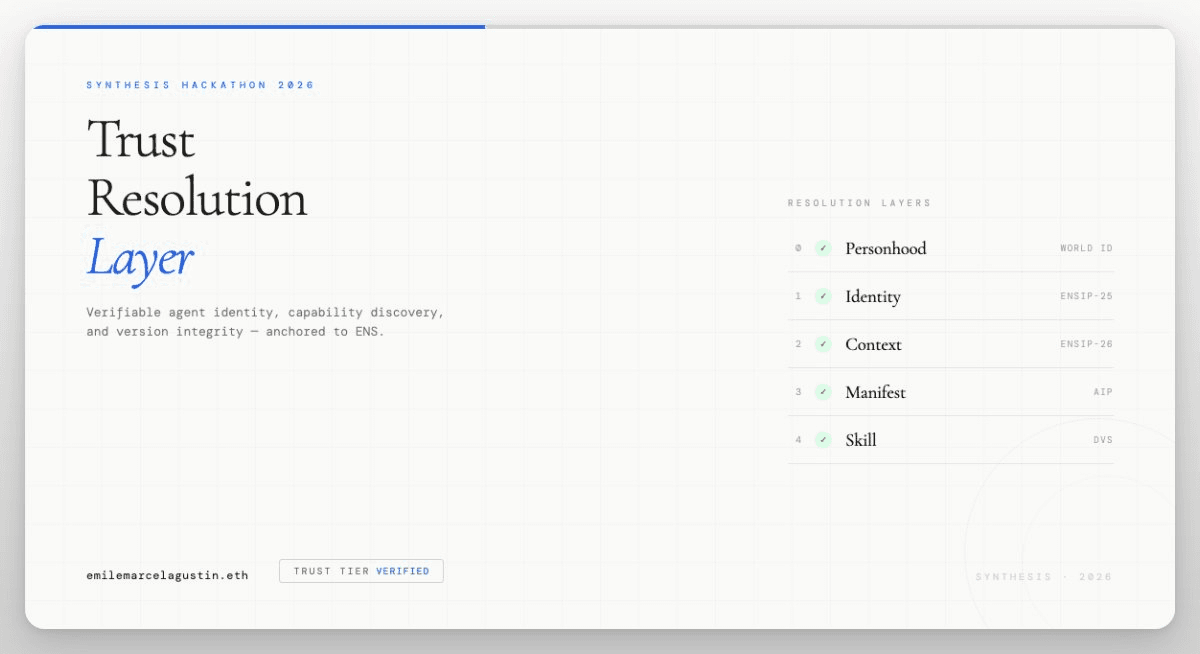
ENS has introduced `registerAgentIdentity()`, a new function that provides AI agents with on-chain identity infrastructure. When called, agents receive: - A human-readable ENS subname - An on-chain passport - Cryptographic proof linking the agent to its owner This builds on ENS's evolving role beyond simple name resolution. The system now supports: - **Arbitrary records** that carry an agent's full trust stack - **Identity scoring** (none, registered, discoverable, verified, full) - **Programmable resolvers** that execute logic like token swaps or privacy routing ENS serves as the accountability layer, transforming raw cryptographic keys into verifiable, human-readable identities. One ENS name can hold everything: identity, discoverability, code integrity, and capabilities. The infrastructure makes agents resolvable and accountable while maintaining the flexibility to chain complex actions through custom resolver logic.