🎪 Devconnect Attendees Get worldfair.eth Subnames
🎪 Devconnect Attendees Get worldfair.eth Subnames
🎪 Devconnect's Digital Identity


Devconnect Buenos Aires introduced a new feature for attendees - worldfair.eth subnames distributed through the official event app.
Key Features:
- Personalized avatars and addresses
- Social metadata integration
- Available to all event participants
Future Plans: The Ethereum Foundation plans to iterate and expand this naming system for upcoming Ethereum events.
This marks the first implementation of event-specific ENS subnames at a major Ethereum conference, potentially setting a new standard for digital identity at blockchain gatherings.
Learn more about the initiative on the EF Devcon Twitter

Every Devconnect attendee was eligible to receive a worldfair.eth subname through the event app, with avatars, addresses, and social metadata. We’re excited to work with the EF to iterate on this for future Ethereum events. x.com/EFDevcon/statu…

Everyone gets their Devconnect username thanks to @ensdomains. Your own worldfair.eth subname. You’ll see it in the app, and you can make it yours: add an address, avatar, socials, whatever you want. ENS provides your onchain identity for the World’s Fair.


🏗️ ENS Evolves Beyond NFTs: Hierarchical Registries and Role-Based Ownership
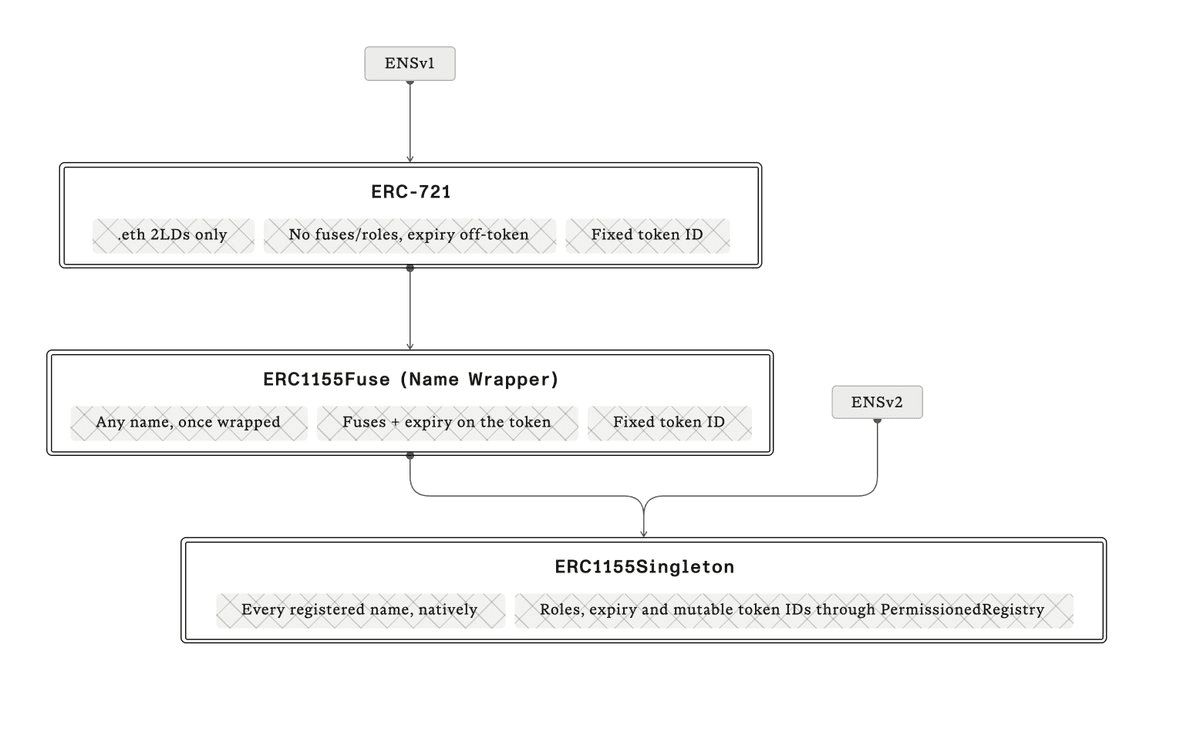
ENS is fundamentally restructuring how domain ownership works with ENSv2. The system moves beyond simple NFT representation to embed ownership, roles, and expiry directly into the registry. **Key changes:** - ENSv1 used ERC721 for .eth names - Name Wrapper introduced ERC1155 with fuses - ENSv2 implements ERC1155Singleton with hierarchical registries The shift reflects a deeper architectural change: names are no longer single entries but structured systems with linked components. Instead of one flat registry, ENSv2 uses hierarchical registries that mirror the hierarchical nature of domain names themselves. This allows for more expressive ownership and delegation while infrastructure layers abstract the complexity for users. Each name maintains one unique owner, but the underlying protocol now supports more nuanced rights and roles. [Read the full technical breakdown](https://ens.domains/blog/post/how-ens-names-evolved)
ENSv2 Launches Universal Resolver for Cross-Chain Name Resolution
**ENS is upgrading its resolver system with ENSv2** The Ethereum Name Service is introducing a Universal Resolver - a single smart contract that can resolve names across multiple environments: - ENSv1 names - ENSv2 names - Layer 2 networks - Offchain names via CCIP-Read **What developers need to know:** Applications using ENS should update their libraries to ensure compatibility with the new Universal Resolver. The system uses CCIP-Read protocol to fetch data from L2s and offchain sources. This consolidation simplifies the resolution process by eliminating the need for separate resolvers for different name types and networks. Developers can find implementation details in the [ENSv2 readiness documentation](https://docs.ens.domains/web/ensv2-readiness/). **Action required:** Review your ENS integration and update libraries to support cross-chain resolution.
ENS Launches registerAgentIdentity() for On-Chain Agent Verification
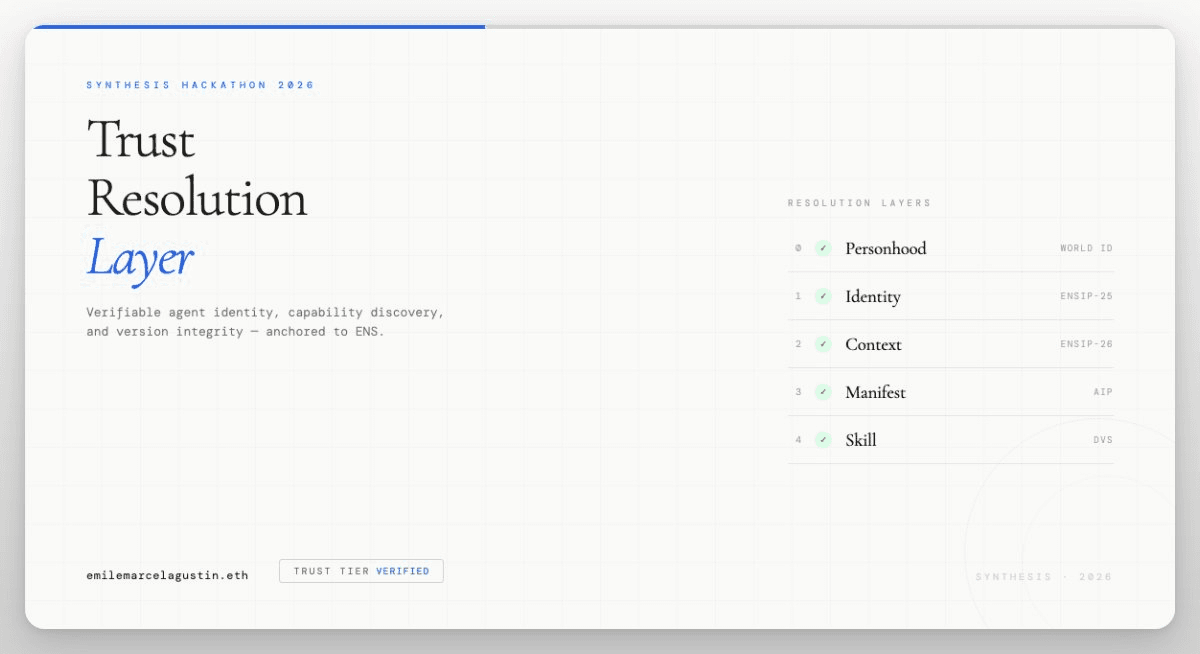
ENS has introduced `registerAgentIdentity()`, a new function that provides AI agents with on-chain identity infrastructure. When called, agents receive: - A human-readable ENS subname - An on-chain passport - Cryptographic proof linking the agent to its owner This builds on ENS's evolving role beyond simple name resolution. The system now supports: - **Arbitrary records** that carry an agent's full trust stack - **Identity scoring** (none, registered, discoverable, verified, full) - **Programmable resolvers** that execute logic like token swaps or privacy routing ENS serves as the accountability layer, transforming raw cryptographic keys into verifiable, human-readable identities. One ENS name can hold everything: identity, discoverability, code integrity, and capabilities. The infrastructure makes agents resolvable and accountable while maintaining the flexibility to chain complex actions through custom resolver logic.
🏆 Trust Resolution Layer Wins First Place for Verifiable Agent Identity
A **Trust Resolution Layer (TRL)** has taken first place for establishing verifiable AI agent identity through ENS. The system combines multiple components: - World ID verification - ENSIP-25 agent registration standard - ENSIP-26 context records - Novel AIP manifest system These elements work together to create a **progressive 5-tier trust scoring system** for autonomous agents. This infrastructure addresses a critical need as AI agents increasingly sign transactions, hold assets, and interact with blockchain protocols. The TRL builds on ENSIP-25, which introduced standardized verification that an onchain-registered AI agent is genuinely associated with an ENS name. The solution provides essential identity infrastructure for the growing ecosystem of autonomous agents operating in web3.
ENS Releases Alpha Log #5 with Reliability and Usability Updates
The Ethereum Name Service has published its fifth alpha development log for ENSv2, detailing continued improvements to the App and Explorer on the Sepolia testnet. **Key Updates:** - Focus on reliability, flexibility, and overall usability enhancements - Builds on previous fixes including transaction modal layouts and Fuses page improvements - Ongoing polish to search functionality, profiles, notifications, and name management features The ENSv2 testing phase continues on Sepolia as the team iterates on the user experience before mainnet deployment. More updates are expected in upcoming alpha logs.