🇵🇭 Circle Opens Philippines Corridor via Coins.ph on Payment Network
🇵🇭 Circle Opens Philippines Corridor via Coins.ph on Payment Network
🇵🇭 Philippines corridor unlocked


Circle Payments Network (CPN) has activated Philippines payouts through Coins.ph, enabling PHP settlements via InstaPay for real-time transfers and local partner banks.
Key features:
- Direct PHP payouts through trusted local rails
- Real-time settlement via InstaPay
- Reduced dependency on correspondent banking
- Single integration for compliant, high-volume transactions
This expansion connects global stablecoin settlement infrastructure to the Philippine market, following recent CPN additions including Hecto (Korea), VelaFi (Asia/US/LatAm), and Saber (EU/India).

Welcome Hecto to Circle Payments Network (CPN)! Hecto has joined CPN to offer compliant, stablecoin-powered fiat payouts for global enterprises, enabling efficient money movement from Korea into overseas markets. This expands their ability to power: → International enterprise

Welcome @Velafi_global to Circle Payments Network (CPN)! VelaFi has joined CPN, enabling real-time, regulation-aligned settlement with payment stablecoins like @USDC and EURC across key global corridors. This unlocks faster, more efficient cross-border flows for: → Enterprise

Now open on Circle Payments Network (CPN): EU and India payouts with @Sabermoney Saber expands CPN coverage across key corridors, connecting stablecoins to local payment rails in Europe and India. → EU (EUR via SEPA) for local euro settlement → India (INR via IMPS, RTGS,

Now open on Circle Payments Network (CPN): Philippines payouts with @coinsph Coinsph is now live on CPN, enabling PHP payouts via trusted local rails. → PHP settlement via InstaPay (real-time) and local partner banks → Reduced reliance on correspondent banking → One

Stablecoins: Crypto's Most Powerful Use Case
Circle's Nikhil Chandhok discusses why stablecoins represent cryptocurrency's most compelling application in a recent podcast episode. **Key Points:** - Stablecoins are gaining mainstream adoption - They offer practical utility beyond speculative trading - Circle positions stablecoins as the bridge between traditional finance and crypto The conversation highlights how stablecoins solve real-world problems by combining blockchain technology with price stability, making them accessible for everyday transactions and cross-border payments.
Sproutly uses blockchain to verify carbon offset claims with USDC settlements
Sproutly is addressing transparency issues in carbon offsetting by recording environmental impact data on blockchain networks. The platform replaces traditional opaque reporting systems with verifiable onchain proof. **Key features:** - Environmental impact recorded directly onchain - USDC used for settlements to maintain predictable value - Aims to accelerate climate funding through greater accountability The approach allows climate finance participants to verify claims rather than relying on self-reported data. By using USDC for transactions, the platform maintains stable settlement values without cryptocurrency volatility. Sproutly previously partnered with TaskOn to enable users to stake and earn rewards tied to real-world carbon capture through tree planting initiatives. [Read more](https://www.circle.com/blog/sproutly-enables-transparent-refi-and-carbon-offsetting-with-usdc)
Circle Partners with Polymarket to Power Prediction Market Infrastructure
Circle has partnered with Polymarket, the world's largest prediction market platform, to provide stablecoin infrastructure for onchain financial markets. **Key Partnership Focus Areas:** - Transparent, fully-reserved stablecoin infrastructure for prediction markets - Improved settlement reliability and reduced friction at scale - Strengthened confidence as participation and liquidity expand The collaboration positions **USDC and Circle's infrastructure** as foundational rails for the evolution of prediction markets. As these platforms mature into information-driven financial tools, the partnership aims to support more robust and scalable onchain market operations. This move represents a step toward institutional-grade infrastructure for decentralized prediction markets. [Read full announcement](http://www.circle.com/pressroom/circle-and-polymarket-partner-to-strengthen-onchain-financial-markets)
Stablecoins Cut Humanitarian Aid Delivery from Weeks to Minutes
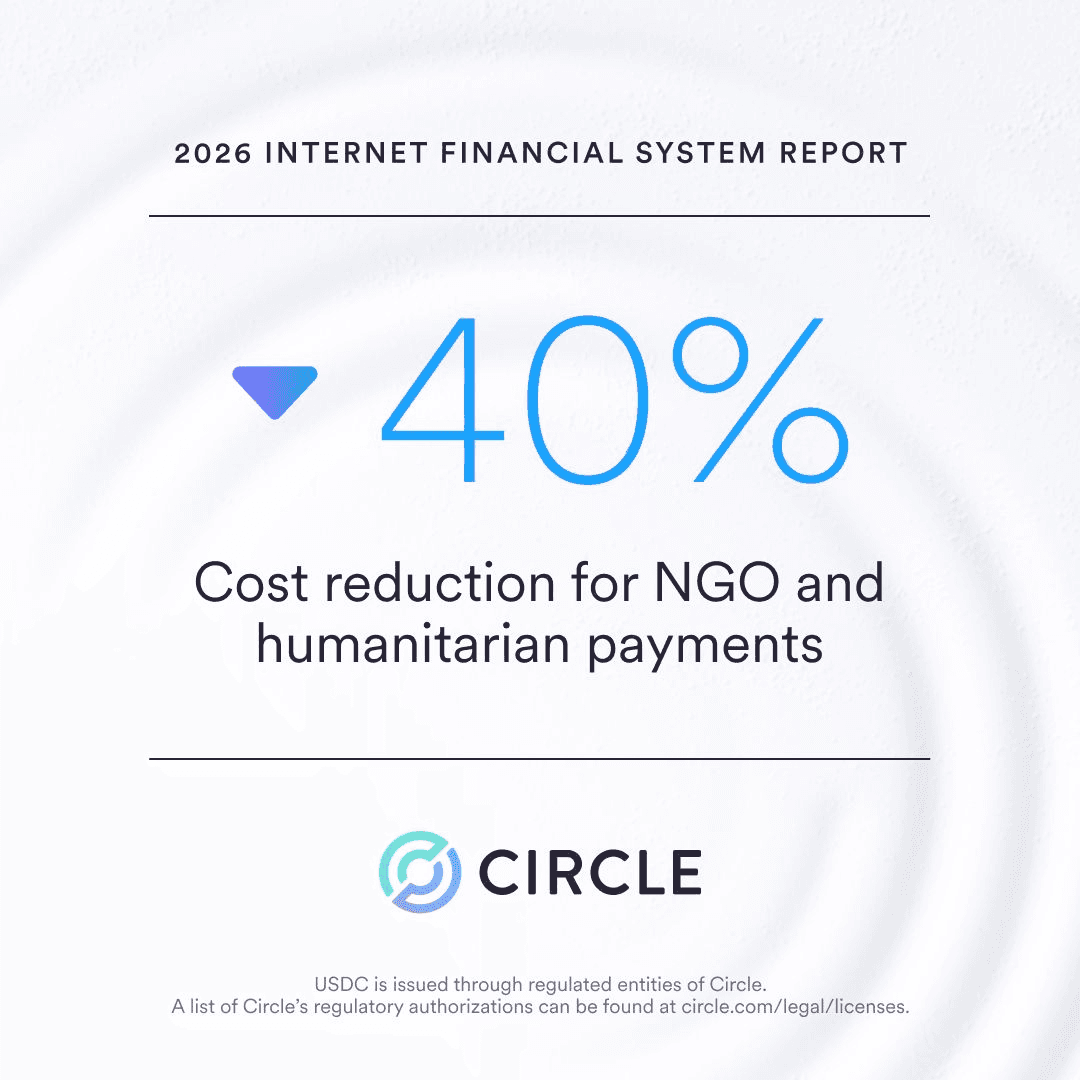
Regulated stablecoins like USDC are changing how humanitarian organizations deliver aid. Traditional financial systems can take weeks to process payments, but stablecoin-based disbursements now happen in minutes. The shift brings three key improvements: - **Faster delivery**: Aid reaches recipients in minutes instead of weeks - **Greater transparency**: Organizations can track funds in real-time - **Better accountability**: Blockchain records provide clear audit trails Circle's report examines how this infrastructure supports both emergency relief and long-term humanitarian programs. The technology addresses a fundamental problem: people in crisis can't wait for slow banking systems. [Read the full report](https://circle.com/reports/internet-financial-system)
The Stablecoin Era Arrives on Open Infrastructure
The stablecoin era has arrived, built on open and programmable infrastructure rather than centralized systems. **Key shift:** - Stablecoins combine fiat stability with blockchain transparency - Infrastructure is open and programmable, not controlled by central authorities - Represents a move from trust-based fiat systems to code-based reliability This marks a transition from traditional fiat currencies—which depend on centralized institutions—to stablecoins that offer stability while maintaining the clarity and freedom of blockchain technology.