Blockchain Tokenization: A New Era in Asset Management
Blockchain Tokenization: A New Era in Asset Management
🔐 Blockchain's financial revolution?

On June 20, 2024, the financial sector witnessed a significant development in blockchain technology. Tokenization on the blockchain has emerged as a novel approach to asset management, offering enhanced uptime and transparency. This advancement is being viewed as a clear indication of blockchain's potential to transform traditional financial systems. The new paradigm is expected to bring about substantial changes in how assets are managed, traded, and secured in the digital age.

Tokenization on the blockchain presents a new paradigm for asset management, promising unparalleled uptime and transparency. A testament to the potential of blockchain technology in revolutionizing finance. 🔒💼 politico.com/newsletters/mo…
Finance Moves Onchain When Infrastructure Works, Not When Asked Nicely
The migration of traditional finance to blockchain isn't happening because of advocacy or requests—it's happening because the underlying infrastructure has finally matured to support it. **Key Reality Check:** - Onchain adoption follows capability, not persuasion - Infrastructure readiness is the actual catalyst for financial migration - The shift represents a practical evolution rather than ideological movement This marks a turning point where blockchain technology has developed the reliability and functionality needed for serious financial applications, moving beyond promises to proven systems.
Private Credit Goes Onchain: Breaking Down Traditional Market Barriers
**Private markets are shifting onchain, fundamentally changing access patterns.** Traditionally, private market participation required: - Strong professional networks - Geographic proximity to financial centers - Significant capital reserves **DeFi infrastructure challenges these gatekeeping mechanisms** by enabling: - Borderless market access - Reduced minimum investment thresholds - Transparent, permissionless participation When private credit instruments move onchain, they inherit blockchain's global accessibility by design. This represents a structural shift from relationship-based to protocol-based market access.
Goldfinch Prime Connects Major Asset Managers Apollo, Ares, and Golub to Blockchain
**Goldfinch Prime** has established connections with leading asset management firms including **Apollo**, **Ares**, and **Golub** through stablecoins and smart contracts. The platform enables blockchain access to private credit funds that collectively manage **over $1 trillion** in assets. This integration brings institutional-grade investment exposure to decentralized finance. - Major asset managers now accessible through single blockchain platform - Smart contract infrastructure facilitates stablecoin transactions - Represents significant step toward mainstream institutional DeFi adoption The development marks a notable bridge between traditional finance and blockchain technology, offering users exposure to established investment managers through decentralized protocols.
Goldfinch Prime Launches Institutional-Grade Private Credit Access
Goldfinch Prime introduces a new DeFi product offering exposure to elite private credit managers including Apollo, Ares, and Blackrock HPS. The platform democratizes access to institutional-grade private credit investments by: - Removing traditional barriers like high capital minimums - Eliminating lengthy lockup periods - Providing broad diversification across top-tier managers This development represents a significant step in making institutional-quality investments accessible through DeFi infrastructure. Learn more: [CoinDesk coverage](https://www.coindesk.com/sponsored-content/goldfinch-prime-a-new-leader-in-the-emerging-rwa-opportunity)
Monroe Capital Launches Income Plus Fund on Goldfinch Prime
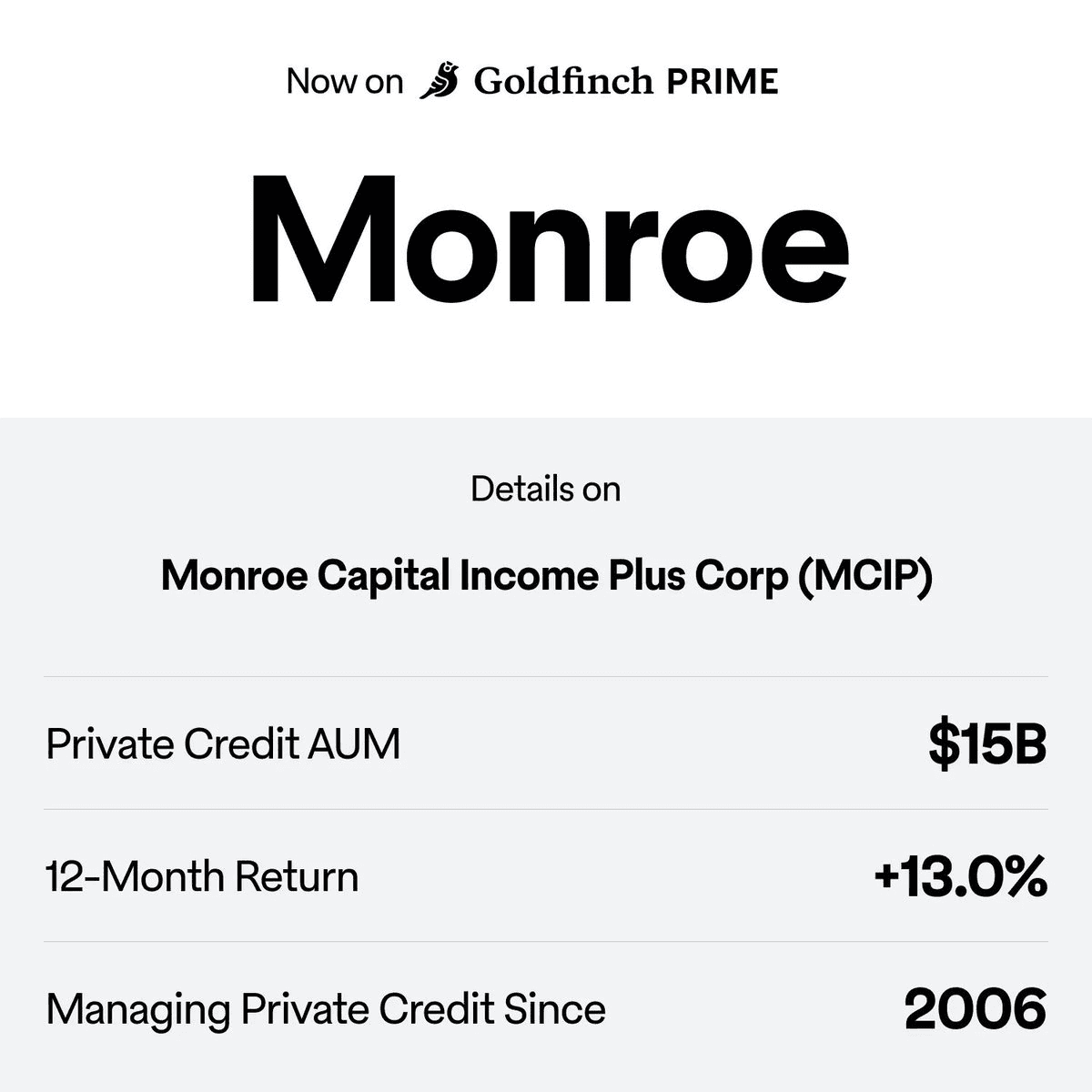
Monroe Capital has introduced a new onchain private credit fund targeting smaller U.S. and Canadian businesses. The Income Plus Fund joins TPG's Twin Brook Capital on the Goldfinch Prime platform. Key features: - Conservative, risk-aware lending approach - Focus on lower middle market companies - Available through Goldfinch Prime platform The fund aims to provide resilient returns through selective lending to established businesses in North America. This launch expands Goldfinch's growing portfolio of institutional-grade private credit offerings.