Arbitrum Reaches Milestone as First Layer 2 to Surpass $150B in Swap Volume
Arbitrum Reaches Milestone as First Layer 2 to Surpass $150B in Swap Volume
🚀 Scaling New Heights


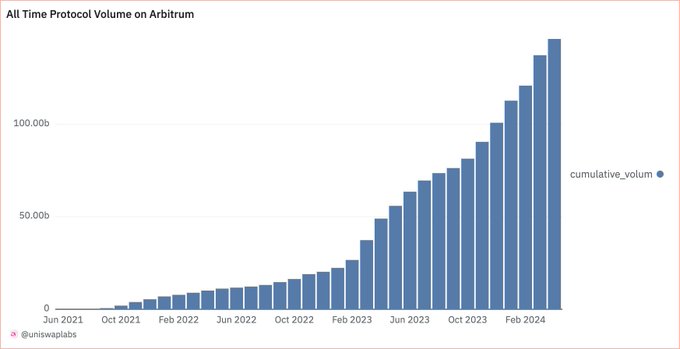
Arbitrum, a layer 2 scaling solution for Ethereum, has officially become the first of its kind to exceed $150 billion in swap volume. This significant achievement highlights the growing adoption and utilization of layer 2 technologies aimed at enhancing the scalability and efficiency of the Ethereum network. Arbitrum's milestone comes after anticipation built up in late April when it was on the cusp of reaching this swap volume milestone.

It’s official: Arbitrum is the first L2 to pass $150B in swap volume 🔷

Arbitrum is about to be the first L2 to pass 150B in swap volume 👀
Uniswap Processes $250M in Stock Token Volume on Robinhood Chain
Uniswap has processed **$250 million in stock token volume** on Robinhood Chain, marking a significant milestone for tokenized real-world assets. The integration makes Uniswap the **primary public automated market maker (AMM)** on Robinhood Chain, which launched earlier this month. The protocol supports trading, liquidity provision, and token auctions through its v4 platform. **Key features now available:** - Fully onchain token auctions via Uniswap Auctions - Trading access through Uniswap Web App, Wallet, and API - Integration with UniswapX for improved execution - AI Skills coming soon for developers and agents The partnership brings together Robinhood's traditional finance accessibility with Uniswap's decentralized market infrastructure, creating a convergence point for real-world asset trading onchain.
Uniswap V4 Launches Permissioned Pools for Regulated Assets
Uniswap has introduced **Permissioned Pools** on V4, enabling compliant trading of regulated assets like tokenized funds and securities on automated market makers (AMMs). **Key features:** - Protocol-level compliance checks using V4's unique hooks and virtual accounting - Allows issuers to access AMM liquidity while meeting regulatory requirements - Enables eligible investors to trade previously restricted assets directly onchain Developed with partners including Superstate, Securitize, and Dowgo. [Read full announcement](https://blog.uniswap.org/introducing-permissioned-pools-on-uniswap-v4?utm_medium=social&utm_source=tw&utm_campaign=permissioned-pools-202607) | [Developer docs](https://developers.uniswap.org/docs/protocols/v4/permissioned-pools/overview?utm_medium=social&utm_source=tw&utm_campaign=permissioned-pools-202607)
Uniswap Releases DualPool Hook Developer Documentation
Uniswap has published developer documentation for its DualPool hook, now available for implementation. **Key Features:** - Allows liquidity providers to earn on both active and idle assets - Developed in collaboration with Spark Finance - Audited and open source **How It Works:** - Deployers park assets in an ERC-4626 vault - Hook pulls liquidity when swaps occur - Funds return within the same block Teams can now deploy their own DualPool hooks using the available documentation at [developers.uniswap.org](http://developers.uniswap.org/docs/protocols/v4/dualpool/overview).
🏦 Spark Launches Stablecoin FX Layer
**Spark is building a Stablecoin FX Layer on Uniswap v4** to address liquidity fragmentation as banks and fintechs launch their own stablecoins. **Key developments:** - Spark migrated $150M in liquidity to Uniswap v4, one of DeFi's largest migrations - Initial pools include USDS/PYUSD and USDS/USDT - The infrastructure allows stablecoins to access shared liquidity instead of isolated pools - Liquidity will move to Spark's new DualPool hook to earn on both active and idle assets **Context:** Fidelity recently chose Uniswap as its liquidity layer for $FIDD stablecoin pools. The FX Layer aims to create shared infrastructure for the growing number of institutional stablecoins entering the market. [Learn more about the Stablecoin FX Layer](https://paragraph.com/@spark-11/spark-uniswap-and-sky-building-the-fx-layer-for-stablecoins?referrer=0xA45F1D29943D19dff604133287047a35ccbADc8a)
Uniswap Launches Tokenized Securities Trading
Uniswap has introduced tokenized securities trading across its product suite, marking a significant expansion into regulated financial instruments. **Key Details:** - Tokenized securities are now available on Uniswap platforms - Geographic restrictions apply to certain jurisdictions - This follows Uniswap's earlier announcement about token auctions coming to the web app The move represents Uniswap's push into traditional finance territory, bringing real-world assets onto decentralized exchanges. Users should verify their jurisdiction's eligibility before trading these instruments. [Read the full announcement](https://blog.uniswap.org/tokenized-securities-are-live?utm_source=tw&utm_medium=social&utm_campaign=tokenized-securities-gtm)