🤖 Agents Pay Their Own Bills
🤖 Agents Pay Their Own Bills
🤖 Agents got wallets


AI agents can now pay for services automatically using USDC — no human intervention, no credit cards, no sign-up forms.
Circle's Agent Stack enables autonomous agents to:
- Hold their own wallets and manage budgets
- Discover and pay for services they need (like voice calls or APIs)
- Complete transactions for as little as $0.007 USDC
- Continue workflows without breaking at paywalls
At the AI Agents Summit Berlin hackathon, developers built 25 projects demonstrating this "agentic economy" in action:
- Proprietor: An agent-run business that earns revenue, pays suppliers, and manages margins
- BytomicProxy: Pay-per-request API access for agents
- 402Cards: Agents buying physical items on mainnet
- giftr: Local marketplace where agents browse and purchase gifts
The pattern is clear: agents are evolving from generating text to completing actual work — researching prospects, placing calls, paying for resources, and returning receipts.
Circle also supports x401, a new protocol for verified identity in agent transactions, complementing x402 for payments.

At @AIAgentsSummit Berlin, developers built with Circle Agent Stack and explored what the agentic economy can look like in practice. We saw agents that could hold wallets, manage budgets, discover paid services, pay in USDC, and return receipts as part of the work they


An agent needs a paid service to complete a task. It pays 0.007 USDC and continues automatically. No sign-up flow. No card. No workflow breaking at the paywall. Just USDC. Powered by Circle Agent Stack: circle.com/agent-stack

The agentic economy needs open standards for both payment and identity. Circle is proud to support @proof's launch of x401, an open protocol for verified identity in the agentic economy. x402 answers how an agent pays. x401 answers who authorized the action.
An agent researches a prospect, prepares the call context, pays for a voice call, and drafts the follow-up. One workflow. Multiple services. Paid for directly in USDC. The whole thing costs about $1.08. This is what the agentic economy starts to look like when agents can

Circle Agent Stack helps developers build agents that can do more than generate text. In this guide, an agent uses Circle Agent Wallet to: → Find a paid voice-call service → Pay for the resources it needs in USDC → Place the call → Return a transcript, recording URL, and

An agent needs a paid service to complete a task. It pays 0.007 USDC and continues automatically. No sign-up flow. No card. No workflow breaking at the paywall. Just USDC. Powered by Circle Agent Stack: agents.circle.com

Circle is supporting builders in Berlin at the @AIAgentsSummit Hackathon. The challenge: build the Best Agent Wallet Application with Circle Agent Stack and Wallet. We’re looking for agents that can hold a wallet, manage a budget, discover paid services, pay in USDC, and return
Circle Emphasizes Redemption Rights as Core USDC Principle at BIS Meeting
At the Bank for International Settlements Annual General Meeting, Circle's Dante Disparte outlined the company's fundamental approach to USDC: **treating issuance as a privilege and redemption as a right**. This philosophy now underpins Circle's payment infrastructure serving over 180 countries. **Key Context:** - Circle recently launched Stablecoin Payouts through Circle Mint France - European partners can now send USDC and EURC payouts via a single API integration - Supported use cases include merchant settlements, supplier payments, platform disbursements, cross-border B2B transactions, and creator payouts The redemption-first principle represents Circle's commitment to maintaining trust in stablecoin infrastructure, ensuring users can always convert their digital assets back to fiat currency. Learn more about Circle Mint France: [circle.com/blog/stablecoin-payouts-now-available-through-circle-mint-france](http://www.circle.com/blog/stablecoin-payouts-now-available-through-circle-mint-france)
Circle Simplifies Token Integration for Developers
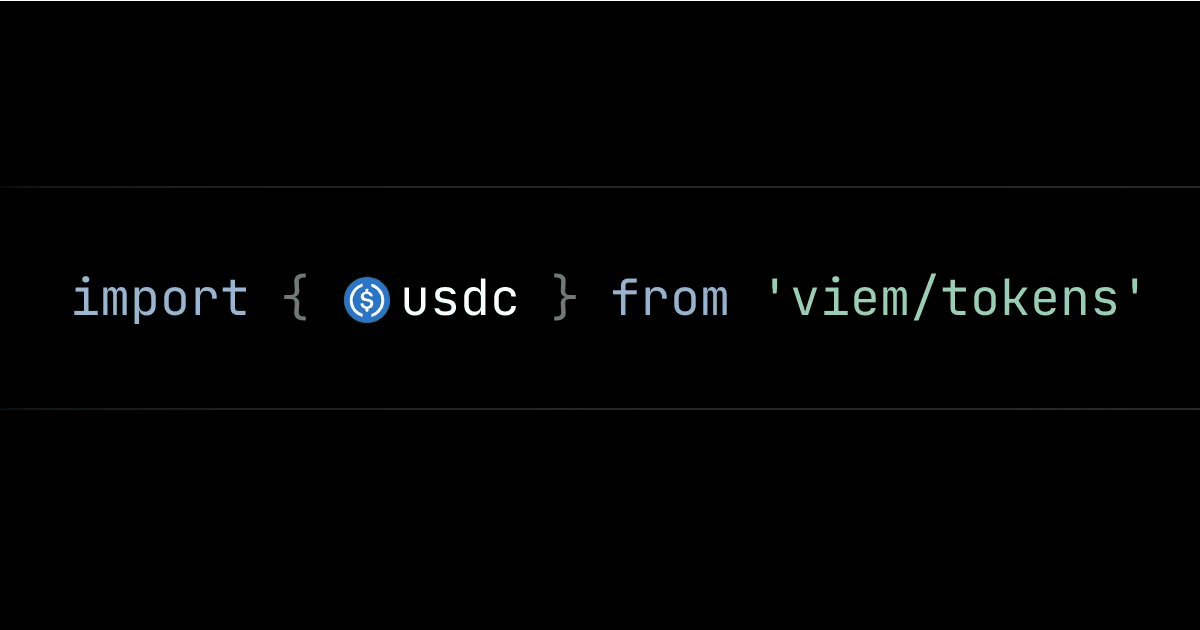
Circle has launched a developer experience update that streamlines stablecoin integration. Developers and AI agents can now import **USDC, EURC, USYC, and cirBTC** directly from viem/tokens without needing a token registry. **Key improvements:** - Direct token imports from viem/tokens - No token registry configuration required - Simplified integration process This update builds on Circle's recent expansion, including native USDC deployment on HyperEVM with Cross-Chain Transfer Protocol (CCTP) V2 support across 14+ blockchains. Developers can access the quickstart guide at [Circle's developer portal](https://developers.circle.com/stablecoins/quickstarts/transfer-usdc-evm).
Gateway Hits Record Week with Over $4.5B in Lifetime USDC Transfer Volume
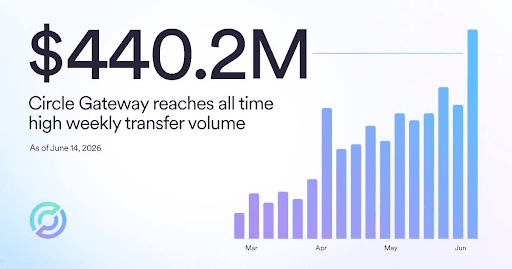
**Gateway achieved its highest weekly performance** for mint and transfer volume, marking a significant milestone in cross-chain USDC movement. **Key metrics:** - Record-breaking week for transaction volume - Total lifetime volume exceeds $4.5 billion - Growing adoption among developers and businesses **What Gateway does:** The platform enables faster and simpler USDC transfers across different blockchain networks, addressing the need for unified liquidity as more projects operate multi-chain. **Context:** This milestone represents substantial growth from April 2026, when Gateway first crossed the $1 billion mark in total transfer volume. The acceleration demonstrates increasing demand for efficient cross-chain stablecoin infrastructure.
🇬🇧 UK Stablecoin Rules
Circle President Heath Tarbert discussed the UK's new stablecoin regulations in a CNBC interview, covering several key topics: - **UK regulatory framework**: Tarbert expressed being "pleasantly surprised" by the UK's approach to stablecoin policy - **USDC positioning**: Discussion of USDC's role as a cash equivalent in financial systems - **Global dollarization**: How stablecoins extend dollar usage internationally - **Market competition**: The evolving landscape among stablecoin issuers - **Institutional adoption**: Growing acceptance of stablecoins by traditional financial institutions The interview comes as regulatory clarity around stablecoins continues to develop globally, with the UK taking steps to establish comprehensive rules for digital dollar-pegged assets.
Stablecoin Transaction Volume Hits New Record in July 2026
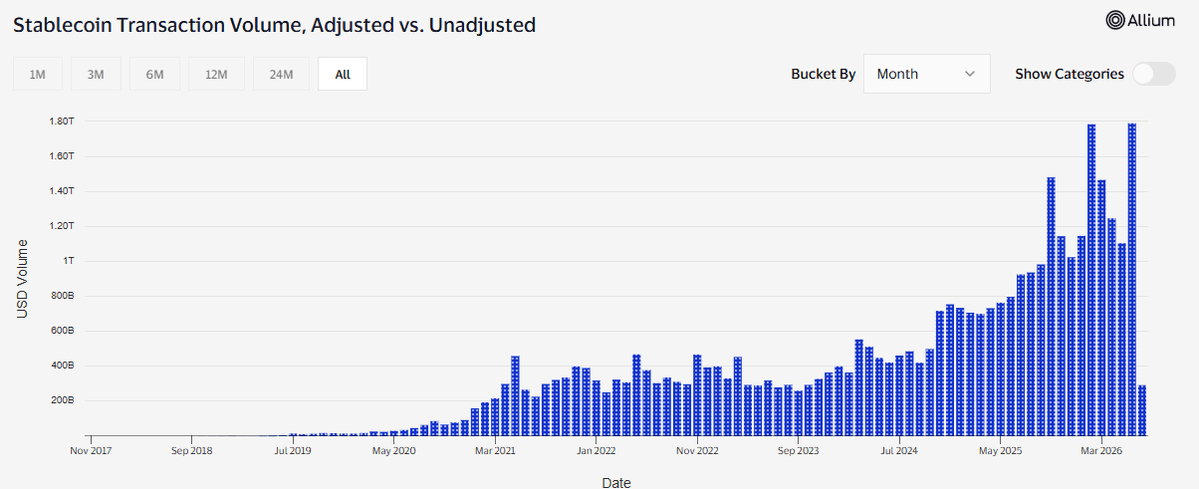
**Stablecoin transaction volumes reached another all-time high in July 2026**, continuing a trend of sustained growth in onchain money movement. - USDC remains a dominant force in facilitating 24/7 value transfers across blockchain networks - This marks the second consecutive month of record-breaking adjusted transaction volume - The growth builds on an 83% increase in stablecoin activity between mid-2024 and mid-2025 USDC's market capitalization has shown significant expansion, nearly doubling year-over-year from $28.5B to over $56B. The data suggests stablecoins are becoming increasingly central to the digital economy's infrastructure, enabling continuous cross-chain value movement as adoption accelerates.