Elysium, the Hyperliquid-aligned Layer 2 built by Kinetiq, launches mainnet on Monday, November 9, 2026 with Zerion as its preferred data provider. From day one, users can track their Elysium assets in the Zerion Wallet, and developers can build on the same data through the Zerion API.
Zerion published its October Zerion API roundup, led by a rebuilt DeFi-positions infrastructure that lets the team onboard new protocols faster. New coverage includes liquidity pools for Metric and Fluid DEX, yield from Yuzu Money, and vaults from Veda.
only_complex), joining Uniswap V2 and Morpho/v1/fungibles now returns flags.is_trash, letting developers filter spam tokens before they reach wallets or trading listscounterparty_address, and webhook subscription lists paginate with page[size] and page[after]asset_class
Zerion unveiled a brand refresh and new website (zerion.io), reintroducing itself with clearer positioning for four audiences: people who track and trade through its wallet, developers who build on its API, agents that act through its CLI, and enterprises that run on its infrastructure. The announcement, paired with a launch video, recasts Zerion's product line as one stack spanning consumer, developer, and agent-facing tools. No product or feature changes were announced beyond the new branding and site.

The Zerion iPhone app now supports Brazilian Portuguese, letting users manage all their wallets, tokens, and NFTs in their own language. Localization aims to make the portfolio tracker more accessible to Portuguese-speaking users in Brazil and beyond.
Zama and Zerion announced that Confidential Tokens are now available to users across Ethereum DeFi inside Zerion's app. Confidential Tokens are Zama's FHE (fully homomorphic encryption) based standard that keeps transaction amounts private on-chain while remaining verifiable.
Metric (metricxyz) went live as a DEX for active pools, where prices follow real-world reference prices and liquidity moves with them. Its token selector now shows every user's EVM token balances, powered by the Zerion API.
Zerion publicly congratulated the team in reply to Metric's launch post, highlighting the integration as another consumer of its portfolio data endpoints.

Zerion posted a video showing $PENGU — Pudgy Penguins' token — being traded on Claude through the Zerion CLI. The demo pairs an AI assistant with the CLI's existing wallet, swap, and bridging commands, letting an agent execute trades conversationally.
npx -y zerion-cli init quick-start flow for agents, though this post focuses on the trading demo itself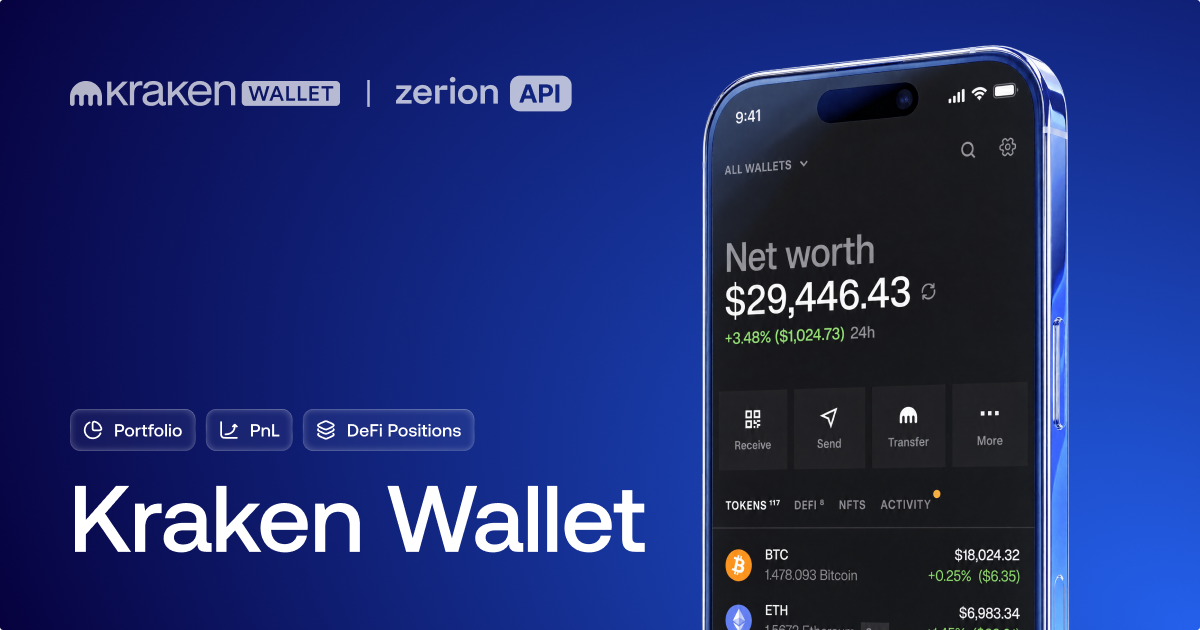
Kraken Wallet, Kraken's open-source, self-custody multichain wallet, uses the Zerion API to power its portfolio view — delivering onchain data for positions, history, and PnL across EVM networks and Solana. The integration lets users see one portfolio even when holdings sit across different account types and any number of addresses.
Kraken's director of product management, Washington Sanchez, said the API enables reliable onchain data and "frees up our time and attention to build more features that give people complete control of their money."
Flovia unveiled its "buying pool" — pitched as "Costco for your API spend" — which pools demand from individuals and startups to unlock bulk pricing on premium APIs. During the early launch, Flovia covers API costs so builders get access for free within usage limits, with a long-term goal of cutting API spend by up to 70%.
Launch partners include OpenAI, Exa, CoinGecko, Nansen, Quicknode, Firecrawl, and Zerion for portfolio and DeFi data. Zerion promoted the announcement, noting the pool is built on Zerion Data, and early access is available via waitlist.
Zerion has added ether.fi's two ETH yield products — weETH liquid staking and the Liquid ETH managed vault — to the Earn flow in its web app. Holders can stake ETH for weETH or deposit into the Liquid ETH vault directly, with the resulting positions tracked alongside the rest of their portfolio.
Zerion announced it would wind down ZERO Network after roughly 18 months, requiring all users to withdraw ETH, tokens, and NFTs by July 31, 2026, as the company pivoted resources back to its core wallet and API products.
Zerion released Zerion CLI, an open-source toolkit that gives AI agents like Claude Code and Cursor the ability to manage crypto portfolios, swap tokens, and sign transactions across 40+ chains.
Zerion launched ZERO Network, a gasless Ethereum Layer 2 rollup built with ZKsync's ZK Stack, enabling Zerion Wallet users to trade, mint, and bridge without paying gas fees.
Zerion released its browser extension wallet for Chrome, Arc, and Brave, bringing multichain portfolio tracking, DeFi positions, and NFT management to desktop after months of early-access testing with 30,000 users.
Zerion raised $12.3 million in Series B funding led by Wintermute Ventures, with participation from Placeholder, Mosaic, Coinbase Ventures, and Alchemy Ventures, to advance its Web3 wallet.
Zerion released its mobile-first, self-custodial smart wallet alongside Zerion DNA, a first-of-its-kind generative living NFT that evolves based on users' onchain activity.
Zerion introduced a 0.5% fee on swaps across supported networks, placing proceeds into treasury-like multisig contracts as a first step toward a decentralized, community-led future.
Zerion added NFT tracking across its apps and launched the Zerion Genesis Collection, a limited-edition generative NFT series created with Art. Lebedev studio, with over 10,000 claimed in the first 24 hours.
Zerion raised $8.2 million in Series A funding led by Mosaic Ventures, with participation from Placeholder, DCG, Lightspeed, and Blockchain.com Ventures.
Zerion raised $2 million in seed funding led by Placeholder, with participation from Blockchain Ventures and Gnosis, to build the best interface for decentralized finance.
Evgeny Yurtaev (CEO), Alexey Bashlykov (CTO), and Vadim Koleoshkin (COO) founded Zerion with a mission to build accessible, permissionless financial tools onchain.
13109 followers · 39 stories