Yearn announced that its risk team, yRiskLabs, has been selected to provide risk analysis for Curve Finance. The team was chosen based on its expertise and history with the Curve ecosystem and its track record in onchain risk management.
Yearn released vaults 3.1.0 in June 2026, an upgrade to its core vault code with two new features and three accounting fixes. Since Yearn does not use upgradeable proxies, existing vaults stay on their older code — the upgrade only applies to newly deployed vaults.
Yearn highlighted a flexmeow update thread from @omgcorn that walks through how the fixed-rate lending facility works. The thread explains the core mechanics — fixed-rate lending, borrowing, looping, and redemptions — and how borrowers compete for liquidity by setting their own rates.
The explainer is educational, breaking down the platform's loan market rather than announcing a new vault or feature. It was surfaced via Yearn's official X account as a retweet.
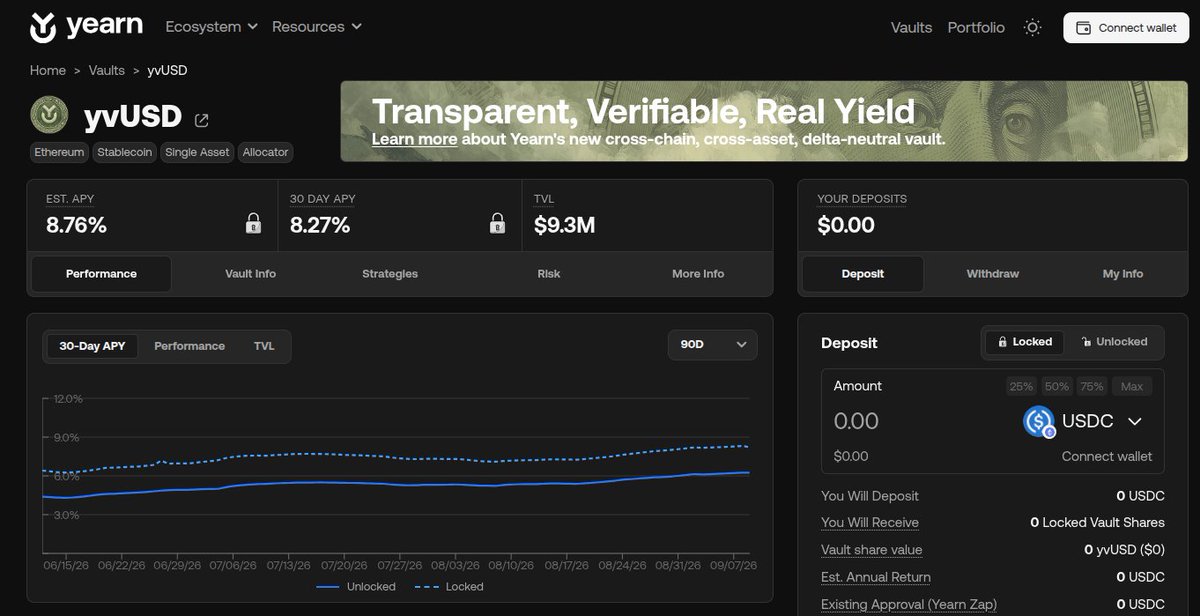
Yearn released yvUSD, a new cross-chain USDC vault introduced in Q1 2026, which uses cross-chain strategies to broaden users' yield opportunities. The vault automatically handles bridging and asset allocation across other networks, so users don't need to manually move stables between different chains and L2s to chase better yields.
Yearn published a thread breaking down the collapse of Stream Finance, which lost hundreds of millions to circular leverage. Depositors saw $520M TVL at 12-18% stablecoin APY in October 2025, but only $160M actually existed; DeFiLlama refused to count the loops and showed ~$200M. Stream held roughly 90% of Elixir's deUSD supply, which was itself backed by Stream's xUSD token.
Yearn notes the loop failed to unwind cleanly: Stream suspended redemptions, lending markets hit 100% utilization freezing withdrawals, and oracles hardcoded xUSD at $1 so liquidations never fired, creating bad debt. It also flags that multiple risk curators were exposed to the risky protocols, leaving users who trusted them holding the bag. The analysis was promoted via Yearn's official X account.
Yearn announced that yvFlexUSDC is now available on the flexmeow platform. It is an allocator vault managed by the Yearn Curation team, expanding the set of strategies users can access through the facility.
Yearn's flexmeow product, live for 107 days, shipped v1.1. The update lets users loop yvUSD (unlocked), ysyBOLD, and yvcrvUSD-2, expanding the strategies available through the facility.
Yearn introduced a new vault, yvcrvUSD-2, which automatically finds the best crvUSD yield opportunities on mainnet and optimizes allocation across them. The vault is described as a "household loop" that scans crvUSD markets to direct capital toward the highest-yielding strategies.
Yearn acknowledged a market manipulation incident involving reUSD and confirmed it has no exposure to reUSD PTs or reUSD itself, saying it is not impacted. The protocol said it is actively following the situation and implementing measures to prevent this kind of manipulation in its own markets.
Yearn acknowledged an exploit of Term Finance's vault contracts. While Term Finance's contracts are built on Yearn's V3 architecture, Yearn says the exploit came through a custom governance wrapper around the vaults, and that this attack vector does not apply to standard Yearn vault setups. Funds were reportedly affected in the incident.
A numerical bug in Yearn's legacy yETH StableSwap pool allowed an attacker to mint trillions of yETH tokens and drain roughly $9 million in assets; Yearn confirmed V2 and V3 vaults were not affected.
Yearn released its third-generation Vault system on the Ethereum mainnet, featuring automation, composability, and flexibility, with anyone able to deploy strategies and vaults without permission.
A misconfiguration in the yUSDT vault's smart contract let an attacker mint excessive yUSDT tokens and drain around $11.54 million; the exploit came from a deprecated iearn contract.
In a tweet, Anton Nell said he and Andre Cronje were closing their chapter of contributing to DeFi/crypto, terminating about 25 apps and services, including advisory roles tied to Yearn Finance.
An attacker exploited a flaw in the v1 yDAI vault using a complex flash-loan transaction, costing the vault about $11.1 million in DAI while netting roughly $2.8 million for the attacker. Deposits into affected v1 vaults were paused.
All 30,000 YFI tokens were distributed to early protocol users via a surprise yield-farming announcement, with no pre-sale, no team allocation, and no founder allocation for Andre Cronje.
Cronje pushed the first commit on what would become Yearn Finance (originally iearn.finance), built to automatically move funds to the highest-yielding lending platforms.
721 followers · 12 stories