Polygon
18142 followers · 42 stories
Exploring the Frontiers of ZK Innovation and Ethereum Scaling.
18142 followers · 42 stories
Exploring the Frontiers of ZK Innovation and Ethereum Scaling.
Polygon has launched CDK Besu, now live as the latest configuration option in Polygon CDK within the Open Money Stack (OMS), per the official announcement. Teams can launch a new private Besu chain or connect an existing Besu network, ending the isolation typical of private chains.
Polygon Labs has completed its acquisition of Coinme, making Polygon a U.S.-regulated payments business and bringing regulated U.S. money movement into the Open Money Stack (OMS). Polygon Foundation CEO Sandeep Nailwal announced the milestone directly, framing the Polygon PoS chain as now operating under U.S. money-transmission rules; the completion was confirmed across Polygon's account and flagged by CoinMarketCap, Cointelegraph, and FintechTV, which characterized Polygon as evolving from a blockchain company into a fully regulated U.S. payments business.
Polygon has officially activated PIP-92, which increases staking rewards for validators on Ethereum:0x455e53cbb86018ac2b8092fdcd39d8444a. The activation was confirmed by Polygon's official account, which reposted the update from the proposal's author. Staking operator Luganodes explained that Polygon stakers have had a share of network fees accruing since April, and PIP-92 is the mechanism that pays out that accumulated backlog to POL stakers.

Kira, the product that combines U.S. banking and stablecoins into one flow, is expanding the stablecoin options available to its clients through Polygon's Open Money Stack (OMS), per Polygon's official account. Kira's AI agents handle account opening, KYBs, RFIs, and payment tracking, with a human signing off on every decision.

Toku, the global payroll and employment provider running across 100+ countries, is extending its stablecoin payroll product using Polygon's Open Money Stack (OMS) for the last-mile wallets and payouts. Toku publicly confirmed the collaboration, saying stablecoins are "becoming real infrastructure for global businesses" (Polygon announcement). Toku covers employment contracts, tax withholding, benefits, and local filings; OMS supplies the wallet and payout rails behind the product.
Tazapay, the cross-border payments platform serving 1,000+ enterprises and fintechs across 30+ countries, is bringing Polygon's Open Money Stack (OMS) on/off-ramps and wallets into its payment flow. Polygon's official account announced the integration, which runs alongside the local and SWIFT rails Tazapay customers already rely on.

Mesh — the payments network connecting 300+ wallets, exchanges, and financial services platforms — is now live as a fiat on-ramp option within Polygon's Open Money Stack (OMS), per Polygon's official account. Fintechs and payment platforms building on OMS get another way for users to fund an account with Mesh.
Featherlend has launched BRZ and frxUSD lending markets on Morpho Vaults on Polygon, with Frax Finance confirming the rollout via its own announcement, reposted by Polygon's official account (Featherlend blog post). Users can borrow BRZ — Transfero's Brazilian Real-pegged stablecoin, backed 1:1 by BRL reserves — using sfrxUSD or etherfuse TESOURO collateral, or borrow frxUSD against tGBP, BRZ, sPOL, or sfrxUSD.
Monerium, Frax Finance, and Capa Fi have connected euro payments to global corridors on Polygon, with the EURe/frxUSD pair live with incentives on Uniswap. The pool gives regulated euro e-money a direct route into onchain dollar liquidity, with Capa Fi bringing FX and payment flows — Polygon's official account highlighted that EURe now has a direct route into dollar liquidity on the network.
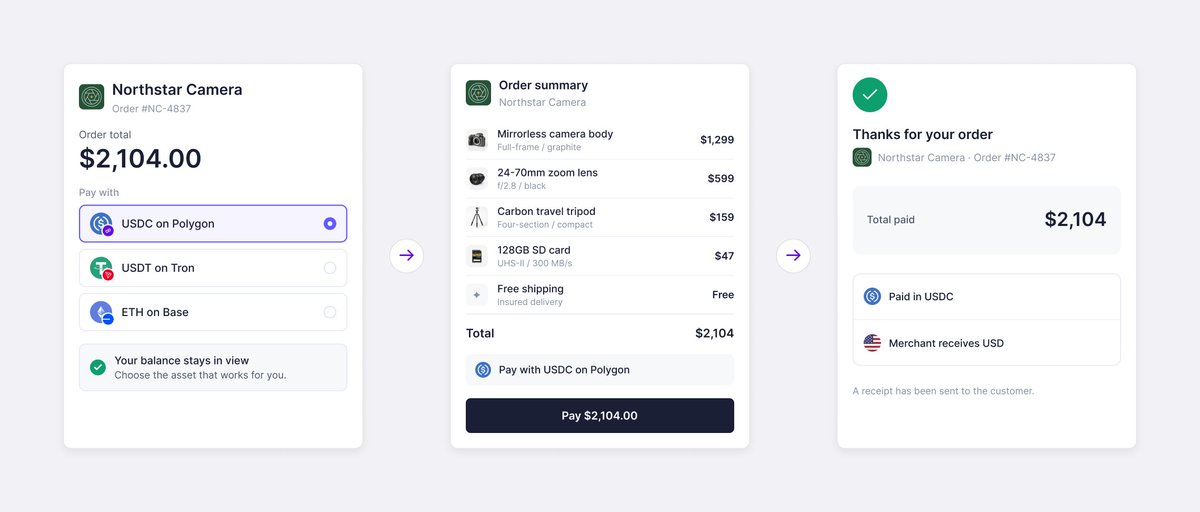
Polygon's Open Money Stack (OMS) now supports stablecoin payments at checkout, letting merchants add a "pay with crypto" option to the checkout flow they already run. Customers can pay across wallets, tokens, and chains without leaving the store to swap, bridge, or cash out, per Polygon's official account.
Polygon Labs completed its acquisition of Coinme, becoming a U.S.-regulated payments business with 37 state money transmitter licenses, 11 exemptions and FinCEN MSB registration, and folding regulated U.S. money movement into the Polygon Open Money Stack.
After community consensus, Polygon upgraded its native token from MATIC to POL as part of the Polygon 2.0 roadmap, making POL the network's gas and staking token.
Polygon Labs promoted chief legal officer Marc Boiron to the newly created CEO role, while President Ryan Wyatt stepped down to an advisory position.
Polygon announced Polygon 2.0, a set of proposed upgrades reimagining the protocol's architecture, tokenomics, and governance toward an aggregated 'value layer of the Internet.'
Polygon raised $450 million by selling MATIC tokens in a round led by Sequoia Capital India, with participation from Tiger Global and SoftBank Vision Fund.
Polygon acquired the Mir blockchain network for 250 million MATIC tokens, worth around $400 million at the time of the deal.
Polygon disclosed a security vulnerability that resulted in the theft of 801,601 MATIC tokens.
Polygon acquired the Hermez Network, a zero-knowledge rollup team, in an August 2021 deal valued at $250 million.
The project renamed itself Polygon Technology, shifting from a single scaling solution to a broader ecosystem of Ethereum scaling solutions.
Polygon's ledger began on June 1, 2020, marking the launch of the Matic proof-of-stake mainnet on Ethereum.
Matic Network ran an initial exchange offering on Binance Launchpad, selling 1.9 billion MATIC tokens (19% of supply) and raising about $5 million.
Matic Network, the predecessor to Polygon, was founded by Jaynti Kanani, Sandeep Nailwal, Anurag Arjun, and Mihailo Bjelic.