Metis details step-by-step post-quantum rollout for Hybrid Rollup on Devnet
Metis' Hybrid Rollup is now live on Devnet — announced back in 2023 but built through years of engineering and testing. It pairs ZK validity proofs with DSeq's post-quantum signatures and Ziren-powered verifiable execution for a post-quantum-safe rollup stack that Metis says cuts withdrawal delays, with the post-quantum proof path still under development. Metis is also adding support for NIST's post-quantum signatures (ML-DSA) to its decentralized sequencer, a rollout direction most L2s haven't yet discussed.
- Metis framed the rollout as built "step by step" through cryptographic agility, bringing hash-based proof verification closer to Ethereum while keeping the existing execution stack, with Devnet as the testbed for each upgrade
- DSeq is being upgraded to support ML-DSA signatures, with the elliptic-curve signing path remaining active today — the change covers sequencer signing only; proof verification needs separate changes
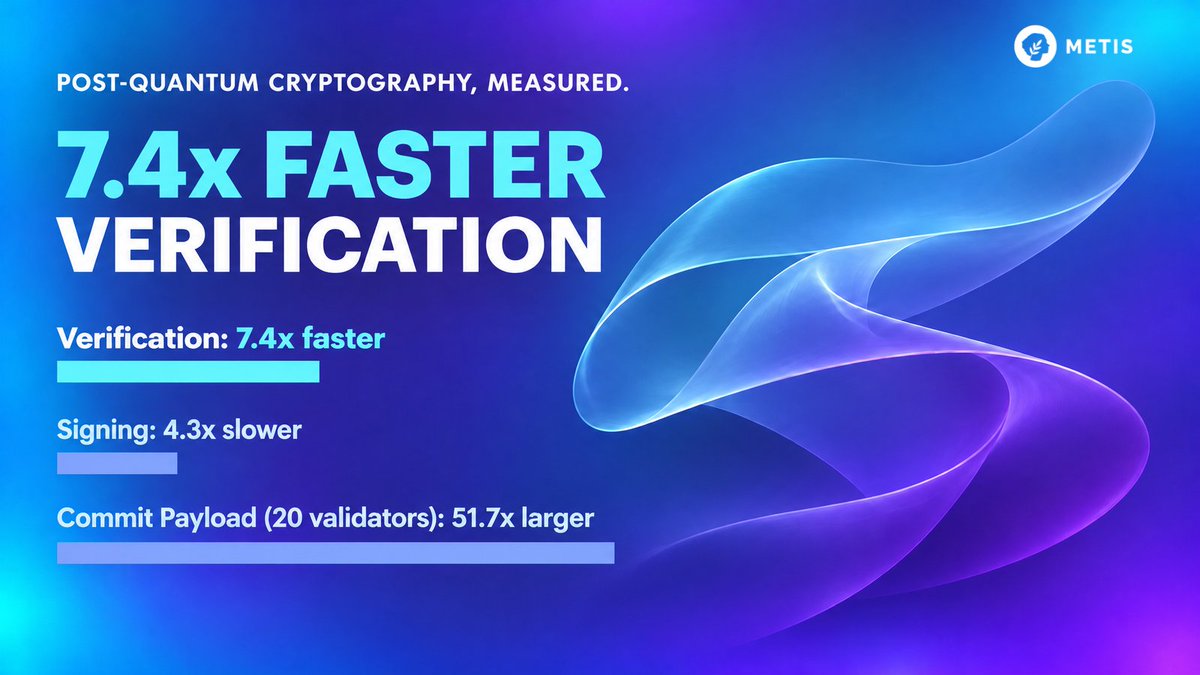
- Metis published measured benchmarks of its Consensus Layer implementation comparing ML-DSA-65 vs. secp256k1: verification is 7.4x faster (23.4 vs. 173.4 µs), signing is 4.3x slower (196 vs. 46.1 µs), and a 20-validator commit payload is 51.7x larger (66,180 vs. 1,280 bytes), noting faster verification comes with those trade-offs
- On the proof side, Ziren supports hash-based verification on the EVM without an elliptic-curve wrapper; a Keccak-based compact shrink verifier for that path has been implemented and benchmarked locally, described as "a starting point, not a finished deployment"
- Metis also explained why MIPS matters: since the May 2025 Andromeda upgrade, mainnet fraud proofs run on a Cannon-style program compiled to MIPS, an instruction set Ziren supports
- ProjectZKM's Ziren is credited as the engine behind the rollup; the first Devnet announcement landed Oct 24, and no mainnet launch date has been shared
Sources
- ML-DSA-65 vs. secp256k1. Measured, not assumed. In our Consensus Layer implementation: Verification: 7.4x faster (23.4 vs. 173.4 µs) Signing: 4.3x slower (196 vs. 46.1 µs) Commit payload (20 validators): 51.7x larger (66,180 vs. 1,280 bytes) Faster verification comes with https://t.co/j8Gp9i9GUwx.com ↗
- The path to post-quantum security is built step by step. Metis is advancing its Hybrid Rollup through cryptographic agility, bringing hash-based proof verification closer to Ethereum while maintaining the existing execution stack. The Devnet is where these upgrades are tested https://t.co/f70TVWMBwDx.com ↗
- Announced in 2023. Built through years of engineering and testing. Powered by @ProjectZKM 's Ziren, Metis Hybrid Rollup brings verifiable execution closer to reality, with a post-quantum proof path under development. The Hybrid Rollup Devnet is now live. Watch the team explain https://t.co/me9VvCuakbx.com ↗
- RT @MetisHero: $Metis is getting ready for the quantum era anons! Metis is adding support for NIST's post quantum signatures to its decent…x.com ↗
- 8/ Together, these changes begin post-quantum signature support and proof verification in the Hybrid Rollup. Costs differ by component, so the rollout is phased. Full breakdown: https://t.co/TuCHBtdnOk Replying to their earlier post: 7/ On the proof side, Ziren supports hash-based verification on the EVM, without an elliptic-curve wrapper. A Keccak-based compact shrink verifier for this path has been implemented and benchmarked…
Metis
is Ethereum's permissionless layer 2 network, powering the next generation of decentralized applications.