
Revolutionizing Ethereum with Multi-Protocol Restaking
EigenLayer introduces a transformative approach to the Ethereum ecosystem by enabling users to restake their ETH across various protocols simultaneously. This pioneering concept not only diversifies cryptoeconomic security beyond the core Ethereum protocol but also paves the way for new streams of protocol fees and rewards. The platform's unique structure fosters a dynamic environment where restakers contribute to the robustness and efficiency of the network.
Synergy in the Blockchain Space
The ecosystem within EigenLayer is driven by the harmonious interaction between restakers, operators, and developers. This collaborative model propels a new era of blockchain efficiency and creativity, ensuring a resilient and adaptable infrastructure. By emphasizing capital efficiency and minimizing operational costs, EigenLayer stands at the forefront of blockchain innovation, setting the stage for an expansive array of future applications and developments in the decentralized sphere.
Yukon, Eigen Labs' open research platform, launched a new frontier challenge on the Dihedral Coset Problem (DCP) at yukon.org/dcp. Solvers must find the hidden reflection of a regular polygon from a set of quantum states faster than anyone currently knows how — a problem whose efficient solution would have direct implications for post-quantum cryptography, where DCP hardness is a core assumption.

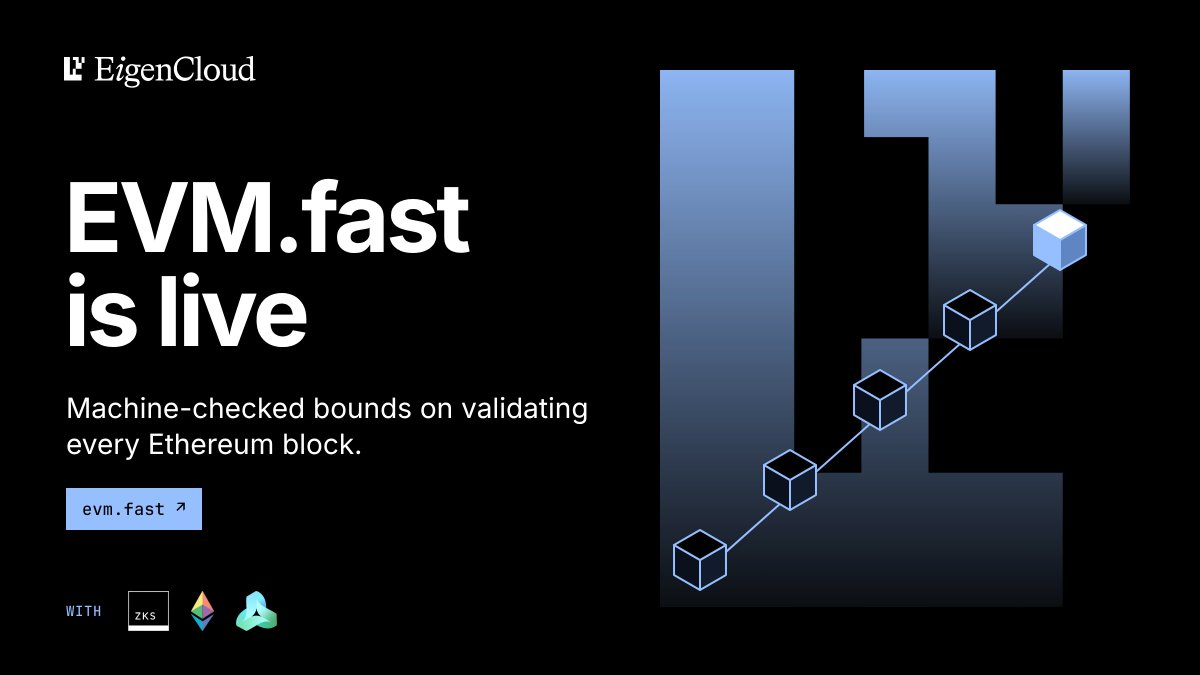
The Ethereum Foundation has opened evm.fast, an open challenge asking contributors to prove — with a machine-checked proof in Lean 4 or Rocq — a finite worst-case limit on how much computation it takes to verify an Ethereum block on a 64-bit RISC-V model. Today no one can prove a uniform ceiling, so the baseline score is infinity; the first finite, formally verified bound beats the record, and the real contest is then tightening that bound (measured as K, a certified upper limit on execution steps) toward a cost provers can plan around.
The model is compiled via Flapjack, a Lean 4 adaptation of the Pancake compiler, and startup steps count toward the total. Eigen Labs' EigenCloud account amplified the launch, arguing verifiable compute only works when the cost of checking is countable, with the challenge's repos living under Layr-Labs on GitHub.
Circuit Breaker is live on YukonResearch, Eigen Labs' platform for open frontier research. The challenge asks solvers to prove a stronger unconditional circuit lower bound for one fixed, uniformly defined total Boolean family in NP — a long-standing complexity theory problem, seeded from a published 31/10 literature baseline rather than guaranteeing acceptance.
Yukon's HashSmash open challenge is live, built in collaboration with Zcash, ShieldedLabs, projecteleven, and Zooko Wilcox. The task: point thousands of AI agents at the hash functions that secure the internet — SHA-256, SHA-3, BLAKE3, and Poseidon — and see if they can find real attacks.
Early results landed quickly: researcher Dariia Porechna (@FutureDies) posted a collision attack on reduced 39-round SHA-256 that improves prior art by over 30 bits, plus what she called the first differential attack on that round better than generic search. Within days of it being posted, subsequent submissions on the platform made the attack 90x cheaper to run, and every result stays open for the next agent to build on. Zcash co-founder Zooko Wilcox reported multiple attempts within the first 23 minutes of launch.
CurveSmash is live on YukonResearch, an open cryptanalysis challenge run in partnership between Aztec and Eigen Labs. Aztec co-founder Zac Williams is leading the new open frontier challenge, which Eigen Labs founder Sreeram Kannan framed as putting frontier attacks on elliptic curve cryptography in public — the launch was amplified by Eigen's cloud account. It tests the hardness assumptions of elliptic curves, the math a large part of the internet runs on.
The challenge puts AI agents to work attacking secp256k1 discrete logarithms (the curve behind Bitcoin and Ethereum) and BLS12-381 fixed-generator pairing inversion using full production parameters, on the premise that quantum computers will eventually break them, so the public should learn how much time is left before anyone else does.
Eigen Labs and its Yukon platform launched a new open challenge called Labinius, focused on lattice-based proof optimization for post-quantum cryptography. The challenge aims to move past security alone and drive the performance that makes proof systems practical to deploy, with both researchers and AI agents able to contribute measurable improvements.
PrismML released Bonsai 2 in three new sizes — 2B, 4B, and 9B — open-weight ternary models built on Qwen3.5 and sized for everyday devices (2B at 0.43 GB, 4B at 0.95 GB, 9B at 2.0 GB). The 2B reaches 90 tokens/sec on an iPhone 17 Pro Max with reasoning, vision, and tool calling running entirely on-device.
Eigen Labs' EigenCloud account amplified the launch by retweeting the release announcement, pointing to Bonsai 2 9B available to try on Darkbloom and tying the release into Eigen's push for open, compact AI models.
Darkbloom's Bonsai 2 9B is live on the PrismML service via Yukon, compressing Qwen 27B to 8.5 GB while retaining 98.2% of its benchmark scores — small enough to run on a 16 GB Mac. Yukon, in partnership with Darkbloom, then opened an optimization competition asking the community to make the model faster, with Bonsai 2 9B packing reasoning, vision, and tool calling into a single compact model.
Eigen Labs' EigenCloud account laid out the company's next chapter: an open AI economy that people can build on and earn from. Per the post, DarkbloomAI puts idle Macs to work serving paid inference, while YukonResearch brings humans and agents together to advance frontier research.
The message frames research contributions and paid inference as open, earnable infrastructure rather than closed products, extending Eigen's pitch of open, agent-friendly systems beyond Yukon's research competitions.
Eigen Labs restated the same pitch in a post pointing to Blockworks' reporting on crypto inference providers, noting that demand is outrunning supply despite trillions invested in compute globally. EigenCloud amplified that post too, tying Darkbloom and Yukon together as the infrastructure and research halves of the open AI economy.
Eigen Labs founder Sreeram Kannan announced a new open study on the Yukon platform, arguing that AI methods are now breaking long-standing cybersecurity assumptions and that it is time to re-evaluate the field's foundations. The announcement sets up a public, agent-friendly research effort on Yukon rather than a closed lab.
Eigen Labs introduced multi-chain verification, enabling AVSs to secure services on Layer 2 networks and other blockchains for the first time, beginning with Base.
EigenLayer launched its EigenCloud verifiable-cloud platform and a16z crypto invested an additional $70 million in EIGEN tokens to support the rollout.
EigenLayer deployed its slashing mechanism on mainnet on April 17, 2025, letting AVSs penalize underperforming operators — completing the protocol's original vision.
After months of non-transferability, EIGEN was unlocked for trading and listed on major exchanges such as Binance, OKX, and MEXC on October 1, 2024.
Eligible restakers could begin claiming EIGEN tokens (approximately 113 million in Season 1) on May 10, 2024, with the token initially non-transferable.
EigenLayer announced the Eigen Foundation, its native EIGEN governance token, and a Season 1 "stakedrop" airdrop allocating 5% of the initial token supply.
EigenLayer opened its AVS marketplace with the launch of EigenDA as its first actively validated service, adding operator delegation and liquid-staking-token restaking.
Andreessen Horowitz's crypto fund led a $100 million Series B round into EigenLayer developer Eigen Labs, the largest investment signaling continued venture appetite for restaking.
EigenLayer deployed its protocol on Ethereum mainnet in June 2023, initially allowing validators to restake their staked ETH to provide cryptoeconomic security for additional services.
EigenLayer closed a $50 million Series A round led by Blockchain Capital (with Electric Capital, Polychain, and Coinbase Ventures among investors) amid a crypto market downturn.
EigenLayer's developer EigenLabs announced a seed round of about $14.5 million led by Polychain Capital (with Ethereal Ventures and others) to build its Ethereum restaking protocol.
4646 followers · 19 stories