Yellow Network Pitches AI Agent Infrastructure at Tokyo Summit
Yellow Network Pitches AI Agent Infrastructure at Tokyo Summit
🤖 AI agents need infrastructure

Yellow Network representatives presented their vision for AI agent commerce infrastructure at the TEAMZ Summit in Tokyo.
Key Points:
- Yellow positions itself as coordination layer for AI agents in DeFi
- Uses state-channel technology for trustless, peer-to-peer transactions
- Targets institutional-grade trading infrastructure
- XRP highlighted as optimal settlement system for institutional use
The team argues legacy blockchains cannot handle billions of AI agents, requiring new infrastructure for the "agentic economy."
At @TEAMZSummit by @teamz_inc in Tokyo last week, @AlexisYellow and @modernfintech got the message out to the XRP community and others that agentic processes are the future of major DeFi adoption - and Yellow will be the central co-ordinator of it all.
A huge thank you to @Mai_XRPLJapan and the XRP Tokyo team for an incredible event 🙏 @alexisyellow and @modernfintech hit the main stage to talk about AI agent commerce and why trust infrastructure is the missing piece. Yellow Network is building that layer. 🟡 #XRPTokyo 🇯🇵


1. AI agents operating with credit cards helping retail traders extract maximum value. 2. XRP "the best settlement system out there" for institutional involvement. 3. Yellow in the middle co-ordinating the infra @AlexisYellow + @modernfintech at XRP Tokyo.
This simple point-by-point explainer reveals just why state-channel technology (underpinning Yellow's trading structure) and AI agents work perfectly together.

Agentic economy is a strong use case for our state channel technology. 1. Two agents deposit collateral into a shared on-chain adjudicator contract. The escrow is non-custodial, programmable, visible to both. 2. Agents exchange signed state updates off-chain through our
“Yellow is extending the foundational principles of Bitcoin being trustless and non-custodial to everyday, high-frequency financial applications." @AlexisYellow in @thefintechtimes ➡️thefintechtimes.com/yellow-network…

"Yellow is the most ambitious attempt to apply state channels to institutional-grade trading infrastructure. It functions as the crypto equivalent of how SWIFT messaging and direct order matching work in traditional finance." Full explainer linked below.⬇️

State channels have long been part of Yellow's long-term vision. Now other crypto entities are waking up to the inherent advantages in blending off-chain and on-chain transactions to maximize the best of both worlds. By @re7alien for @YellowMedia_HQ yellow.com/research/state…
Watch in full: Last week's XRP Tokyo keynote from @AlexisYellow and @modernfintech The Internet of Value for the Agentic Economy Alexis and Steven explain how legacy blockchains cannot "supervise" billions of AI agents. Instead, we need a peer-to-peer trustless layer for them
🎯 Yellow Builders Alliance Gains Momentum with Blok Assets Support Session
The **Yellow Builders Alliance** continues expanding its support network for ecosystem developers. Tomorrow, Juan Mari from **Blok Assets** will present how his organization plans to assist builders in the Yellow ecosystem. **Key Context:** - The alliance connects developers with top-tier resources and funding - Recent partners include: - **Boosty Labs** (150+ developers, 250+ shipped projects) - **Blok Assets** (specializes in asset tokenization) - **CMC Labs** (from CoinMarketCap) - **Cointelegraph Accelerator** - **ChainGPT Pad** - **Syndika** and **Cede Hub** **What It Means:** The alliance provides developers building on Yellow's SDK with direct access to venture capital, technical expertise, and growth support. Projects can qualify for investments up to $100k plus additional benefits. Over 500 projects have been developed using Yellow's infrastructure since the platform's Ethereum mainnet launch in March 2026.
Yellow Launches Non-Custodial Settlement Layer Connecting XRP and EVM Chains for AI Agents

**Yellow has introduced a non-custodial settlement layer** that bridges XRP and EVM liquidity, enabling AI agents to move value across chains without requiring permission. - The platform allows **agentic workflows to clear at machine speed** - AI agents can transact with each other in a trustless environment - Yellow positions XRP as an institutional settlement layer for high-volume AI-to-AI transactions The infrastructure addresses a key friction point in autonomous agent operations: the ability to execute cross-chain value transfers programmatically. By connecting different blockchain ecosystems through a single settlement layer, Yellow removes intermediaries from the process. This development comes as AI agent activity increases across blockchain networks, creating demand for seamless interoperability solutions that operate at computational speeds rather than human intervention timescales.
🏆 Yellow SDK Challenge: $50,000 Prize for One Spectacular Product
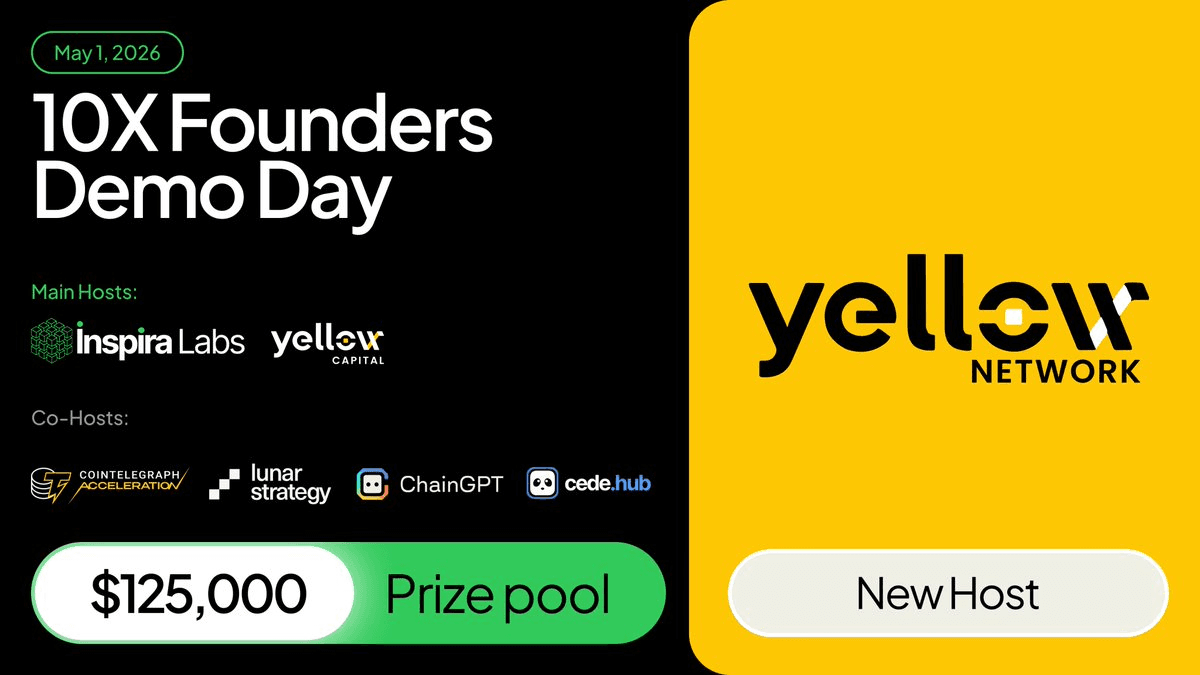
**StarkWare is offering a $50,000 prize** for one builder who ships an outstanding product using the Yellow SDK. **Key Details:** - Single winner takes home $50,000 - Must build and ship a product using Yellow SDK - Open to all builders **Resources Available:** - [30-minute demo](https://x.com/StarkWareLtd/status/2028029201488498839) - [5-minute SDK presentation](https://x.com/StarkWareLtd/status/2028029201488498839) - Previous $3,000 challenge ran through March 11 This follows an earlier 2-week build challenge with a $3,000 prize. The significantly larger prize pool signals StarkWare's commitment to fostering innovative development on their platform.
🏦 Amex Launches AI Agent Commerce Kit

American Express launched its **Agentic Commerce Experiences (ACE) Developer Kit**, featuring agent registration, intent verification, tokenized credentials, and dispute resolution. This marks a significant move by traditional finance to adapt infrastructure for AI agent transactions. The kit addresses trust and settlement challenges as autonomous agents increasingly conduct commerce. The development validates the growing need for AI-native payment rails. However, Amex's solution remains network-specific, requiring registration within their ecosystem. Protocol-level alternatives like Yellow Network offer network-agnostic settlement layers that work across any agent or platform. The contrast highlights two approaches: closed financial systems versus open infrastructure. As AI agents proliferate across commerce, gaming, and prediction markets, the race is on to establish the standard for machine-to-machine transactions.