Why Stable Pools Beat Standard AMMs for Pegged Asset Swaps
Why Stable Pools Beat Standard AMMs for Pegged Asset Swaps
🔄 The slippage problem

Standard AMMs weren't designed for pegged assets. When swapping stablecoins or liquid staking tokens on traditional automated market makers, you pay unnecessary slippage costs—even though these assets should trade near 1:1.
Stable pools solve this problem through amplified mathematics. By concentrating liquidity around the parity price range, they enable:
- Larger swap sizes with minimal price impact
- Tighter spreads for correlated assets
- True capital efficiency where trading actually happens
Unlike concentrated liquidity ranges (Uniswap V3-style) that can leave you exposed when assets depeg, stable pools maintain some liquidity at every price point—making them both pioneers and the endgame solution for pegged asset trading.
For three stablecoins all tracking the same dollar value, StableSwap math puts liquidity exactly where it's needed.

That's where stable pools fit. Stable pools concentrate liquidity around the 1:1 price range using amplified mathematics. Translation? Larger swaps with lower price impact.
Swapping pegged assets shouldn't cost you in slippage. But on a standard AMM, it does. The curve wasn't built for assets that move together. Let's understand stable pools and why they exist 🧵

-> Stable Pools handle correlated assets with tight spreads. Stablecoins and LSTs trade efficiently on a chain where gas doesn't constrain activity. Assets that should trade near parity get the depth they need.
But what's the big deal of stable pools? Stable Pools are optimized for assets trading near parity. Three stablecoins, all tracking the same dollar value, means StableSwap math can concentrate liquidity exactly where trading happens. This is real capital efficiency in action.

DFB Network Manages $3M+ in Stablecoin Liquidity Across 12 Chains
**DFB network** operates as an institutional stablecoin liquidity specialist, managing over **$3 million across 12+ blockchain networks**. **Key Operations:** - Handles multiple stablecoins including BRZ and IDRX - Deploys automated cross-chain arbitrage strategies - Utilizes stable pools designed for institutional liquidity management **Market Context:** This development aligns with broader industry trends showing stablecoin B2B payment volumes growing 60% year-over-year, particularly in cross-border flows and treasury management where traditional banking remains slow and costly.
Balancer Launches First FX Pool on Monad Enabling Direct Access to Korean Government Bonds
Balancer has deployed its first foreign exchange (FX) pool on Monad, pairing USDC with tokenized Korean Treasury Bonds (KTB). **What's New:** - Single-swap access to Korean sovereign debt without Korean brokerage accounts - Traditional barriers (local accounts, complex onboarding) eliminated - StableSurge hook mechanism protects the peg **How It Works:** Unlike traditional Stable Pools that pair similar assets, this FX pool creates a liquid market between USD exposure and Korean government bonds, enabling institutional-grade cross-border swaps. **Why It Matters:** This represents a significant step in tokenizing traditional finance assets and making them accessible globally through DeFi infrastructure.
Korean Treasury Bonds Go Onchain via USDC Integration
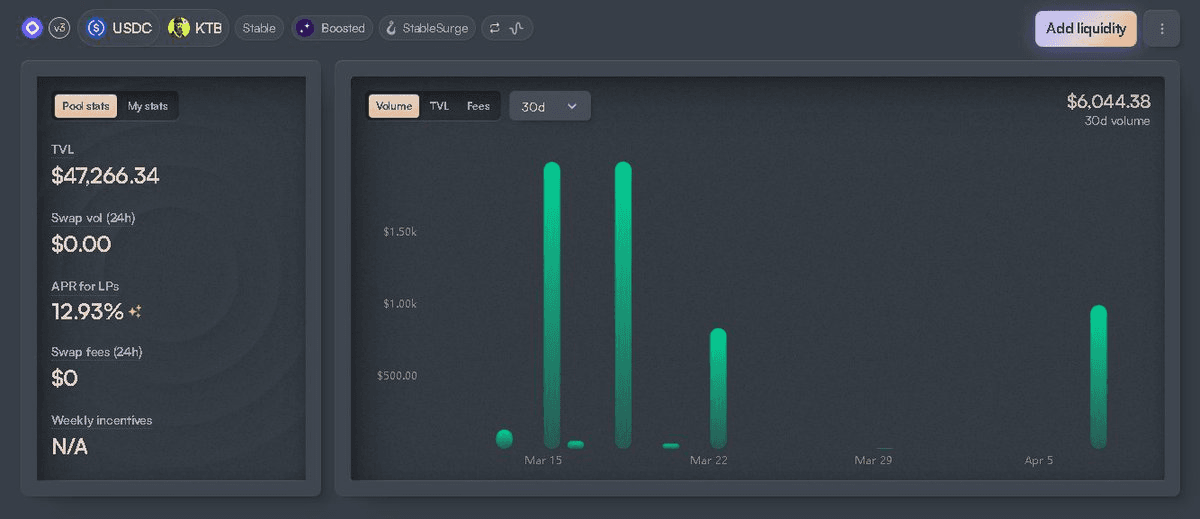
**Tokenized Korean Government Debt Now Accessible Onchain** Korean Treasury Bonds (KTB) from @etherfuse are now available through @DFB_DeFi, backed by USDC from @circle and boosted via @neverland_money. **Key Details:** - Real sovereign debt tokenized for blockchain access - First onchain gateway to Asian government bonds - USDC serves as the dollar-backed stablecoin foundation - Builds on Circle's existing South Korean presence through @Korbit_exchange This integration creates a bridge between traditional Asian sovereign debt markets and decentralized finance infrastructure.
🚀 Amplify Launches LBP on Balancer Infrastructure
**AmplifyWorld has officially launched its Liquidity Bootstrapping Pool (LBP) using Balancer's infrastructure.** - The launch follows an announcement from late March confirming Amplify's plans to utilize Balancer's platform - LBPs are a mechanism for fair token distribution that helps projects launch with better price discovery - This deployment demonstrates Balancer's continued adoption as infrastructure for DeFi projects Balancer's infrastructure enables projects to create customizable liquidity pools with dynamic weighting, making it a popular choice for token launches and liquidity management.
🎯 Balancer Launches $500K veBAL Holder Compensation Campaign
Balancer has announced a **$500K compensation campaign** for veBAL holders, following the approval of **BIP-919**. **Key Details:** - Distribution will occur **proportionally over 6 months** - Further implementation details to be announced - This follows previous unwinding efforts where 134 accounts claimed ~$5,000 worth of unlocked veBAL The compensation represents Balancer's continued effort to address veBAL holder concerns through structured, transparent distribution mechanisms.