Why DEX Multihop Routing Creates a Hidden Scaling Ceiling
Why DEX Multihop Routing Creates a Hidden Scaling Ceiling
🔗 DEX routing's hidden problem

Multihop routing allows DEXes to execute trades through intermediate tokens when direct pools don't exist, but this design creates structural inefficiencies at scale.
Three core problems emerge:
Fragmented liquidity: Large reserves sit unused because liquidity is isolated within specific pools. A USDe-to-USDT swap might exclude DAI/USDC liquidity entirely, even though it exists.
Compounding costs: Each hop multiplies fees, price impact, and gas costs. A 3-hop route means 3x the expenses.
Throughput bottlenecks: Swap capacity is limited by the weakest intermediate pool, not total TVL. A $10M pool becomes irrelevant if routing depends on a smaller $1M pool.
Real data from Curve-style stablecoin pools shows some swaps require 5+ intermediate pools. Many large pools barely participate in routing.
The result: traders get worse execution, LPs see inefficient capital use, and DEX builders face limited composability.
Algebra Labs argues this isn't a routing problem but a liquidity design problem. The solution requires rethinking how liquidity is structured, moving toward unified liquidity surfaces rather than isolated pools.

Multihop routing keeps DEXes running – but it also creates a scaling ceiling. 🔹 Liquidity remains fragmented 🔹 Each hop adds fees, price impact, and gas 🔹 Throughput is capped by the weakest intermediate pool The result? Even with deep TVL, large trades suffer from worse

🍊 Satsuma DEX Launches on Citrea Bitcoin Layer 2 Mainnet
**Satsuma DEX is now live on Citrea's mainnet**, marking a significant milestone for Bitcoin Layer 2 infrastructure. **Key features include:** - Built on Algebra Integral's concentrated liquidity AMM (CLAMM) architecture - Low-fee trading through efficient core design - Modular V4 plugin system for extensibility - veModel tokenomics for yield generation The launch enables users to **swap assets and earn yield** within the growing Bitcoin L2 ecosystem. Satsuma leverages Algebra's proven technology, which powers concentrated liquidity mechanisms across multiple chains. This deployment follows months of development since the initial announcement in June 2025, bringing advanced DeFi functionality to Bitcoin-based infrastructure through Citrea's Layer 2 solution.
NestExchange Achieves 1.88x TVL-to-Volume Ratio on Hyperliquid
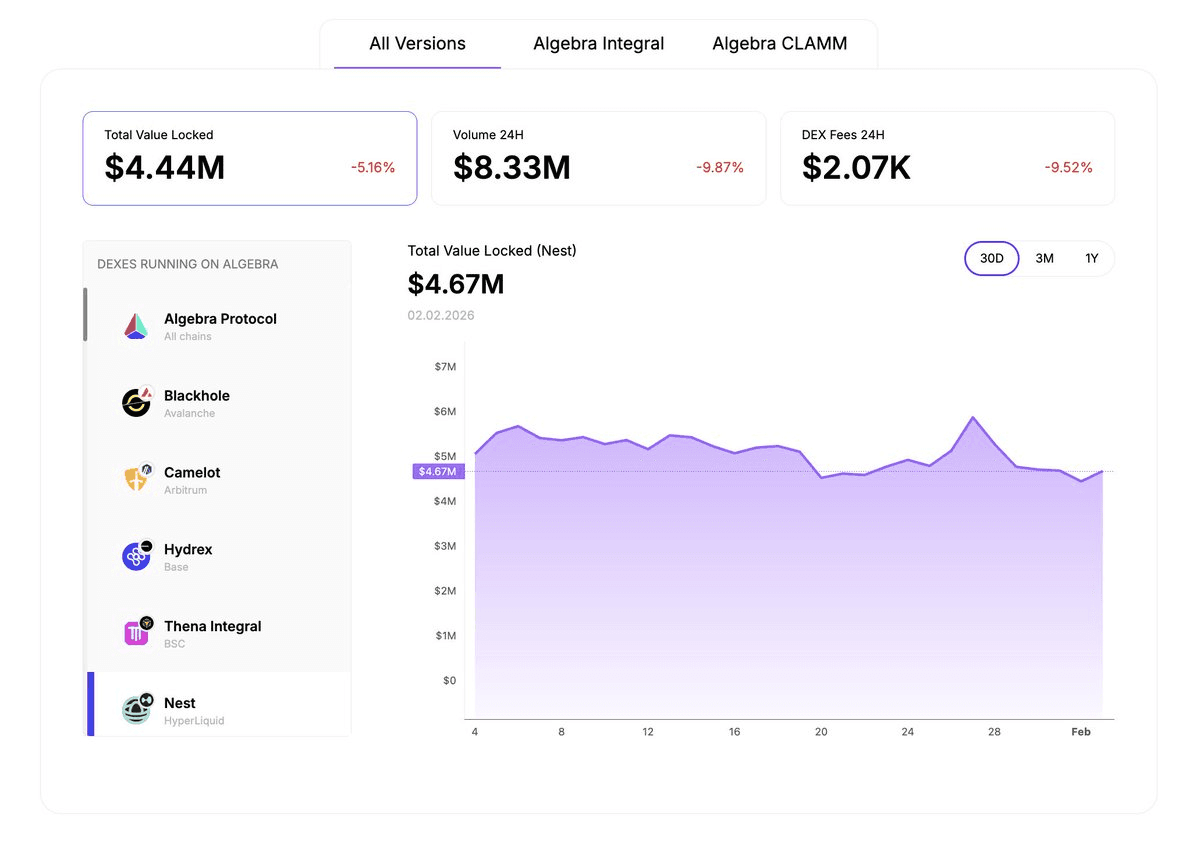
**NestExchange demonstrates exceptional capital efficiency** with $8.33M in 24-hour trading volume against just $4.44M in total value locked (TVL) - a ratio of 1.88x. **Key metrics:** - 24h volume: $8.33M - TVL: $4.44M - Platform: Hyperliquid - Technology: Powered by Algebra **Context:** Algebra, the concentrated liquidity protocol, continues expanding across DeFi with $166B total volume and 50+ DEX integrations. The platform's adaptive fee mechanism and capital efficiency features enable exchanges like NestExchange to maximize trading activity relative to locked capital.
Algebra Launches White-Label DEX Solution
Algebra has launched its white-label CLAMM (Concentrated Liquidity AMM) solution for builders looking to deploy next-generation DEXes. The offering includes: - **Concentrated liquidity** with dynamic fees - **V4 plugins** for modular functionality - **ve(3,3) tokenomics** out of the box - **Rapid deployment** in weeks instead of months The solution eliminates the need to build from scratch, allowing teams to integrate Algebra's production-ready infrastructure and launch quickly. This follows recent ecosystem growth, with Algebra powering 90+ DEXes across EVM chains including Henesys DEX on MapleStory and Satsuma on Citrea. Algebra's modular architecture enables customization through plugins while maintaining a battle-tested core. Teams can add features like KYC, limit orders, and custom fee models without disrupting existing liquidity. Interested builders can apply at [algebra.finance/form](http://algebra.finance/form/)
Algebra Solves DEX Upgrade Problem with Modular Plugin Architecture
Algebra addresses three core DEX challenges: static fees that hurt liquidity providers, inflexible monolithic code, and liquidity resets during upgrades. **The Solution:** - Modular plugin system keeps core logic immutable - Upgrades happen without liquidity migration - Deployed across 95 DEXes and 80+ chains **Key Features:** - Dynamic fees - Limit orders - TWAP oracles - Integrated farming The architecture allows DeFi modules to be upgraded independently while maintaining liquidity positions, creating a competitive market for DEX functionality improvements.
🎯 Algebra Launches MEV-X: On-Chain Backrun Plugin That Captures MEV Value Instead of Leaking It
Algebra has launched the **MEV-X On-Chain Backrun plugin**, a protocol-native solution that captures MEV (Maximal Extractable Value) instead of letting it leak to external actors. **Key Features:** - Internalizes backrun MEV directly inside swaps using post-swap hooks - Fully on-chain and atomic execution - No UI or backend required - Lightweight gas optimization - **MEV profits shared between protocol and traders** This follows Algebra's earlier integration with ReflexMEV, which generated **$64K revenue from $11M protected volume** in just two weeks on Gliquid. The plugin represents a shift from MEV as value extraction to **MEV as shared value** - rewarding liquidity providers and traders rather than draining them. Learn more: [MEV-X Backrun Plugin](http://market.algebra.finance/plugin/mevx-backrun/)