Who Defines Reality When AI Mediates Human Reasoning?
Who Defines Reality When AI Mediates Human Reasoning?
🧠 Who defines reality

As a small number of companies become the primary interface between billions of people and information, epistemic capture poses a material risk. When AI extends beyond showing us what exists to shaping how we think, this risk becomes existential.
The critical question is no longer just about who builds AI models, but who gets to define reality itself.
The solution: Infrastructure that preserves collective sensemaking in human hands, ensuring our agency remains intact as AI becomes more deeply integrated into how we understand the world.

When a handful of firms become the interface between billions of people and our understanding of the world, the risk of epistemic capture becomes material. When AI extends that mediation from what we see to how we reason, the risk becomes existential. At that point, the central
🐝 How Bees Coordinate Without Talking—And Why It Matters for AI Agents
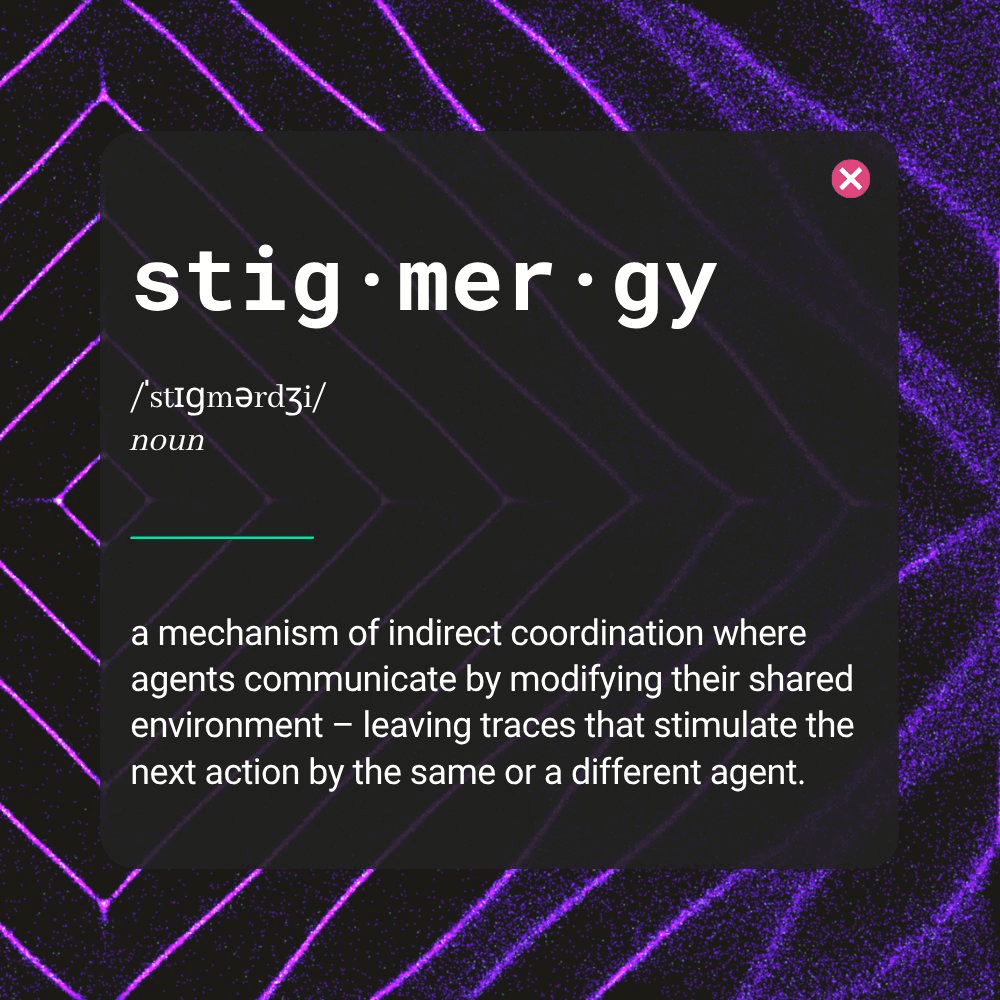
**Stigmergy** is how bees coordinate without direct communication—they leave traces in their environment that signal what to do next. This same pattern already exists in: - **Open source**: bugs, TODOs, unfinished features - **Onchain systems**: treasury balances, proposals, protocol states As AI agents gain the ability to read and respond to environmental signals autonomously, stigmergy becomes a mechanism for **turning shared environment into shared direction at machine speed**. [Read more](https://gitcoin.co/mechanisms/stigmergy)
🌐 Gitcoin Proposes Networked Epistemology for Complex Problems
Gitcoin Research argues that traditional centralized systems for collective understanding are failing in the face of modern complexity. **The Problem:** - Legacy approaches (centralization, bureaucracy) work for simple, defined problems - Complex, entangled issues expose their limitations - Results: misinformation, polarization, institutional decay **The Solution:** Gitcoin proposes a new framework called "networked epistemology" - a model for collective understanding that adapts faster than traditional systems. [Read the full research](https://gitcoin.co/research/a-networked-epistemology)
🔧 Gitcoin GG24 Deep Funding Results
Gitcoin has released the **deep funding update** for GG24's Web3 Tooling and Infrastructure round. **Key Details:** - Projects can now check their qualification status for deep funding - Part of GG24's six-domain structure allocating **$1.8M total** - First round fully designed through structured sensemaking - Focuses on developer tooling and infrastructure projects This represents Gitcoin's approach to directing capital toward critical Web3 development needs. [Check qualification status](https://gov.gitcoin.co/t/deep-funding-gg24-web3-tooling-and-infra-round/25040)
Gitcoin Pivots to Lean Experimentation Model for 2026
Gitcoin has outlined a strategic reset for 2026, moving away from its previous approach to focus on three core principles: **The AAA Framework:** - **Alignment**: Fund projects that advance human thriving - **Alpha**: Identify and attract high-potential builders - **Accelerate**: Operate with small, efficient teams **Coalition-First Funding** The platform will require projects to demonstrate 60-70% funding from external sources before receiving Gitcoin support. This approach aims to surface builders with genuine community backing through the upcoming GG25 round. **Experimental Approach** Rather than committing to large-scale initiatives, Gitcoin will run low-budget, time-limited experiments throughout 2026. The organization will only pursue recapitalization and scaling after these experiments show clear traction and legitimacy. This represents a significant shift from Gitcoin's previous grant-making model, emphasizing validation and external support over direct funding. The strategy suggests a more cautious approach following lessons learned from past rounds. [Read the full strategy](https://gov.gitcoin.co/t/gitcoin-2026-strategy-tl-dr/25049/1)