Venus Flux Unifies Lending, Borrowing, and DEX Swaps in Single Liquidity Pool
Venus Flux Unifies Lending, Borrowing, and DEX Swaps in Single Liquidity Pool
🔄 One pool, three functions

Venus Flux introduces a fundamentally different architecture from traditional lending protocols through Fluid's unified liquidity layer.
Key Innovation:
- Single deposit simultaneously backs three functions: lending positions, borrowing capacity, and DEX trading liquidity
- All operations share the same liquidity pool, eliminating siloed capital
How It Works:
- Deposits flow into one shared reserve that serves multiple vaults
- Borrowing demand from 30+ vaults concentrates into unified pools per asset
- Higher structural utilization leads to better rates for lenders
Three Distinct Modes:
Lend: Standard supply with enhanced capital efficiency
Borrow: CDP-style collateralized positions (similar to MakerDAO). Collateral stays separate as security. Smart vaults can hold DEX LP positions as collateral, earning swap fees that offset borrowing costs.
Multiply: Automated leverage in one transaction. Example: 3x BNB exposure through automatic supply, borrow, and re-collateralization loop.
Rate Stability: Shared liquidity absorbs individual vault demand spikes more efficiently than isolated pools, reducing rate volatility while maintaining utilization-based pricing.

Venus now has two lending products: Core and Flux (powered by @0xfluid). Many users assumed Flux would cannibalise Core's liquidity, but it hasn't. Flux is a fundamentally different system: different architecture, different mechanics, different purpose. Here's how Flux operates

4/ Multiply (Venus Flux) runs on a different architecture entirely. Flux is built on Fluid's unified liquidity layer — lending, borrowing, and DEX swaps share the same pool. A single deposit simultaneously backs lending positions, borrowing capacity, and trading liquidity. →
5/ Beyond Lend, Flux has two other distinct modes — and they work very differently. Borrow is CDP-style, closer to MakerDAO than Venus Core. You supply a collateral asset (BNB, BTCB, ETH, wBETH, syrupUSDT, and others) and borrow against it. Your collateral never enters the
4/ Multiply (Venus Flux) runs on a different architecture entirely. Flux is built on Fluid's unified liquidity layer — lending, borrowing, and DEX swaps share the same pool. A single deposit simultaneously backs lending positions, borrowing capacity, and trading liquidity. →
4/ That shared liquidity layer is also why Flux stablecoin rates can run significantly higher than Core. On Core, each asset's supply rate depends on that asset's individual utilization. On Flux, borrow demand from 30+ active vaults concentrates into one shared reserve per
6/ On Core: borrow rates can spike sharply when a single market hits high utilization. You're exposed to one market's demand curve drawing on a fixed liquidity silo. On Flux: the same utilization model applies, but liquidity is shared across vaults — individual borrowing spikes
6/ On Core: borrow rates can spike sharply when a single market hits high utilization. You're exposed to one market's demand curve drawing on a fixed liquidity silo. On Flux: the same utilization model applies, but liquidity is shared across vaults — individual borrowing spikes
5/ Beyond Lend, Flux has two other distinct modes — and they work very differently. Borrow is CDP-style, closer to MakerDAO than Venus Core. You supply a collateral asset (BNB, BTCB, ETH, wBETH, syrupUSDT, and others) and borrow against it. Your collateral never enters the
4/ Flux still tracks per-token utilization, which is the same formula as Core. What's different is the capital efficiency behind it. Fluid's unified liquidity architecture pools lending deposits across all markets and vaults. When borrowing demand spikes in one vault, it draws
Venus now has two lending products: Core and Flux (powered by @0xfluid). Many users assumed Flux would cannibalise Core's liquidity, but it hasn't. Flux is a fundamentally different system: different architecture, different mechanics, different purpose. Here's how Flux operates
4/ That shared liquidity layer is also why Flux stablecoin rates can run significantly higher than Core. On Core, each asset's supply rate depends on that asset's individual utilization. On Flux, borrow demand from 30+ active vaults concentrates into one shared reserve per
Venus Protocol Closes 5th Anniversary Quiz Contest with 500 USDT Prize Pool
Venus Protocol's **5th anniversary quiz contest** ends today, offering participants a final chance to compete for prizes. **Contest Details:** - 500 USDT total prize pool - Ten winners will share the rewards - Perfect scores required to qualify - Winners announced tomorrow Participants must submit all correct answers by the deadline to be eligible for the prize distribution.
Venus Protocol $40,000 WBNB Pool Incentive Program Ends Today
**Final opportunity** to participate in Venus Protocol's $40,000 incentive program for the $WBNB pool on Merkl. **Key requirements:** - Hold at least 50 $XVS tokens in your wallet - Supply or borrow in the $WBNB pool - Program ends today (November 29, 2025) **Benefits available:** - Boosted supply rates for lenders - Subsidized borrowing costs - Share of $40,000 total rewards The 5-day program launched on November 25 and provides incentives on both supply and borrow sides of the pool. [Access the program](https://app.merkl.xyz/?search=Venus) | [Venus WBNB Pool](https://app.venus.io/#/pool/0xfD36E2c2a6789Db23113685031d7F16329158384/market/0x6bCa74586218dB34cdB402295796b79663d816e9?chainId=56&tab=supply)
Venus Joins BNB Chain DeFi Festival with $1M Prize Pool

**Venus Protocol** has joined the BNB Chain DeFi festival alongside SolvProtocol and BounceBit. The collaboration features a **combined $1M prize pool** available through Binance Wallet. - Festival brings together major DeFi protocols on BNB Chain - Prize distribution details to be announced soon - Participants can access rewards via Binance Wallet More announcements expected on how users can claim their share of the substantial reward pool.
Venus Protocol Launches USDC Borrowing Incentives
Venus Protocol has introduced new borrowing incentives in partnership with Gauntlet. The program offers: - 15,000 USDC in rewards for USDC borrowers - Two-week duration for the incentive program - Available exclusively on Unichain Users can access these rewards through the [Venus Core Pool](https://app.venus.io/#/core-pool/market/0xB953f92B9f759d97d2F2Dec10A8A3cf75fcE3A95?chainId=130). *Time-sensitive opportunity: Limited two-week window to participate.*
Venus Protocol on ZKSync Sees Massive User Growth in January
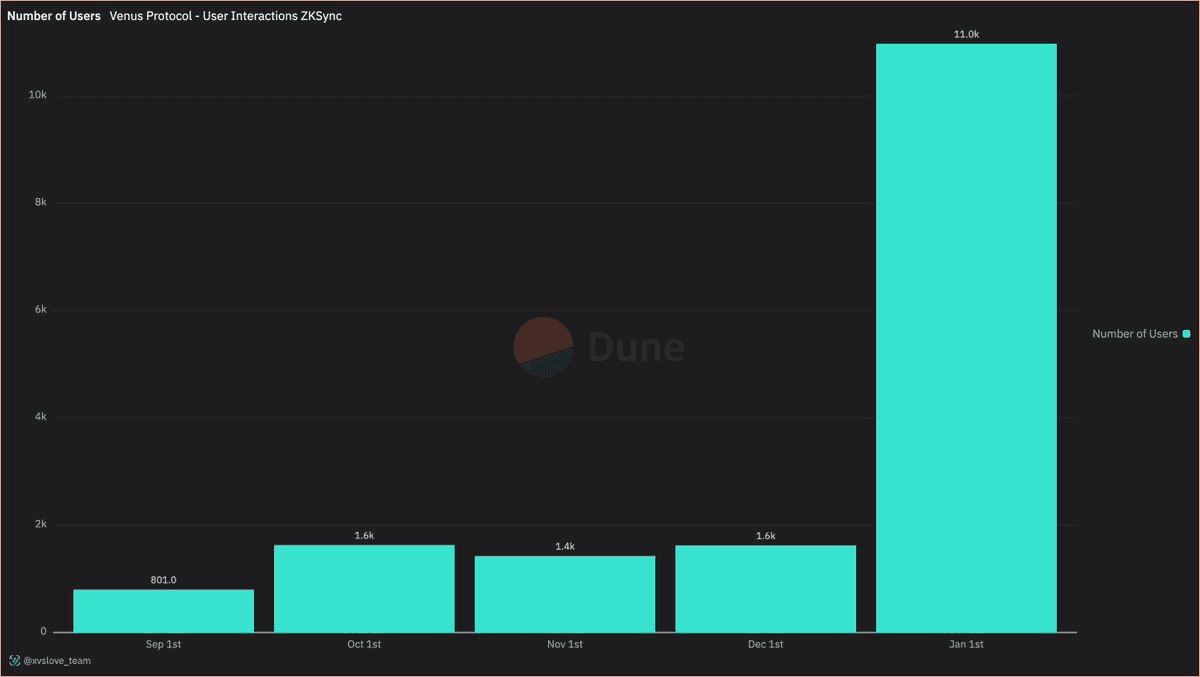
Venus Protocol experienced significant user growth on the ZKSync network in January 2024: - Monthly active users increased from 1,600 to 11,000 - Represents a 576% month-over-month growth - Total user base since launch: 13,200 Data verified through [Dune Analytics](https://dune.com/xvslove_team/venus-protocol-dashboard#zkSync). This growth indicates rising adoption of DeFi services on ZKSync's layer-2 network.