Thorchain to Burn 60m RUNE for Lending Space
Thorchain to Burn 60m RUNE for Lending Space


In the next network upgrade, Thorchain will burn 60m RUNE to create space for lending, onboarding a minimum of $100m in new collateral for monetisation. Borrowers will enjoy a 50% LTV loan with no liquidation. The system is expected to double in TVL and quadruple in price action as it expands.

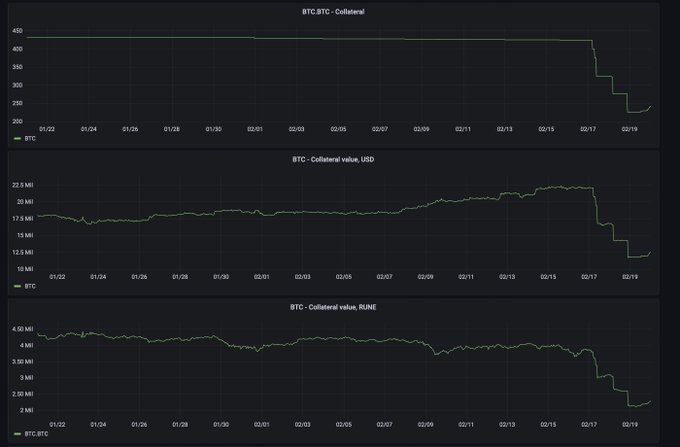
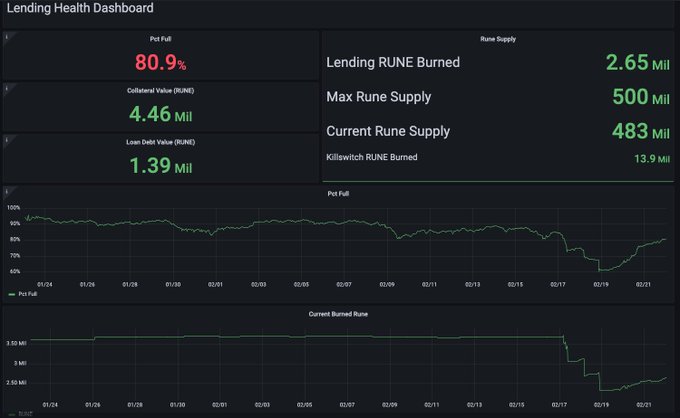
In the lead-up to the MAXCR drop from 500% to 200% many BTC lenders closed (likely in order to re-open). 425 BTC ($22m) down to 226 BTC ($11m). A very good stress test on the system. Almost 50% of the lending book closed in 3 days. How did the system go in the last few days?

Big news in @THORChain land! TC now offers the best loan terms in all of crypto: 50% LTV, 0% interest, NO LIQUIDATION, and no expirary Seems too good to be true, but it is! A $RUNE 🧵👇
All @THORChain loans can now be taken out at 50% LTV. This user borrowed $26k against a 1 $BTC deposit to do whatever they like with. They'll pay 0% interest for this service, and won't be liquidated even if BTC goes to $1. It's hard not to see lending get maxxed out soon⚡️

🏦→ Loan open [m90j] Collateral deposited: 0.999 BTC ($51,872) CR: x2.0 Debt: $25,927 Target asset: Rune ᚱ dashboards.ninerealms.com/#lending
My looped $ETH position is currently up an extra 44% compared to holding spot. I pay no interest fees and can't be liquidated. Interested? If you missed the boat before, free leverage on $BTC and $ETH is about to become available on @THORChain again ⚡️

I took out an early $ETH backed loan through Thorchain at around 47% LTV. I looped back into $ETH 3x and now have exposure to 70% more $ETH compared to holding spot. There are no interest costs, funding fees or liquidations. If you're ok with the smart contract risk and are
V128 will burn 60m RUNE to make space for lending. This will onboard a minimum of $100m in new collateral for TC to monetise in its liquidity. Borrowers get an amazing loan (50% LTV), TC gets assets to monetise. Win-Win

10 more nodes to vote. 60,000,000 $RUNE will be burnt, and effectively turned into collateral buffer - allowing an additional $100m+ of collateral to be onboarded to the system. $100m of BTC and ETH loans at 200% CR. Onwards

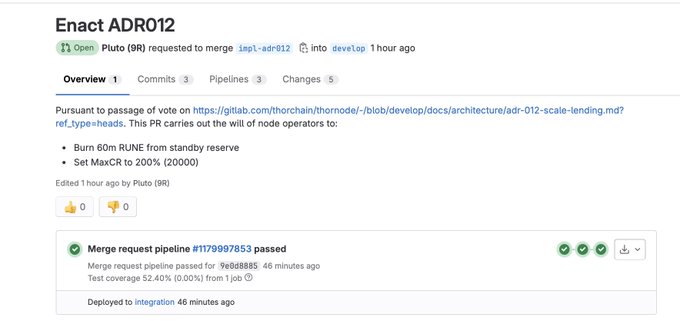
In the next THORNode release v128, 60m $RUNE will be burned to create capacity for 2.1k BTC (or 41k ETH) collateral for lending with a fixed LTV of 50% Keep track with the below PR: gitlab.com/thorchain/thor…
ADR12 has been voted on. 60m RUNE will now be burnt, and provided for acceleration of lending. Lending CR's will drop to 200% flat - ie, a 1 BTC loan will yield $25k debt (50%). Onwards.
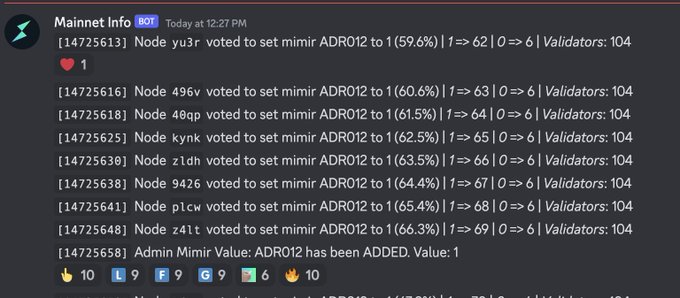
Now that ADR12 has passed, let's talk about how it will be enacted and compare it with any similar events in past. 🧵
ADR12 has received strong support. 1) Burns 60m RUNE (essentially giving the protocol control of that supply) 2) Allowing Lending Collateral to scale to ~25m RUNE ($125m worth of collateral can be onboarded) 3) Collateral is given to TC for free by users, for TC to monetise
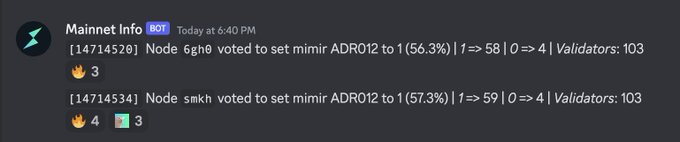
103 THORNodes are currently voting on whether to burn 60m $RUNE (worth over $300m) and drop lending collateralisation ratios to 200%. Currently at 32% for. Jump in the discord to participate in the discussion. Onwards!

Every little $ETH price pump is like a knife to my heart… cos my lending collateral was liquidated at $1700. Not blaming that specific lending protocol… BUT, no liquidation, no interest, no expiry, flat 50% LTV loans NOW AVAILABLE on @THORChain ?!? Sign me up!!! 😻💚⚡️
🏦→ Loan open [m90j] Collateral deposited: 0.999 BTC ($51,872) CR: x2.0 Debt: $25,927 Target asset: Rune ᚱ dashboards.ninerealms.com/#lending

What if you could double your exposure to $ETH without liquidations or paying interest? That is the benefit of looping your loan on @THORChain Loop your loan 7x and you will have twice the exposure with: ⚡️No expiry ⚡️No interest ⚡️No liquidations 7x Loop loan: You have
MaxCR has been lowered to 200%. All loans now opened are 50% LTV - deposit 1 BTC, borrow $25k in debt. No liquidations, no interest, no expiry. Lending is now 9 months old and has almost 1000 users. Now let's talk about how TC benefits from this.
What's going to happen now? 1) Next network upgrade will burn 60m RUNE 2) Mimir will drop maxCR down to 200% This will mean: 1) Over $100m of new loans to the system 2) Unbeatable loan terms TC is now positioned to be the lead for decentralised L1 lending
🔄 Rujira's instant lending
**THORChain's block-based settlement creates a timing gap** that prevents perfect real-time arbitrage. Swaps settle at the end of each block in a fixed order—secure by design, but not instant. **Rujira Network bridges this gap** through its Virtualisation Strategy: - Users receive tokens **instantly** from Rujira's lending pool - Rujira executes the actual THORChain swap at block end - Charges a small premium while absorbing brief price risk **The result**: automatic arbitrage every block when price deviations occur. This keeps THORChain prices more accurate, reduces slippage, and speeds up execution when combined with Rapid Swaps. Previously, external bots captured ~$3M monthly in arbitrage profits from average 0.40% pool price deviations. Rujira's approach aims to internalize 10-50% of the estimated $800M monthly arbitrage volume, returning value to the ecosystem while improving user experience through tighter spreads and better quotes.
🔒 Privacy Paradox
**THORChain maintains full transparency while supporting privacy coins like Monero** The protocol demonstrates that integrating privacy-focused assets doesn't compromise its transparent architecture. Every swap remains visible on-chain, even when involving privacy coins. **Key points:** - Protocol-level transparency persists regardless of asset privacy features - Monero integration expected within weeks - Native cross-chain swaps without wrapped tokens or KYC requirements - Direct API access for builders through THORChain's Native API Unlike centralized exchanges that require identity verification for privacy coin trades, THORChain enables permissionless swaps while maintaining protocol transparency. [Read the full technical explanation](https://blog.thorchain.org/thorchain-is-transparent-even-with-privacy-coins)
THORChain Could Enable Monero Arbitrage After Exchange Delistings
As centralized exchanges potentially delist Monero, THORChain may become critical infrastructure for price discovery and arbitrage. **Key Points:** - @devel484 explains how arbitrage would function if spot exchanges remove Monero listings - THORChain's decentralized liquidity protocol could serve as the primary price-setting mechanism - The integration would allow traders to maintain market efficiency without centralized venues - Discussion centers on what price discovery looks like post-integration The shift would represent a significant test of decentralized infrastructure's ability to replace traditional exchange functions.
THORChain Enables Wallet-Free Swaps Through Pre-Registration
THORChain has introduced a swap mechanism that eliminates the need for wallet connections during execution. **How it works:** - Users pre-register swap intent on-chain, specifying destination asset and receiving address - System generates a reference ID and QR code with vault address and exact amount - Users scan and send from any wallet type (hardware, cold storage, etc.) - THORChain matches incoming transactions to registered intent and executes to destination **Key benefits:** - No wallet connection required at execution - No open approval contracts - Uses native L1 transactions only
EU Users Choose Self-Custody Over New Exchanges After MiCA Restrictions
Following MiCA regulations that restricted EU exchange access in July, millions of users opted for self-custody rather than seeking alternative platforms. **Key Developments:** - EU users responded to exchange restrictions by taking direct control of their funds - Decentralized exchanges (DEXs) saw increased adoption as centralized options became limited - THORChain emerged as a significant infrastructure provider enabling this transition **What Changed:** The regulatory shift forced users to reconsider their relationship with centralized platforms. Rather than waiting for compliant exchanges, many moved to self-custody solutions and decentralized trading infrastructure. Analysis from [Crypto.News](https://crypto.news/nobody-needed-exchanges-to-begin-with/) and [CoinCodex](https://coincodex.com/article/87303/self-custody-is-the-trade-again/) highlights how this regulatory pressure accelerated a trend toward decentralization that was already underway. The shift demonstrates that users can maintain trading activity without relying on traditional exchange infrastructure when given the right tools and protocols.