Thorchain celebrates $1 million swap at 3 basis points
Thorchain celebrates $1 million swap at 3 basis points


Thorchain highlights a successful $1 million swap executed at 3 basis points, showcasing the platform's efficiency as a global settlement layer for native assets. The platform aims to continue improving with features like trade accounts, order books, and rapid swaps.

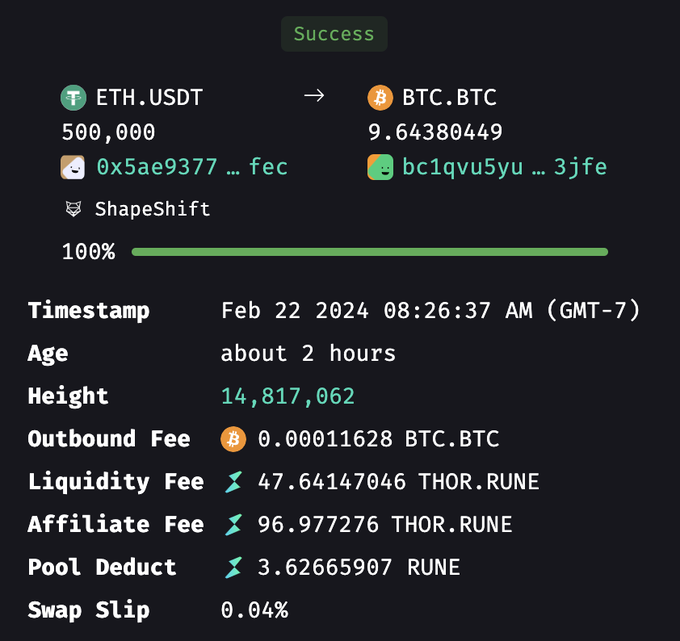
Never tire of seeing exchanges use @THORChain as it was intended: as a scalable, global settlement layer of native assets. A ~1 million dollar swap executing at 3 basis points, just beautiful

🌊 Streaming swap finished 👤[1123]: 300.0 $ETH → ⚡ → 17.2 $BTC ($969.7K) Slip: 0.030 %, liq. fee: $484.2 ⏱️ Time: 1 hour 15 min. runescan.io/tx/925A5834699…
Seeing many of these every day is still surreal to me. $500k swap executing at 4 basis points of slip. Streaming swaps is impressive now, and will get much better with trade accounts, order books, and rapid swaps.
🔄 Rujira's instant lending
**THORChain's block-based settlement creates a timing gap** that prevents perfect real-time arbitrage. Swaps settle at the end of each block in a fixed order—secure by design, but not instant. **Rujira Network bridges this gap** through its Virtualisation Strategy: - Users receive tokens **instantly** from Rujira's lending pool - Rujira executes the actual THORChain swap at block end - Charges a small premium while absorbing brief price risk **The result**: automatic arbitrage every block when price deviations occur. This keeps THORChain prices more accurate, reduces slippage, and speeds up execution when combined with Rapid Swaps. Previously, external bots captured ~$3M monthly in arbitrage profits from average 0.40% pool price deviations. Rujira's approach aims to internalize 10-50% of the estimated $800M monthly arbitrage volume, returning value to the ecosystem while improving user experience through tighter spreads and better quotes.
🔒 Privacy Paradox
**THORChain maintains full transparency while supporting privacy coins like Monero** The protocol demonstrates that integrating privacy-focused assets doesn't compromise its transparent architecture. Every swap remains visible on-chain, even when involving privacy coins. **Key points:** - Protocol-level transparency persists regardless of asset privacy features - Monero integration expected within weeks - Native cross-chain swaps without wrapped tokens or KYC requirements - Direct API access for builders through THORChain's Native API Unlike centralized exchanges that require identity verification for privacy coin trades, THORChain enables permissionless swaps while maintaining protocol transparency. [Read the full technical explanation](https://blog.thorchain.org/thorchain-is-transparent-even-with-privacy-coins)
THORChain Could Enable Monero Arbitrage After Exchange Delistings
As centralized exchanges potentially delist Monero, THORChain may become critical infrastructure for price discovery and arbitrage. **Key Points:** - @devel484 explains how arbitrage would function if spot exchanges remove Monero listings - THORChain's decentralized liquidity protocol could serve as the primary price-setting mechanism - The integration would allow traders to maintain market efficiency without centralized venues - Discussion centers on what price discovery looks like post-integration The shift would represent a significant test of decentralized infrastructure's ability to replace traditional exchange functions.
THORChain Enables Wallet-Free Swaps Through Pre-Registration
THORChain has introduced a swap mechanism that eliminates the need for wallet connections during execution. **How it works:** - Users pre-register swap intent on-chain, specifying destination asset and receiving address - System generates a reference ID and QR code with vault address and exact amount - Users scan and send from any wallet type (hardware, cold storage, etc.) - THORChain matches incoming transactions to registered intent and executes to destination **Key benefits:** - No wallet connection required at execution - No open approval contracts - Uses native L1 transactions only
EU Users Choose Self-Custody Over New Exchanges After MiCA Restrictions
Following MiCA regulations that restricted EU exchange access in July, millions of users opted for self-custody rather than seeking alternative platforms. **Key Developments:** - EU users responded to exchange restrictions by taking direct control of their funds - Decentralized exchanges (DEXs) saw increased adoption as centralized options became limited - THORChain emerged as a significant infrastructure provider enabling this transition **What Changed:** The regulatory shift forced users to reconsider their relationship with centralized platforms. Rather than waiting for compliant exchanges, many moved to self-custody solutions and decentralized trading infrastructure. Analysis from [Crypto.News](https://crypto.news/nobody-needed-exchanges-to-begin-with/) and [CoinCodex](https://coincodex.com/article/87303/self-custody-is-the-trade-again/) highlights how this regulatory pressure accelerated a trend toward decentralization that was already underway. The shift demonstrates that users can maintain trading activity without relying on traditional exchange infrastructure when given the right tools and protocols.