The Graph Open-Sources Market-Leading Blockchain Indexing Solution
The Graph Open-Sources Market-Leading Blockchain Indexing Solution
🔍 Blockchain indexing dominance

The Graph has created and open-sourced Subgraphs, now the most widely used blockchain indexing solution in the market.
This development builds on significant growth:
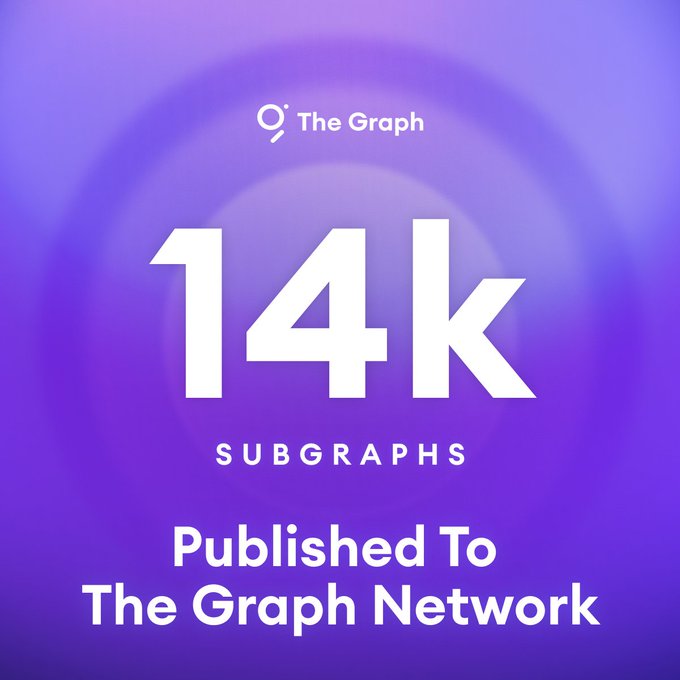
- 14,000 Subgraphs are currently live on The Graph Network
- All subgraphs are open source and ready to query
- Developers can access instant blockchain insights without gatekeeping
2025 expansion highlights:
- Added support for multiple new chains including Soneium, Solana, Abstract Chain, Unichain, Monad, and Tron
- Enhanced support across Subgraphs, Substreams, and Token API
- Simplified developer access to onchain data through familiar standards
Subgraphs have become the standard for querying blockchain data, enabling developers to power their dapps with comprehensive blockchain insights across various networks.
The Graph continues advancing its mission as the data layer for web3, making blockchain data more accessible and standardized for developers regardless of which chain they're building on.

🌐 2025 has been a big year for The Graph. Since January, support has expanded across Subgraphs, Substreams, and the Token API, giving builders access to more networks than ever. Here are some of the chains The Graph has added support for since the beginning of 2025: ⚡ @Soneium
The Graph created and open-sourced the most used blockchain indexing solution on the market (Subgraphs). Just sayin’.
🎉 14,000 Subgraphs are now live on The Graph Network Subgraphs have become the standard for querying blockchain data. On The Graph Network, all of them are open source and ready to query, so you can power your dapp with instant blockchain insights, without gatekeeping.
The Graph Showcases Enterprise Blockchain Infrastructure at Digital Asset Summit NYC
**The Graph is attending the Digital Asset Summit 2026 in New York City**, showcasing infrastructure solutions for institutional blockchain adoption. **Key highlights:** - Verifiable data pipelines for enterprise use - Blockchain database solutions ready for institutional deployment - The Graph team available at their booth for meetings The event focuses on infrastructure that enables institutions to operationalize onchain data, marking continued institutional interest in blockchain technology.
The Graph Brings Subgraph Indexing to Tempo Payments Chain
The Graph now supports Tempo's Moderato testnet and Mainnet with Subgraph indexing capabilities, enabling developers to build payment-focused applications without custom infrastructure. **Key capabilities for fintech teams:** - Index stablecoin transfers and track settlement patterns - Build real-time payment tracking dashboards - Create compliance monitoring tools for cross-border flows - Develop automated payroll verification systems - Generate settlement analytics for tokenized deposits Developers can transform raw on-chain data into queryable GraphQL APIs, backed by The Graph's indexing infrastructure across 70+ networks. This integration provides the data layer infrastructure needed for payment-first blockchain applications.
The Graph Foundation Schedules Public Quarterly Call for March 31
**The Graph Foundation** is hosting an open quarterly call on **March 31** for the entire community. **Agenda includes:** - Strategy updates - Deep dive into product and protocol roadmap - Network economics discussion - Q&A session This follows the recent publication of The Graph's Technical Roadmap and 2025 Grants Report. The call provides an opportunity for community members to engage directly with the foundation on upcoming developments. Full details and registration information are available in the forum.
The Graph Rolls Out 2026 Roadmap for Substreams Network Expansion
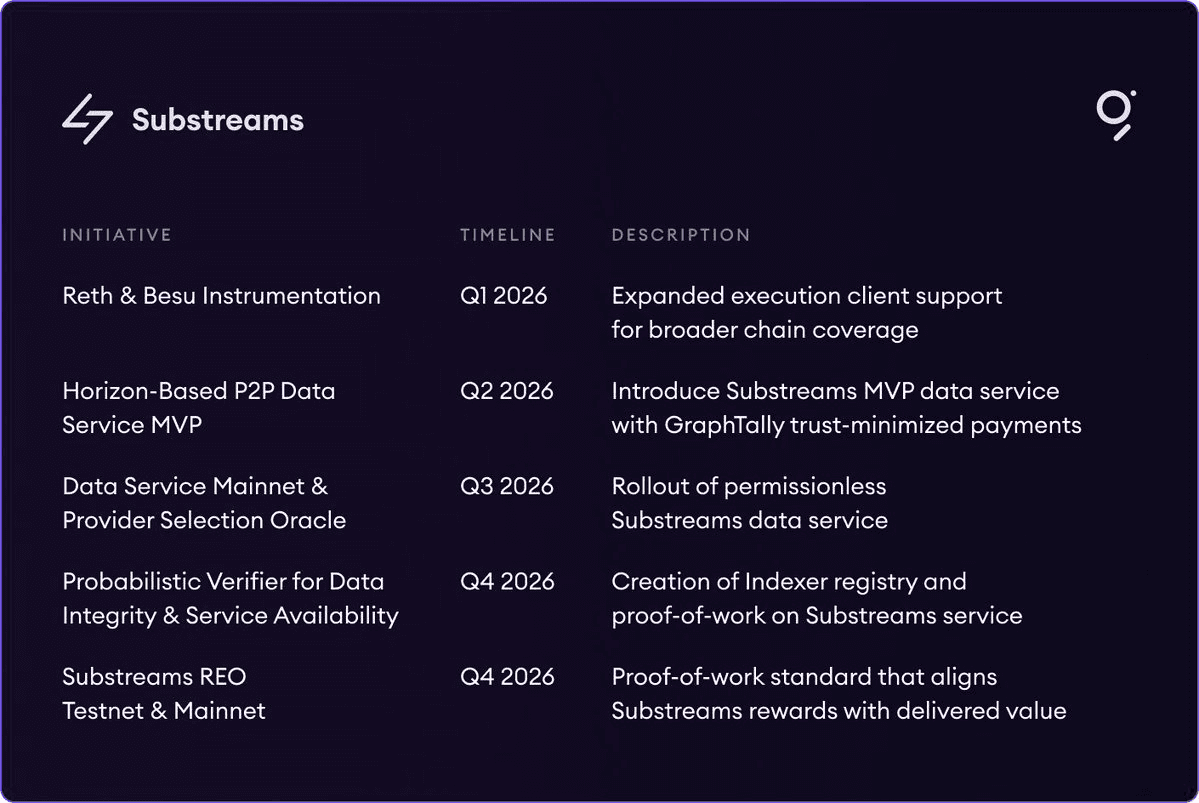
**The Graph announced its 2026 roadmap for Substreams**, the protocol that reduces Ethereum history processing from weeks to hours through parallel processing. **Key milestones:** - **Q1:** Reth and Besu instrumentation for expanded chain coverage - **Q2:** Horizon-based P2P data service with GraphTally payments - **Q3:** Mainnet rollout and Provider Selection Oracle - **Q4:** Probabilistic verifier for data integrity and Substreams REO The upgrades transform Substreams into a **fully permissionless data service** with trust-minimized payments and verification mechanisms. The technology already supports high-throughput chains including Solana, Base, and BSC with sub-second latency. Substreams addresses blockchain indexing bottlenecks by connecting directly to nodes rather than relying on RPC calls, enabling parallel data streaming across multiple channels simultaneously.
DTCC Blockchain Experiment Tests Financial System Resilience
**Could blockchain reduce systemic risk in traditional finance?** Andrew Clews, Enterprise Strategy & Governance Lead at The Graph Foundation, examines The DTCC's blockchain experiment through a critical lens. Rather than focusing on efficiency gains, he asks whether blockchain technology could make financial markets: - Fail less frequently - Fail less catastrophically when problems occur - Better serve the people who depend on them Clews has spent his career working toward fairer financial infrastructure. He sees blockchain's potential not just in cost savings, but in creating **more auditable systems** for all market participants. The DTCC experiment offers early signals about whether distributed ledger technology can address the structural inefficiencies that cost traditional finance billions annually—and more importantly, whether it can reduce the kind of systemic failures that impact everyday people. This perspective shifts the conversation from blockchain hype to practical questions about financial system resilience and accountability.