The Graph Evolves Beyond Subgraphs Into Multi-Service Data Platform
The Graph Evolves Beyond Subgraphs Into Multi-Service Data Platform
🔮 The Graph's new identity

The Graph is positioning itself as an alternative to centralized infrastructure like AWS for blockchain data services. The protocol is expanding from its original limited product offerings to support multiple specialized data services.
Key developments:
- Teams can now build custom data services on The Graph's open infrastructure
- Six specialized data products planned, including real-time streaming and SQL analytics
- Unified protocol layer called Horizon will connect these services
- Designed for developers, AI agents, analysts, and institutions
The 2026 technical roadmap outlines this transformation into a comprehensive data services platform for the onchain economy, moving beyond its initial focus on subgraphs.

"We have a data service that we think is really cool — we want to serve data to users. Do we have to use a centralized back end like AWS? No, you can go to The Graph. For a long time, there was only a handful of products available on the protocol. The vision is a proliferation of

Blockchain data is powerful. Accessing it should not be complicated. @TwentyTwoNode, Team Lead at @graphprotocol, sat down with @LockFryer to break down how The Graph makes reading blockchain data faster and easier. 01:27 - What is The Graph? 02:17 - How long it’s been around
Substreams Brings Parallel Processing and Sub-Second Latency to Blockchain Indexing
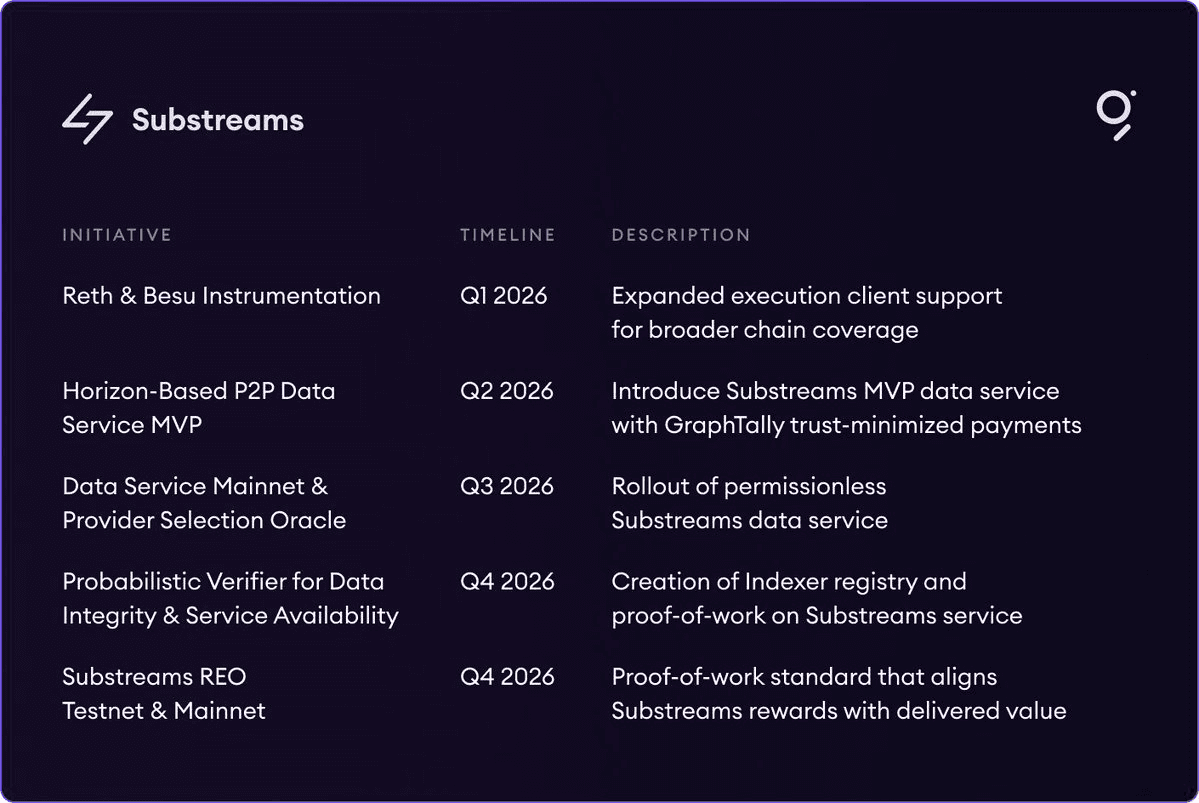
Sequential blockchain indexing struggles at scale. **Substreams addresses this challenge** through parallel processing, composable modules, and sub-second latency across chains including Solana, Base, and BSC. **Key technical advances:** - Parallel processing architecture replaces sequential indexing bottlenecks - Sub-second data latency for real-time applications - Support for high-throughput chains (Solana, Base, BSC) **2026 Network Evolution:** Substreams transitions The Graph Network into a fully permissionless data service with: - Trust-minimized payment systems - Provider Selection Oracle for routing - Probabilistic verifier ensuring data integrity The infrastructure targets traditional financial institutions requiring compliance-ready, high-throughput blockchain data access. The parallel processing approach has demonstrated 70% cost reductions and significantly faster historical data backfills compared to sequential methods. [Learn more about Substreams modules](https://substreams.dev/)
Tempo Integrates The Graph's Subgraphs for Payment Chain Data Access
**Tempo's Moderato and Mainnet are now indexable with The Graph's Subgraphs**, enabling developers to transform raw onchain data into queryable GraphQL APIs without custom infrastructure. **Key use cases for builders:** - Real-time payment tracking dashboards - Stablecoin transfer reconciliation - Compliance monitoring for cross-border flows - Automated payroll verification - Settlement analytics for tokenized deposits This integration provides a standardized data layer for the payments chain, allowing developers to build payment applications with easier access to blockchain data.
🔮 Builder Creates Natural Language Interface for $1.7B Prediction Market Data in One Weekend
A developer built a natural language interface for accessing $1.7 billion in on-chain prediction market data over a single weekend using The Graph protocol. **Key achievements:** - Created 3 custom Subgraphs - Developed 10 MCP (Model Context Protocol) tools - Enabled conversational queries of massive blockchain datasets - Required only one API key This demonstrates The Graph's capability to make blockchain data accessible through simple conversation rather than complex queries. The MCP integration allows AI tools like Claude and Cursor to pull information from over 12,000 Subgraphs using natural language, eliminating the need for technical expertise to access on-chain data.
AI Tool Enables Plain English Queries for Live Aave Protocol Data
A new tool called **graph-aave-mcp** allows developers and content creators to query Aave protocol data using plain English instead of GraphQL. **Key features:** - Real-time access to lending markets, liquidations, flash loans, health factors, and governance data - Fetches live data from The Graph Protocol subgraphs - Single npm install covers all major Aave deployments - Eliminates manual lookups and stale data **Use cases:** - Builders can prototype dashboards by describing requirements in natural language - Content creators can query live data while writing threads - Researchers and risk analysts can access current protocol metrics without technical barriers The tool removes the need for GraphQL knowledge, unit conversions, or outdated screenshots when working with Aave data.