AI Models Built on Decentralized Networks Show Greater Resilience
AI Models Built on Decentralized Networks Show Greater Resilience
🤖 When AI Meets Web3


Decentralized networks are proving crucial for building more resilient and trustworthy AI systems. Here's why:
- Censorship-resistant infrastructure ensures transparent operation
- Open, verifiable data reduces inherent AI biases
- The Graph's decentralized network provides AI-ready blockchain data
- Integration enables secure, reliable AI applications
The convergence of AI and web3 technologies is creating a foundation for unbiased AI development that anyone can trust. This builds on The Graph's existing work in making blockchain data accessible and reliable for developers.
Learn more about building decentralized AI applications at The Graph docs.

Today at @ETHGlobal Pragma, @yanivgraph will announce something new for building composable web3 apps using decentralized knowledge graphs. You don’t want to miss it. 🎤 Building Consumer Apps for a User-Owned Privacy First Web 📅 July 3 ⏰ 17:10 📍 Main Stage (Carlton Cannes)

Institutions are looking for clarity. Developers are looking for composability. Users are looking for trust. Decentralization answers all three. The Graph.
Need lightning-fast data at scale? Substreams powers top web3 & AI dapps, delivering precise indexing in real time at any volume. Build bigger without slowing down. Get started with Substreams today ⬇️
The Graph started with indexing. Now it’s building what comes next. Here’s what’s launched in 2025, plus a glimpse into a whole new Graph 👇
Hey, builders! @ETHGlobal is about to begin 🇫🇷 Visit The Graph’s booth to learn how to supercharge your project with fast and reliable onchain data, integrate it with AI applications, or build with the Knowledge Graph Framework and compete for $10k in bounties. This year’s

Building in web3? The Graph's decentralized network transforms raw blockchain data into usable insights with Subgraphs, Substreams, and Token API. Powered by $GRT, The Graph is the backbone for scalable, efficient app development.
.@solana’s speed is meaningless if your data layer crawls. Substreams brings real-time indexing for high‑TPS chains, instant historical backfills, automatic re‑org handling, historical account data, and pre‑built decodings. No RPC bottlenecks, no extra infra tax. Read the newest
Substreams is the superpower that can take your dapp to the next level. Every day, leading web3 and AI apps are choosing Substreams to help them scale their production. No other solution delivers performance with that speed and accuracy at that volume. Get started with
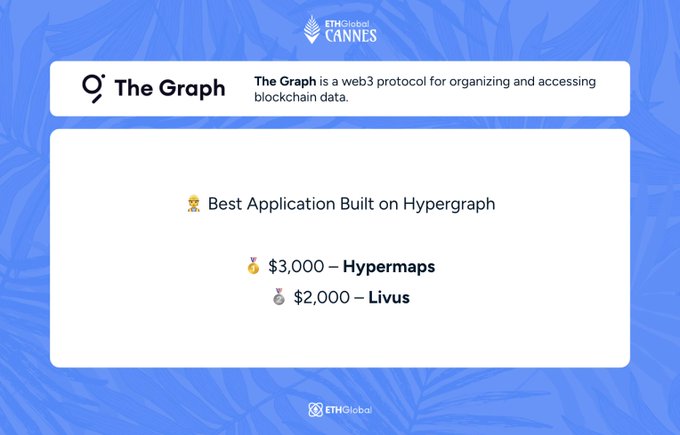
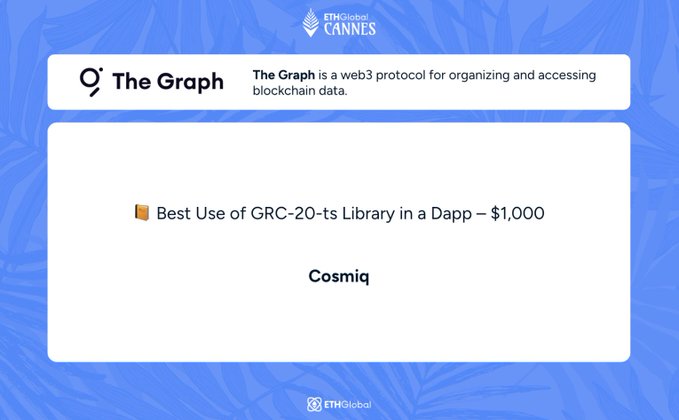
.@ETHGlobal Cannes is a wrap 🇫🇷 Shoutout to all hackers who chose to build with The Graph and submitted their projects - it’s now time to announce the winners 🥁 📒 Best Use of GRC-20-ts Library in a Dapp Prize: 1000 USDC Winner: Cosmiq - an AI platform to build full-stack web3

The Hypergraph Developer Preview is live! Build privacy-preserving, composable apps with a local-first framework. 🔐 E2E encryption 🖇️ GRC-20 composability ℹ️ Access to a decentralized knowledge graph ➕ TypeSync & Geo Connect for effortless schemas & private-space access
Substreams turbocharges your dapp with real-time blockchain data in milliseconds. Top web3 and AI teams run it in production for instant scaling, zero lag, and pinpoint accuracy at massive volume. Plug in Substreams and ship faster today ⬇️
Welcome to The Graph, @cronosapp ⚡ Developers building on Cronos EVM chain can now query blockchain data via Subgraphs, powering everything from onchain coordination to AI-enabled dapps. Start building with Cronos data in Subgraph Studio today 🏗️

The Graph’s decentralized network, fueled by $GRT, is how web3 stays resilient. Fast queries, unstoppable data, and a network designed for the builders 🔧
The Graph powers decentralized data infrastructure. Open APIs, not gatekeepers. Subgraphs and Substreams keep indexing neutral, censorship-resistant, and accessible. Building for the long game.
Decentralization is a design decision. The Graph has built open data infrastructure that empowers builders, safeguards users, and ensures no single party can shut down or manipulate access to information.
Tweet not found
The embedded tweet could not be found…
The Graph serves data to all types of web3 projects. From NFTs 🖼️ to DeFi 💸 to Governance 🏛️ and beyond. The Graph Network, powered by $GRT, keeps web3 fast, reliable, and accessible.
Protocols that embrace decentralization aren’t outdated - they’re future-proof. The Graph is investing in the next era of infrastructure designed for AI and global scale 👀
Institutions need clear, fair standards when engaging with crypto. The Graph Foundation supports frameworks that help markets thrive without compromising decentralization 🤝 regulation & decentralization work together.
TRON 🤝 The Graph @trondao builders unlocked a faster way to index and stream onchain data. With Substreams, TRON devs can expect an easier development experience when building dapps, analytics dashboards, AI agents and more, with unmatched speed and precision. Get started ⬇️
One week since launching Hypergraph & developers are already building incredible apps! From AI-powered mind maps to personal health vaults, teams are using Hypergraph to create the next generation of consumer applications. The consumer web3 revolution is here 👇
AI models built on decentralized networks are more resilient. This means building censorship-resistant systems that operate transparently and anyone can trust. As AI and web3 converge, they lay a foundation for secure, reliable, and unbiased AI applications. The Graph 🤝AI
Solana’s Speed Shouldn’t Break Your Indexer @solana's insane throughput powers next-gen apps - from DeFi to DePIN. But indexing it? That’s a pain. Substreams solves 5 major headaches: 1️⃣ Real-Time Data, Not 5s Delays Firehose streams blocks live - no lag, no missed events. →
In order for AI to thrive, it needs open, transparent, and permissionless data. Exactly like what anyone can access on The Graph! The Graph will not only challenge the AI status quo, but new AI models will develop on top of & as a result of The Graph’s open and growing knowledge

The next giant leap for web3 isn’t another model, it’s a shared graph of verified, linked, interpretable data. We already have the pieces in place, they just need to be connected.
Tempo Integrates The Graph's Subgraphs for Stablecoin Payment Indexing
Tempo, a blockchain designed for stablecoin payments, now supports The Graph's Subgraphs for data indexing. This integration allows developers to: - **Track stablecoin transfers** in real-time - **Reconcile balances** and monitor settlement flows - **Build compliance dashboards** using GraphQL APIs - **Access payment data** without custom backend infrastructure The integration covers both Tempo's Moderato testnet and Mainnet, enabling developers to query on-chain payment data through clean APIs. Use cases include payment tracking dashboards, cross-border compliance monitoring, automated payroll verification, and settlement analytics. The Graph's indexing infrastructure, already deployed across 70+ networks, now provides payments-focused data tools for fintech teams building on Tempo.
The Graph Expands Beyond Subgraphs to Serve Broader Market
The Graph is launching an expanded product suite that extends beyond its core Subgraph offering. The new services aim to capture a larger addressable market by supporting more data services and use cases. **Key Points:** - Protocol economics redesigned to distribute growth benefits across all participants - Expansion builds on The Graph's open-source foundation, which has attracted 75,000+ developers - New suite maintains the open standards approach that has driven ecosystem-wide improvements The move represents a strategic shift from a single-product focus to a broader data infrastructure platform, while preserving the collaborative development model that has defined The Graph's growth.
GRT Expands Cross-Chain Presence and Liquid Staking Access
**The Graph token ($GRT) is expanding its multi-chain presence through Chainlink's Cross-Chain Interoperability Protocol (CCIP).** The token is now bridgeable across: - Arbitrum - Base - Avalanche Solana integration is planned as the next addition to the bridging infrastructure. **A Liquid Staking Initiative is under development** to simplify delegation processes for users on centralized exchanges, making participation in The Graph's network more accessible to a broader audience.
Token API Launches Cross-Chain Data Infrastructure for Web3 Platforms
A new Token API now provides pre-indexed token data across 10 blockchain networks, eliminating the need for platforms to build their own indexing systems. **Key Features:** - Production-ready data infrastructure - Support for 10 chains with plans for expansion - Designed for wallets, explorers, marketplaces, and analytics tools **What This Means:** Developers can now access standardized token information without investing resources in custom indexing solutions. The API handles the technical complexity of tracking token data across multiple chains, allowing teams to focus on building user-facing features. This infrastructure layer addresses a common pain point in web3 development, where each platform previously needed to maintain its own data indexing systems.
Substreams Targets DeFi and AI with Real-Time Data Streaming via Horizon
Substreams is moving toward full protocol integration through Horizon, focusing on real-time data streaming for high-throughput blockchains. **Target Markets:** - DeFi protocols - AI infrastructure - Large-scale analytics platforms - Financial institutions **Supported Chains:** - Solana - Base - Binance The integration aims to serve organizations requiring immediate data access on fast-moving blockchain networks, addressing the growing demand for real-time blockchain data in both crypto-native and traditional finance sectors.