The Asset Allocation Journey in Crypto
The Asset Allocation Journey in Crypto

Insights from Centrifuge Credit Group provide a guide on asset allocation in the crypto space. The journey includes setting objectives, benchmarking, budgeting, investing, and monitoring. Emphasis on risk management, diversification, and staying informed to navigate towards financial goals effectively. Check out the full article for a detailed overview.

The Asset Allocation Journey in Crypto: A Thread Inspired by Centrifuge Credit Group Today, we investigate the intricacies of asset allocation with insights from @centrifuge Credit Group. 👉 Whether you're managing a stablecoin reserve or a project treasury, this thread is

@centrifuge Credit Group: Asset Allocation Process Primer The process of asset allocation can be understood through five steps: -Objective Setting -Benchmarking -Budgeting -Inv. & Diversifying -Monitoring ✅ Let’s look at them in turn gov.centrifuge.io/t/asset-alloca… @yieldkollector
ERC-7540 Standard Enables Async Settlement for Real-World Assets in DeFi

Centrifuge has published details on **ERC-7540**, a standard for asynchronous vaults that enables real-world assets to function properly in DeFi. **Key developments:** - Centrifuge co-authored the standard and has tested it across **$1.6B+ in RWA pools** - The standard is now available as a public building block in OpenZeppelin Community Contracts - Addresses the fundamental challenge of async settlement for real-world assets onchain The standard tackles the next phase of RWA development: **utilization**. This includes whether these assets can serve as collateral, move across venues, and attract liquidity. ERC-7540 provides the infrastructure for greater composability of real-world assets across the Ethereum ecosystem, moving beyond basic issuance to practical DeFi integration. [Read the full technical details](https://centrifuge.io/blog/asynchronous-vaults)
Morpho Midnight Brings Fixed-Rate Credit to DeFi
Morpho has launched Midnight, introducing fixed-rate, fixed-term credit to decentralized finance. This marks a shift from DeFi's traditional variable-rate model. **Key developments:** - Fixed-rate lending now available onchain through Morpho's infrastructure - Morpho serves as backend for major DeFi earn products - Real-world assets (RWAs) including treasuries and credit are the platform's fastest-growing collateral category Paul Frambot, Morpho's CEO, explains this wasn't technically feasible before and represents a potential unlock for institutional capital entering DeFi.
🏦 Ground Connects Banks to Tokenized Treasury Yields
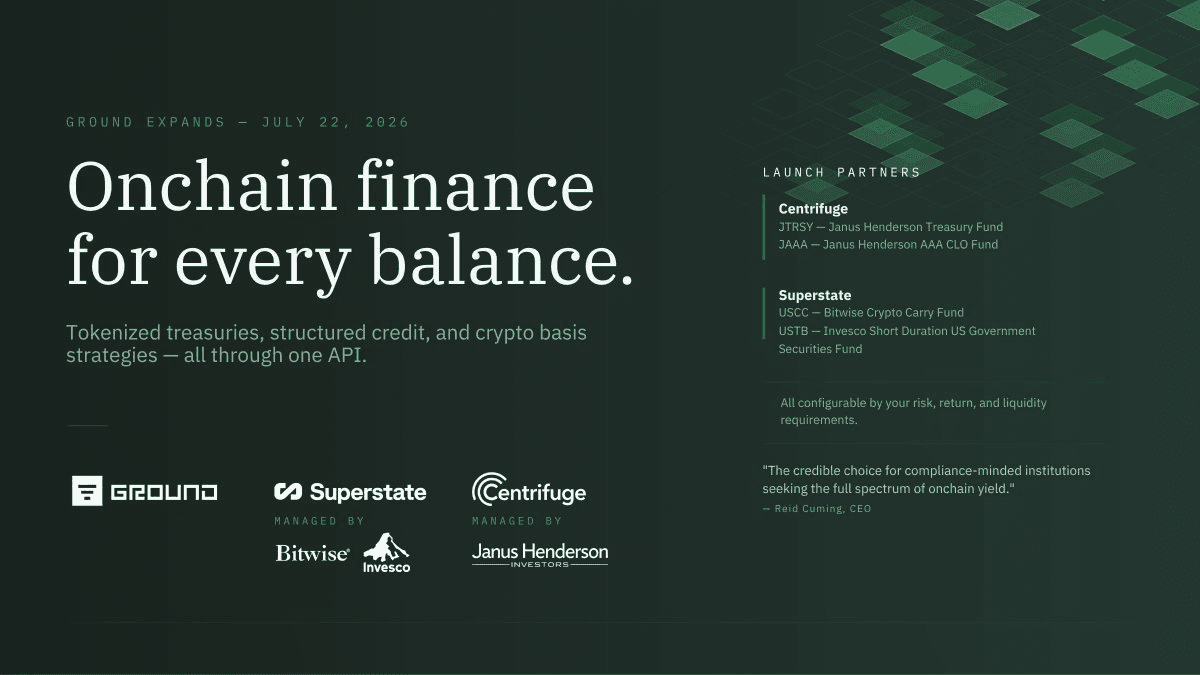
**Ground** now enables banks and fintechs to access institutional yield products through their existing interfaces. The integration includes: - **$JTRSY** (tokenized T-bills) - **$JAAA** (tokenized assets) - Expansion beyond crypto-native yield into real-world assets This follows JTRSY's integration with **M0**, where it serves as eligible collateral for stablecoin issuers. M0 currently powers 19 live stablecoins with $320M in supply and $30B+ in annualized transfer volume. **Key infrastructure**: JTRSY offers up to $500M in daily instant liquidity through Grove Basin, positioning it as base-layer collateral for next-generation stablecoin design. The move represents a significant distribution channel for tokenized treasuries, which now account for nearly half of all tokenized RWAs (excluding stablecoins).
🏦 Centrifuge Unifies Crypto and Real-World Assets in Single Portfolio
Centrifuge Labs has introduced its Onchain Portfolio Manager, eliminating the need for separate vaults to manage crypto-native and real-world assets. **Key Features:** - Single portfolio can now hold both asset classes - Multi-step operations (swaps, bridging, deposits) execute as single transactions - Unified NAV accounting across all positions, including cross-chain assets - Supports operations across 10 blockchains **Technical Infrastructure:** The v3.2 update builds on v3.1's automated accounting and modular infrastructure. The platform now covers the complete lifecycle of institutional assets: issuance, pricing, distribution, and operations. Centrifuge CTO @offerijns explains how this consolidation changes portfolio management workflows. The audited infrastructure currently secures over $1.9B in onchain capital. This development addresses a practical limitation in onchain asset management, where mixed portfolios previously required maintaining separate vault structures.
Institutional Capital Flows Onchain as Infrastructure Takes Shape
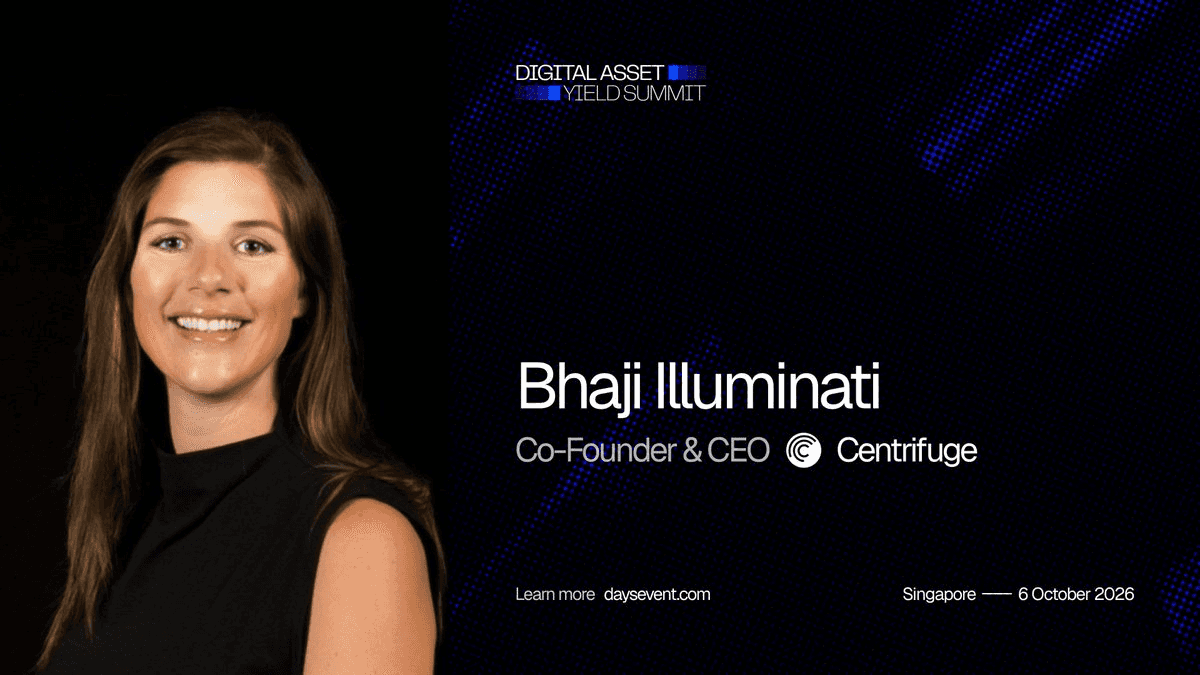
Institutional money is moving onchain, with supporting infrastructure being developed simultaneously. At Yield Summit, discussions centered on the next phase beyond asset arrival: - **Liquidity development** for institutional-grade trading - **Secondary market** infrastructure - **Real DeFi utility** integration The focus shifts from simply bringing institutional capital onchain to creating functional markets and use cases. Infrastructure providers are working to bridge the gap between traditional finance and decentralized systems, addressing the technical and operational requirements institutions need. This represents a maturation phase where the industry moves beyond proof-of-concept to building practical, scalable solutions for institutional participation in onchain markets.