SWEAT Partners with Burn Lab to Build Social Growth Layer for Movement Economy
SWEAT Partners with Burn Lab to Build Social Growth Layer for Movement Economy
🏃 Movement Meets Social


SWEAT, the movement-powered crypto platform, has announced a collaboration with Burn Lab to develop a "Social Growth Layer" that combines physical activity with social connectivity.
Key Points:
- The partnership aims to integrate social connectivity, community coordination, and real-world activity into consumer crypto applications
- SWEAT has been building a movement-based economy since 2014, where physical activity generates economic value
- The collaboration focuses on creating earned participation models rather than passive engagement
- This represents a shift toward social-driven growth mechanisms in web3
The partnership signals a move toward combining fitness tracking with social coordination tools, potentially creating new models for community-driven crypto adoption through real-world activities.

🔥 Proof of Sweat meets the Social Growth Layer. Excited to collaborate with @letsburnlab to explore how social connectivity, community coordination, and real-world activity can power the next generation of consumer crypto. The future of growth is social. The future of

🔥 LETSBURN × @UXLINKofficial STEPN had sneakers. We have sweat. UXLINK has social graphs. Now imagine combining both. Proof of Sweat meets the Social Growth Layer. Every calorie burned can become more than personal progress, it can become social momentum, community

🤝 UXLINK Partners with Cluster Protocol to Scale AI-Driven Social dApps on Base

UXLINK has announced a strategic partnership with Cluster Protocol to advance AI-powered social decentralized applications. The collaboration combines three key components: - **UXLINK's social infrastructure** - leveraging their established Web3 social platform - **Cluster's Private AI orchestration** - enabling secure, autonomous AI workflows - **CodeXero's browser-native IDE** - simplifying development directly in web browsers The partnership aims to make Web3 development more accessible by removing technical barriers. By building on Base, the teams are focusing on scalability for autonomous AI workflows. This follows UXLINK's recent pattern of AI-focused partnerships, including collaborations with Adapt for AI-powered trading, SodaBot for agent infrastructure, and Interlace for payment solutions. The consistent theme across these partnerships is bridging social connectivity with AI capabilities to drive Web3 adoption. The integration represents a practical step toward making decentralized application development more approachable for builders while maintaining the social-first approach that defines UXLINK's platform.
UXLINK Partners with Haven AI to Bring Autonomous Yield Strategies to Social Communities
UXLINK has announced a partnership with Haven AI, an autonomous execution layer that enables AI agents to manage on-chain fixed income strategies. **Key Features:** - Haven AI's OpenClaw agent converts natural language commands into cross-chain yield strategies - Integration aims to make Web3 finance more accessible through intuitive AI-driven tools - Partnership explores potential for automated yield generation within social communities This collaboration builds on UXLINK's recent integration with ChainAware, which brought predictive intelligence to their social ecosystem. The platform continues positioning itself as a bridge between traditional social platforms and Web3 functionality. The partnership signals growing interest in combining AI automation with decentralized finance, particularly for community-focused applications.
UXLINK Partners with Decentralized Intelligence to Enhance AI-Powered Web3 Social Platform

**UXLINK**, a leading AI-powered Web3 social platform, has announced a strategic partnership with **Decentralized Intelligence (DI)**. **Key Integration Points:** - DI's distributed compute power infrastructure - DI Phone integration - ICO Launchpad access - Crypto-native AI models - X Agent DEX Launchpad capabilities The collaboration aims to bring enhanced intelligence to the UXLINK ecosystem, building on the platform's focus on authentic, bi-directional social connections in Web3. This follows UXLINK's recent partnership with [TecHubNews](https://twitter.com/TecHubNews) announced earlier in April, which focused on combining social infrastructure with professional media influence. *The partnership represents another step in UXLINK's mission to bridge Web2 and Web3 through socialized interactions.*
UXLINK Completes March Buyback and Teases AI Agent Strategy
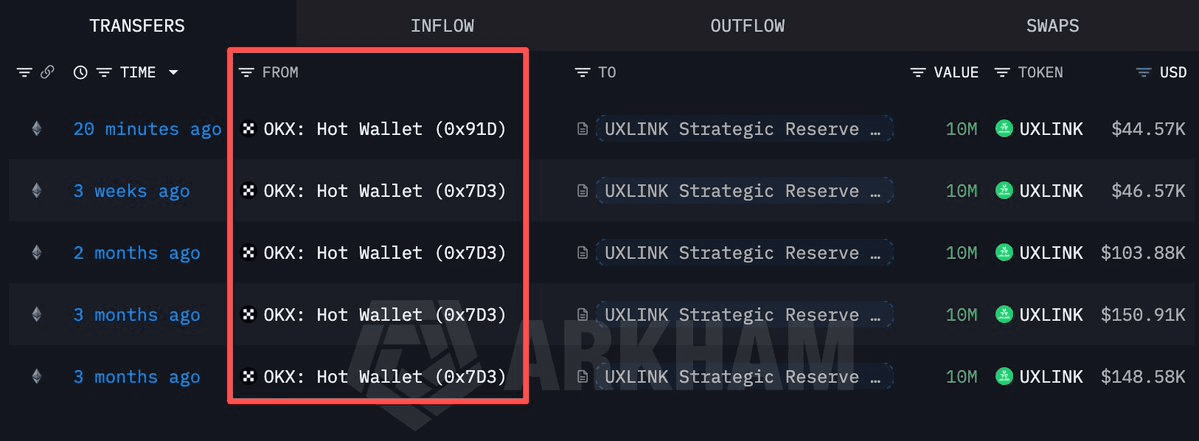
UXLINK has completed its fourth consecutive monthly buyback, purchasing 1% of $UXLINK tokens for its Strategic Reserve. **Buyback Track Record:** - December: Completed - January: Completed - February: Completed - March: Completed The team maintains that current market valuation doesn't fully reflect the platform's value and growth. **What's Coming:** UXLINK is developing a new strategic direction combining AI agents, crypto, and social features. The company describes this as building "the bedrock of the Agent Economy" to benefit its community and users. The buyback can be verified on-chain at address: [0xC0Eda16A19ADC26300A51257f3218d4E68ed1e3E](https://etherscan.io/address/0xC0Eda16A19ADC26300A51257f3218d4E68ed1e3E)
UXLINK and ForU AI Explore Reputation Graphs as Web3's Next Infrastructure Layer
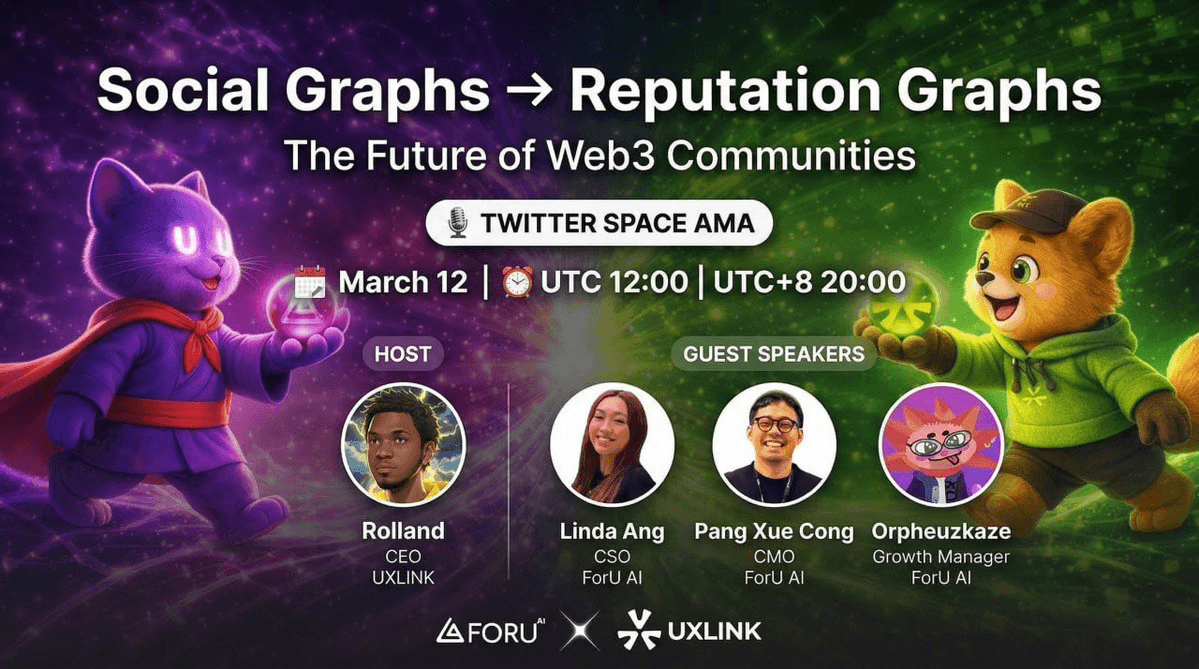
UXLINK CEO Rolland Saf joined ForU AI's team for a discussion on March 12 about the shift from social graphs to reputation graphs in Web3. The conversation focused on: - How **social graphs connect people** while **reputation graphs establish trust** - The development of reputation systems as foundational infrastructure for Web3 communities - The evolution beyond simple connections toward trust-based networks Speakers included Linda Ang (CSO), Pang Xue Cong (CMO), and Orpheuzkaze (Growth) from ForU AI. This discussion aligns with UXLINK's 2026 strategy to expand its social infrastructure beyond connections. The platform, which has over 50 million registered users, is building what it calls a "Social Growth Layer" that combines social features with AI and financial tools. The session explored how reputation systems could become a critical component for Web3 applications seeking to verify authentic users and build trust within decentralized communities. [Join the conversation](https://x.com/i/spaces/1qxvvkLNLbexB)