strkBTC Bridge Launches with Five-Member Federation for Bitcoin Operations
strkBTC Bridge Launches with Five-Member Federation for Bitcoin Operations
🔗 Five guardians control

The strkBTC bridge now operates through a Federation of five independent institutions managing Bitcoin bridging infrastructure.
Federation Members:
- Twinstake
- NEAR Protocol/Intents
- Luganodes
- UTXO Management
- Xverse
Each member operates infrastructure supporting the minting, burning, and bridging of BTC and strkBTC tokens.
The Federation provides a defined operational trust model for moving Bitcoin into and out of the Starknet ecosystem. This multi-institutional approach distributes responsibility across independent operators rather than relying on a single entity.

strkBTC bridge uses a Federation, a group of five independent institutions: @Twinstake, @NEARProtocol/Intents, @Luganodes, @utxo_management and @xverse Each member is responsible for operating infrastructure that supports the minting, burning, and bridging of BTC + strkBTC.
🏦 DeFa Launches Private Financial Infrastructure on Starknet
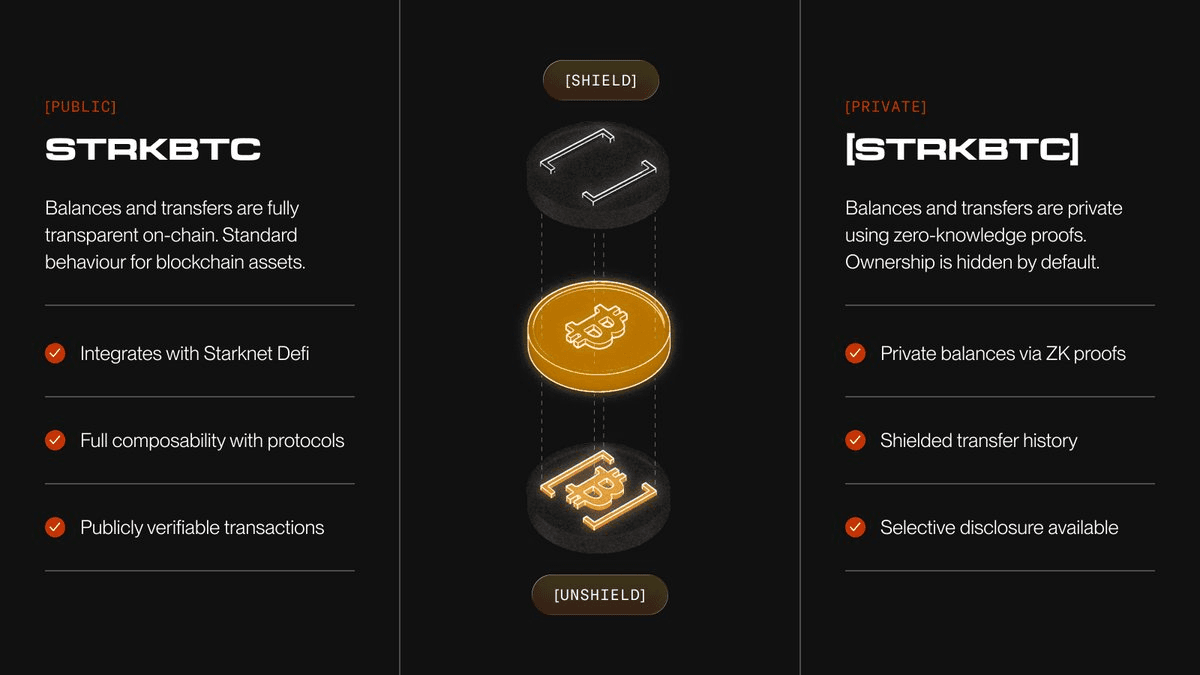
**DeFa Private Mainnet** has launched on Starknet, bringing confidential financial infrastructure to the network. The platform offers: - **Confidential stablecoin liquidity** for private transactions - **Verified receivables** with privacy protections - **Trusted cashflow infrastructure** for businesses All features are powered by **STRK20**, Starknet's privacy framework that allows users to shield ERC-20 assets with one click. The system maintains confidentiality by default while allowing selective disclosure when legally required. DeFa builds on Starknet's recent privacy rollout, which includes private transfers, swaps, and shielded balances. The network's proving technology enables complex private transactions at a fixed cost of 4 STRK, making privacy practical for everyday use. This marks a significant expansion of private DeFi capabilities on Starknet, moving beyond basic transfers to institutional-grade financial infrastructure.
🛡️ Shield Rush Campaign Goes Live on Starknet
**Shield Rush is now live** on Starknet, offering users a new way to earn rewards through daily activities. **What is Shield Rush?** - A campaign where participants complete daily activities using Shielding technology - Earn a share of rewards by participating - Powered by StarkWare Ltd **Getting Started** Visit the [Shield Rush website](https://strk20.starknet.io/shield-rush) to begin participating in the campaign. The campaign is open to anyone interested in engaging with Starknet's Shielding features while earning rewards.
🔐 STRK20 Brings Selective Privacy to Starknet with Auditor Access
**STRK20** introduces privacy features for ERC-20 tokens on Starknet while maintaining regulatory compliance through encrypted viewing keys. **Key Features:** - Private balances, transfers, and swaps for any ERC-20 on Starknet - Fixed cost of 4 $STRK per transaction, regardless of size - Single shared privacy pool that strengthens as more users join - Encrypted viewing keys allow authorized auditors to access specific information on legitimate requests **How It Works:** Users can shield ERC-20 tokens into private balances, conduct private transactions, then unshield with one click—all within the same wallet and liquidity pools. The framework leverages Starknet's provable computation capabilities to verify private transactions without exposing details. As the privacy pool grows with more users and assets, individual transactions become harder to isolate. **Ecosystem Expansion:** STRK20 is rolling out across Starknet with integrations for [avnu](https://avnu.fi) and [Ekubo](https://ekubo.org), plus an open-source SDK. The [Proof of Privacy incubator](https://starknet.io) supports teams building private applications for payments, trading, identity, and DeFi. *Privacy by default, accountability when required.*
Why Every Privacy Solution Failed Until Now
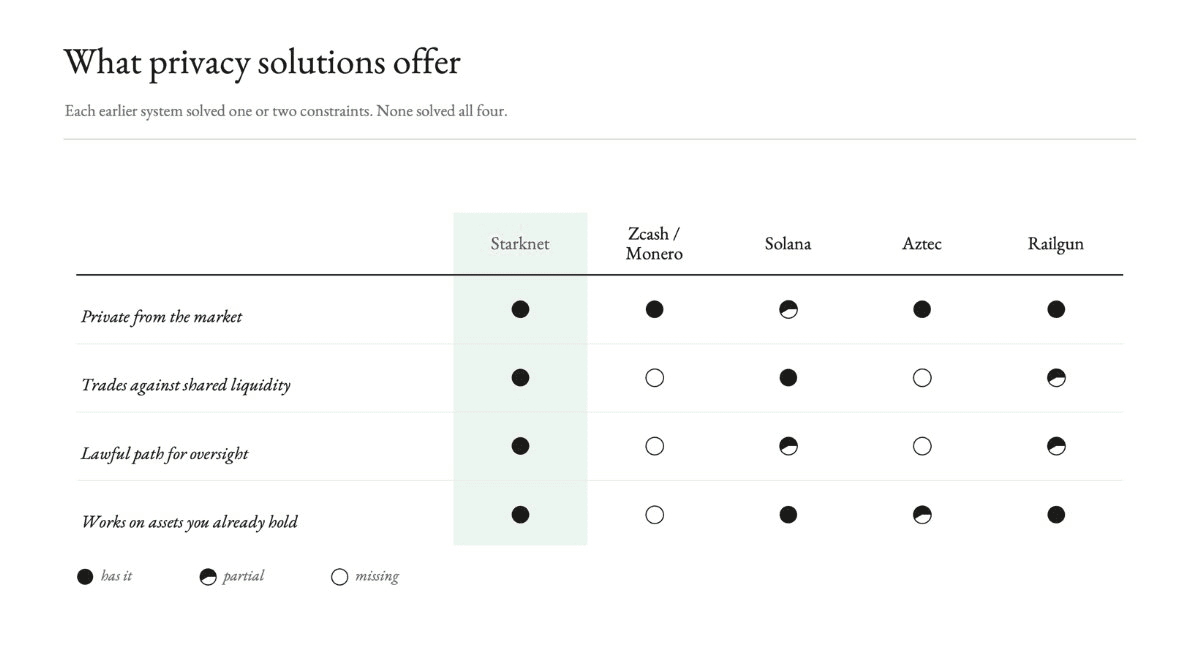
**Decentralised** examined why no privacy solution has succeeded in crypto markets until now. Every previous attempt collapsed in one of three predictable ways: - **Walled gardens**: Assets locked into isolated private networks - **Bolted-on privacy**: Retrofitted solutions that fragmented liquidity across markets - **Compliance conflicts**: Systems that worked technically but couldn't meet regulatory requirements The core problem? A forced choice between privacy and compliance—institutions could have one or the other, never both in a usable form.