Streamr Launches Quantum-Resistant Security Stack
Streamr Launches Quantum-Resistant Security Stack
⚛️ Quantum Hackers Hate This

Streamr has launched its quantum-resistant security implementation, addressing future cryptographic threats. The update includes:
- ML-DSA-87 for quantum-safe identity and signatures
- ML-KEM-1024 + HKDF + AES-256 for key exchange
- AES-256 for encryption
This move comes as NIST warns that current cryptographic standards (RSA, DSA, ECDSA, ECDH) may become vulnerable by 2035. The new security stack, available in SDK v103.0.0, is compliant with NIST standards FIPS-204 and FIPS-203.
Key sectors benefiting: Finance, healthcare, energy, and defense can now stream sensitive data with future-proof security.

⚛️ ❝RSA, ECDSA, EdDSA, DH, and ECDH will be deprecated by 2030 and disallowed after 2035❞ The threat? @NISTcyber warns that quantum computers may soon break today’s encryption. And the danger is already here: “harvest now, decrypt later” means data stolen today could be
Are you ready for the quantum computing era? ⚛️ If not, we’re here to help. The first edition of Streamr’s quantum-resistant security stack is live: 🔸 ML-DSA-87 for quantum-safe identity & signatures 🔸 ML-KEM-1024 + HKDF + AES-256 for key exchange 🔸AES-256 for encryption
Quantum-resistant streaming is now live on Streamr! ⚛️🛡️ We’ve just taken a big step to future-proof the Network with quantum-safe algorithms for identity, signatures, encryption, and key exchange. What’s the threat? The @NIST @NISTcyber says classical cryptography (RSA, DSA,
Streamr Integrates Biometric Login via Openfort for Frictionless Web3 Onboarding
Streamr has integrated Openfort's biometric login technology to simplify user onboarding. The implementation removes traditional barriers for both Web2 and Web3 users entering the platform. **Key Features:** - Biometric authentication replaces complex wallet setup processes - Seamless experience for users unfamiliar with crypto wallets - Clean technical integration between Streamr and Openfort The solution addresses a persistent challenge in Web3: reducing friction during the initial user experience. By implementing biometric login, Streamr enables users to access decentralized data streaming without navigating typical crypto onboarding hurdles. This development aligns with Streamr's broader infrastructure, which uses DATA token staking for bandwidth allocation through smart contract-based Sponsorships.
🚨 Billion Records Exposed: The Case Against Centralized Identity Systems
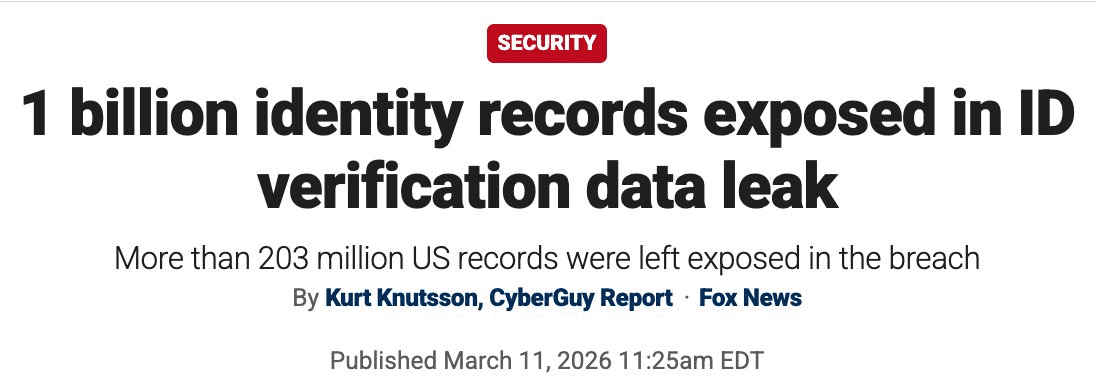
**A massive data breach has exposed 1 billion identity-verification records, with over 203 million belonging to Americans.** This incident highlights a critical flaw in centralized digital identity systems: - Mandatory digital ID and age-verification systems concentrate sensitive data in single points of failure - Unlike passwords, identity data cannot be changed once compromised - The breach follows a pattern: an Illinois government breach earlier this year exposed 700,000 health records **The core issue**: Centralizing identity data doesn't reduce risk—it amplifies it by creating attractive targets for attackers. As governments push for age verification laws requiring websites to collect and store ID information, this breach serves as a stark reminder that even well-resourced agencies struggle to protect sensitive data. The question remains: if government systems with compliance teams fail, why would commercial platforms fare better?
🤖 Agents need data
As decentralized AI scales vertically, a critical infrastructure question emerges: **how will millions of autonomous agents access live data without centralized bottlenecks?** **The challenge:** - DeAI systems require real-time information flows - Traditional centralized data brokers create single points of failure - Peer-to-peer architecture becomes essential at scale **Streamr's approach:** Built specifically for this moment, Streamr enables encrypted, peer-to-peer data streaming without central intermediaries—the foundation local-first AI systems need to function reliably.
Streamr Launches Alpha Video Conferencing Platform with Peer-to-Peer Architecture
Streamr has opened its alpha video conferencing platform at tv.streamr.network/alpha. The service offers: - Direct human-to-human video calls - No routing through centralized platform servers - Built-in security through serverless architecture The platform represents a shift from traditional video conferencing infrastructure, eliminating the need for data to pass through intermediary servers. Users can sign up now to test the alpha version. This launch follows Streamr's broader work on decentralized data streaming infrastructure, where bandwidth is exchanged through token-based sponsorships rather than traditional hosting arrangements.
🔄 Data in Motion
**Streamr is challenging the traditional internet model** by keeping data constantly moving instead of storing it in vulnerable databases. **The core shift:** - Traditional internet: store data first, move it later - Streamr's approach: data moves first, stays encrypted, never sits still **Why this matters:** - Stored data creates single points of failure - Data breaches, outages, and surveillance target static databases - Moving encrypted data removes what can be breached **The philosophy:** Privacy doesn't come from better promises or fixing broken institutions. It comes from eliminating centralized databases entirely. Streamr positions this as the next evolution of data streaming—where data stays under user control rather than residing on someone else's servers.