Spark Protocol Expands Borrowing Options with 4 New Assets
Spark Protocol Expands Borrowing Options with 4 New Assets
🔥 New Coins Enter The Vault


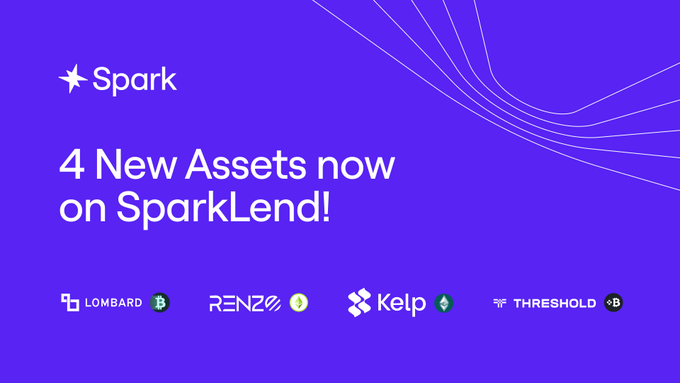
SparkLend has integrated four new assets into its borrowing platform:
- rsETH from KelpDAO
- ezETH from Renzo Protocol
- tBTC from The T Network
- LBTC from Lombard Finance
These additions expand the range of collateral options available for borrowing on the platform. Users can now access these new borrowing capabilities through the Spark lending platform.
The integration follows recent platform upgrades, with Renzo Protocol being the latest addition to enable ezETH borrowing.

The borrowing options on Spark just keep expanding ⚡️ 4 new assets have been onboarded to SparkLend. Enabling you to borrow against an even broader range of assets: 🔹 rsETH - @KelpDAO 🔹 ezETH - @renzoai 🔹 tBTC - @TheTNetwork 🔹 LBTC - @Lombard_Finance Explore
Spark Prime Integrates RedStone for Institutional Crypto Lending
Spark Prime, the institutional crypto lending platform, has integrated with RedStone to support institutional borrowers like Anchorage. **Key Integration Details:** - RedStone integration is a vital component of Spark Prime's infrastructure - Enables institutional-grade crypto borrowing services - Supports Anchorage and other institutional clients **About Spark Prime:** Launched in February 2026, Spark Prime is a CeDeFi margin lending platform powered by Arkis's margin technology. The platform offers: - **Enhanced security**: Over-collateralized positions for more resilient delta-neutral lending - **Capital efficiency**: Improved efficiency compared to traditional DeFi lending markets - **Transparency**: Real-time position visibility through protocol-level data The platform enables institutional borrowers to deploy collateral seamlessly across both DeFi and CeFi venues, addressing the opacity issues common in traditional funds.
Spark's Security Framework: Bounded Automation for Institutional Liquidity
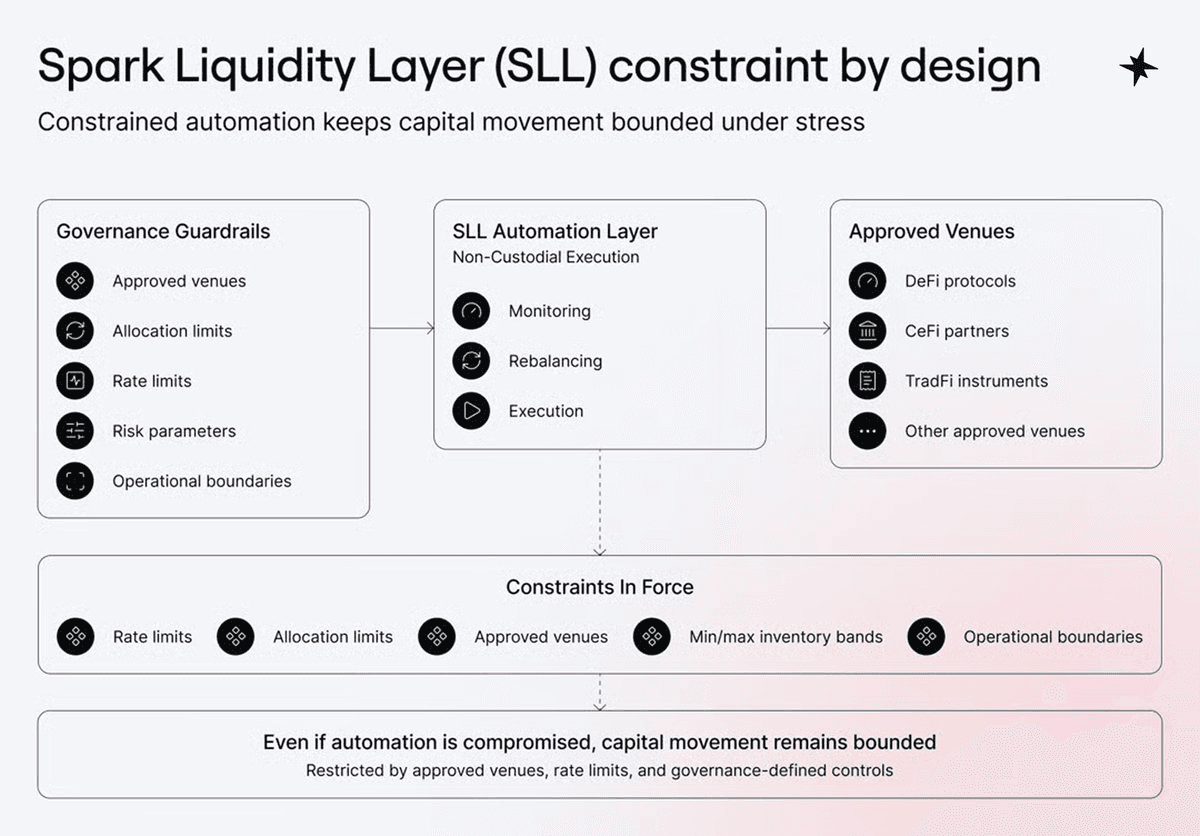
Spark Liquidity Layer introduces a security model where automation operates within strict governance-defined boundaries. The system uses three constraint layers: - **Approved venues** limit where capital can move - **Allocation and rate limits** control how much moves and at what speed - **Min/max inventory bands** cap holdings per venue The key security property: even if automation is compromised, capital movement remains bounded by pre-execution constraints. For institutional infrastructure, trust lies in the constraint system itself, not the automation layer. This approach solves liquidity orchestration's core challenge—enabling fast capital movement across venues without creating unbounded exposure risk. [Read full security framework](http://paragraph.com/@spark-11/spark-security-framework)
Spark Savings Integrates Natively Into Rabby Wallet for Direct Yield Earning
Spark Savings has launched native integration within Rabby wallet, allowing users to earn yields on USDS, USDC, USDT, and ETH without leaving their wallet interface. **Key features:** - Direct earning on idle assets within Rabby - No bridges or additional steps required - Instant redemption capability - Protected by Spark Savings Risk Framework with risk absorption layers The integration represents a shift in wallet functionality—from simple asset storage to active capital management. Users can now put idle funds to work while maintaining the security and convenience of their trusted wallet environment. The service supports multiple stablecoins and ETH, with deposits processed in approximately 60 seconds through a straightforward interface.
Spark's $1.11B USDT Liquidity Layer: How Two-Role Capital Split Solves the Deployment vs. Liquidity Dilemma
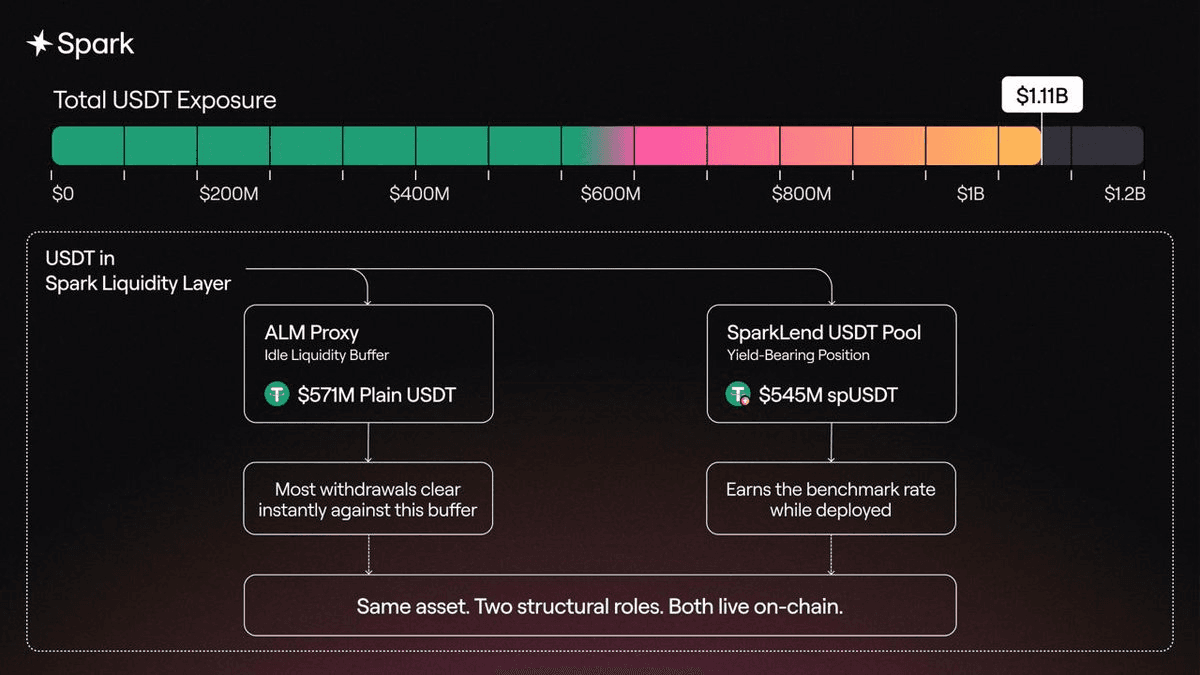
**The Core Challenge** Credit markets face a fundamental tradeoff: hold too much capital in reserve and returns drop; deploy too much and liquidity dries up. **Spark's Two-Role Solution** Spark's Liquidity Layer manages $1.11B USDT through a strategic split: - **$571M in plain USDT** sits in the ALM proxy as an idle liquidity buffer, enabling instant withdrawals for most users - **$545M deployed as spUSDT** into SparkLend's USDT pool, earning the benchmark rate **Why It Matters** This dual-role structure allows Spark Savings USDT to simultaneously offer: - Real liquidity depth for withdrawals - Competitive returns through active deployment - Larger exits handled through a request flow when needed The approach demonstrates how the same asset can serve different functions—immediate availability and yield generation—without forcing users to choose between liquidity and returns. [Deposit USDT](https://app.spark.fi/savings/mainnet/spusdt)
SparkLend Attracts 2,748 wBTC in Three Days Following March Launch
SparkLend has accumulated over 2,748 wBTC as collateral since launching in March, with the majority arriving within a three-day period as borrowers refinanced existing positions. **Key developments:** - Initial 3,000 wBTC deposit cap reached quickly, prompting an increase to 30,000 wBTC - New capacity opens gradually at 500 wBTC every 12 hours through cap automator mechanism - Rapid adoption indicates strong demand for BTC-backed borrowing venues The swift capital migration suggests the market was waiting for infrastructure rather than lacking demand. Borrowers can access the platform at [app.spark.fi/borrow](https://app.spark.fi/borrow).