Spark Positions Itself as Alternative to Traditional Banking
Spark Positions Itself as Alternative to Traditional Banking
🏦 Banks Hate This Alternative


Traditional banking systems continue to face criticism for:
- Requiring permissions for personal fund access
- Lacking default transparency
- Operating with user value extraction models
Spark emerges as a decentralized alternative, aiming to address these limitations in traditional banking infrastructure. The protocol integrates with the DAI ecosystem to provide permissionless financial services.
Key Differentiators:
- Direct user control over funds
- Default transparency
- User-centric value model
- Decentralized architecture

Imagine this: > You need permission to use your own money > Transparency is the exception, not the default > Built to extract value from users That’s banks of today for you. You convinced yet, or need more reasons to skip banks?

Spark Points Season 4 Shifts Focus to SPK Staking
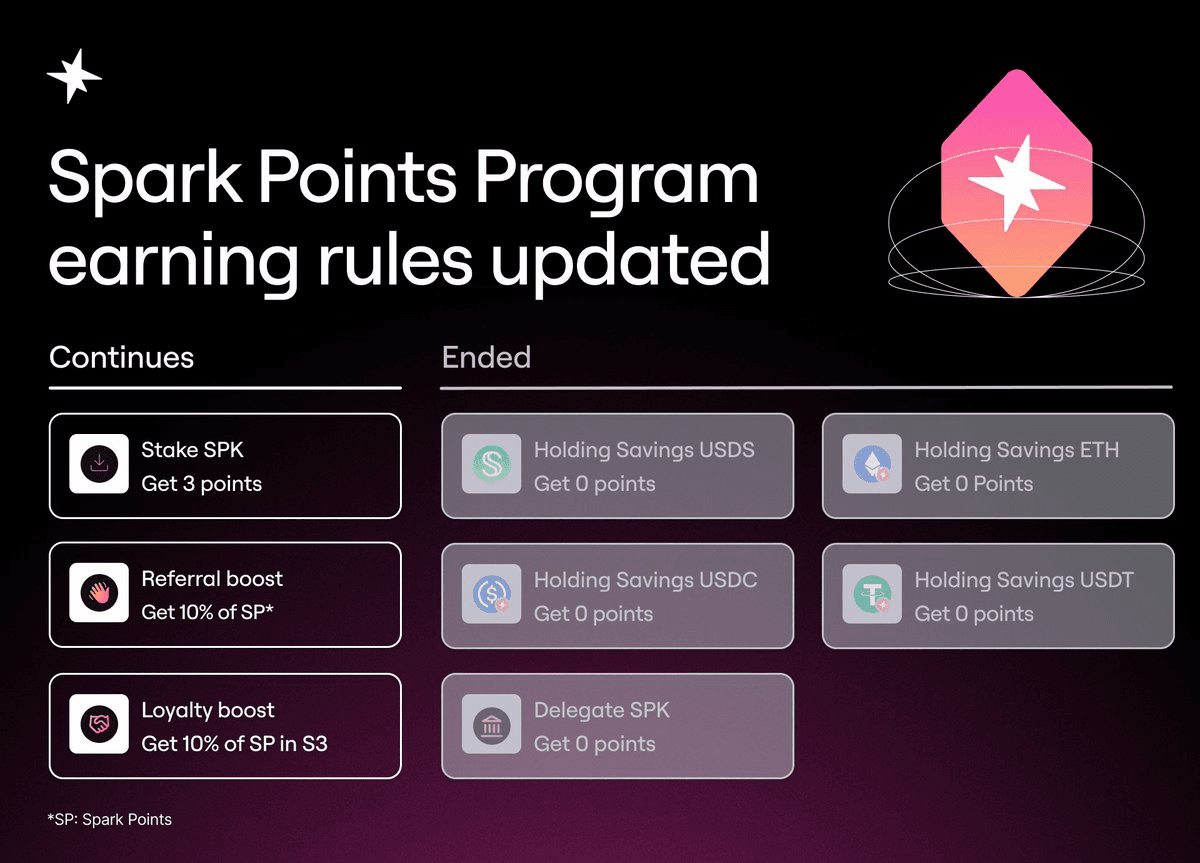
Spark has updated its Season 4 points program with significant changes to earning mechanics. **Key Changes:** - Holding Savings USDS, USDC, USDT, or ETH and delegating SPK no longer earns points - All users can now earn points by staking SPK - Referral and loyalty boosts remain active **Current Status:** - Over 10,000 wallets are participating - Less than one month remains in Season 4 The shift moves away from passive savings holdings toward active SPK staking as the primary earning method. Users who previously earned through savings deposits will need to adjust their strategy. [Join Season 4](https://app.spark.fi/points)
SLL Balances Yield and Safety Through Automated Rebalancing
The Spark Liquidity Layer (SLL) addresses a common DeFi trade-off by simultaneously pursuing yield and maintaining safety buffers. The protocol offers: - **Instant liquidity** with competitive yields - **Stable borrow rates** maintained through continuous rebalancing - **Fully automated operations** with no manual intervention The system works by scanning DeFi markets 24/7 for risk-adjusted opportunities, programmatically deploying capital when favorable conditions arise and withdrawing when they fade. This approach enables smooth user experience while capturing yield across different markets. [Monetsupply](https://twitter.com/Monetsupply), Head of Strategy, provides a detailed breakdown of the mechanics.
Spark Protocol Generates $800k Weekly Revenue Through Multi-Product Strategy
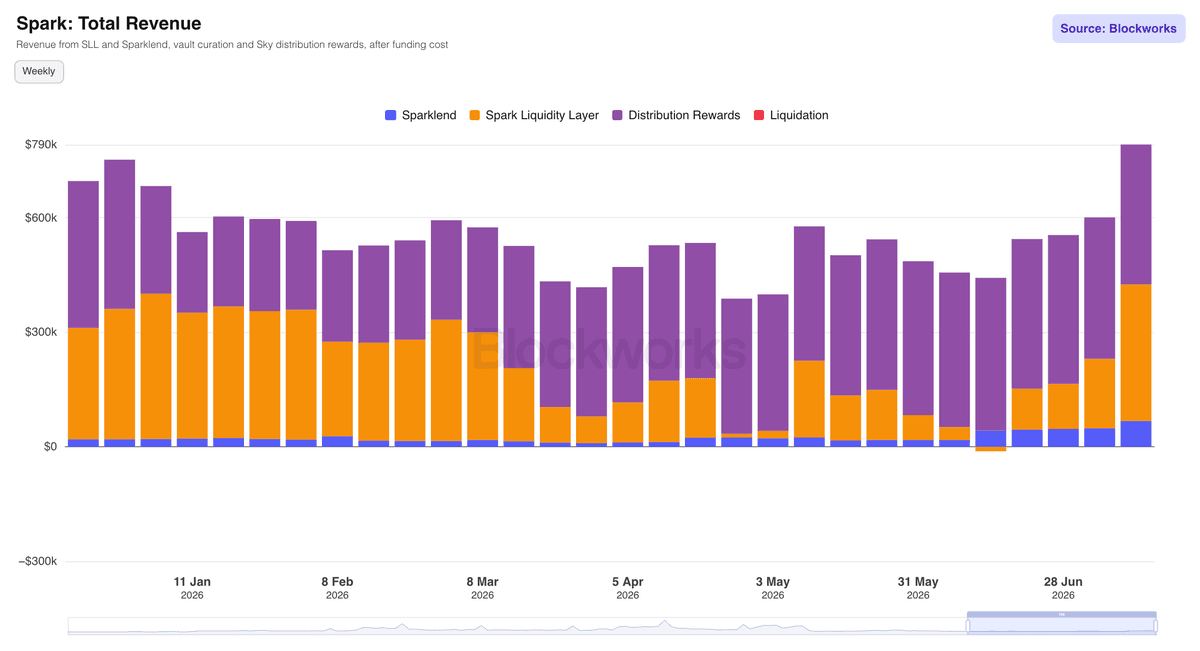
Spark Protocol reported **$800,000 in revenue over one week**, demonstrating the effectiveness of its integrated product suite. The revenue came from three simultaneous sources: - **SLL spread** (Spark Liquidity Layer) - **Distribution rewards** - **SparkLend** lending protocol operations This marks a significant milestone in the protocol's ability to monetize its balance sheet across multiple products simultaneously. The performance follows strong growth in SparkLend, which previously recorded $500M in new borrows and $1.2B in deposits during a volatile market period in April. The multi-product approach allows Spark to capture value from different aspects of DeFi activity while maintaining its focus on the DAI ecosystem. [View Spark Fundamentals](https://app.spark.fi/borrow)
Spark Savings Expands to USDT0 on Arbitrum
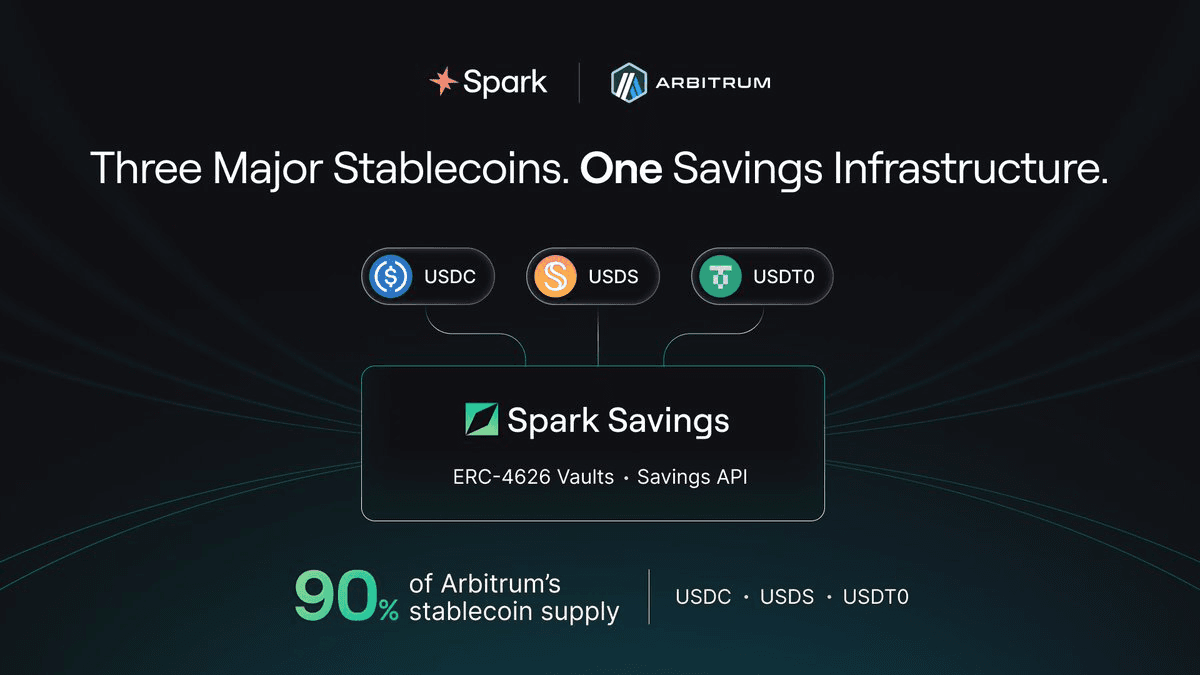
Spark Savings on Arbitrum has added support for USDT0, expanding its stablecoin offerings. **Key Updates:** - Builders can now integrate savings functionality across three stablecoins: USDC, USDS, and USDT0 - These stablecoins represent over 90% of Arbitrum's total stablecoin supply - Integration uses standard ERC-4626 vault architecture The expansion allows developers to embed Spark Savings directly into their applications, providing users with earning opportunities on their stablecoin holdings. Users can deposit, earn yield, and withdraw at any time. [Learn more about the integration](https://paragraph.com/@spark-11/spark-savings-on-arbitrum-now-supports-usdt0?referrer=0xA45F1D29943D19dff604133287047a35ccbADc8a)
StandX Deploys Stablecoin Reserves Through Spark Protocol
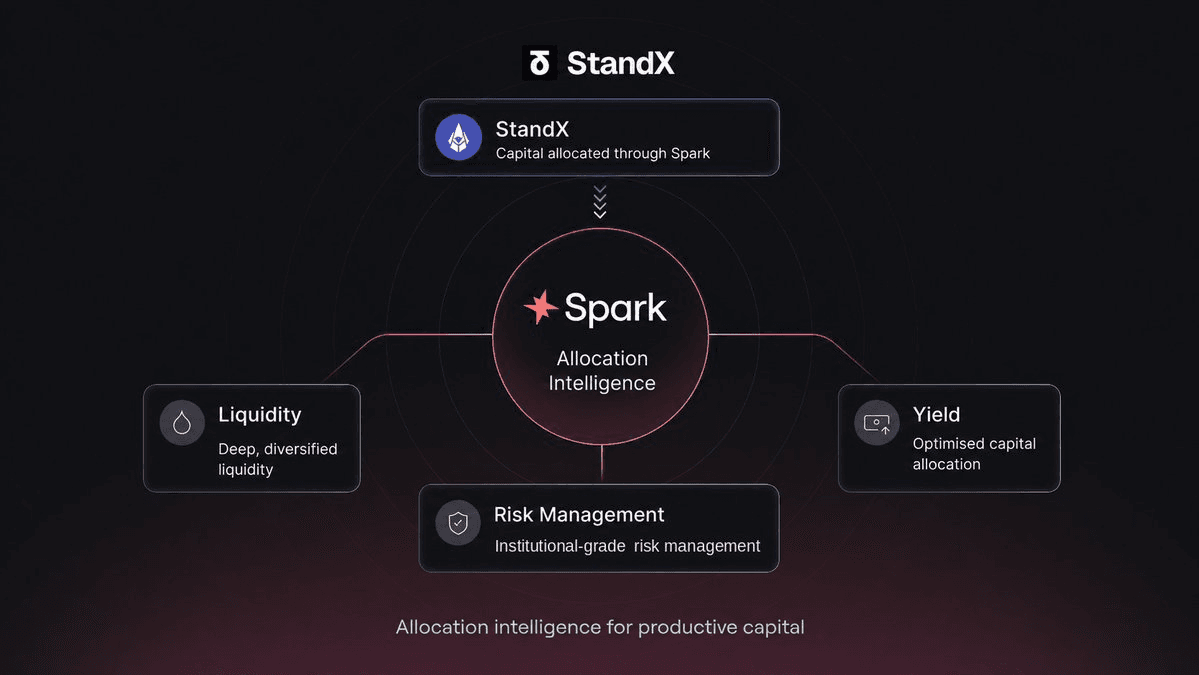
StandX is using Spark for transparent, on-chain capital allocation of its stablecoin reserves. **Key Development:** - Stablecoin issuers are moving beyond holding idle reserves - StandX integrates with Spark's infrastructure for capital deployment - Protocols are combining specialist infrastructure rather than building from scratch The shift reflects a broader trend: as financial products move on-chain, the focus is shifting from simply issuing stablecoins to efficiently allocating the capital backing them.