SEC Chair Paul Atkins Pushes to Reduce Capital Market Barriers for Americans
SEC Chair Paul Atkins Pushes to Reduce Capital Market Barriers for Americans
🏛️ SEC's Bold Move

SEC Chair Paul Atkins is advocating for broader access to capital markets, stating that the current path to public ownership has become too narrow and costly.
Key points from Atkins' push:
- Excessive regulations create more friction than benefit
- Current rules make public ownership costlier and more burdensome
- Focus on increasing access for all Americans
This aligns with previous statements about making the U.S. the crypto capital of the world through regulatory clarity and innovation-friendly oversight.
The move signals a potential shift toward harmonized digital asset regulation and reduced barriers for companies seeking public markets.

SEC Chair @SECPaulSAtkins making a strong push for increasing access to capital markets for all Americans: "The path to public ownership has become narrower, costlier, and overly burdened with rules that often create more friction than benefit."

Chairman Paul Atkins is delivering remarks on @America250 at the @NYSE. x.com/i/broadcasts/1…
🎭 CLARITY Act Faces Uphill Battle
The crypto industry is pushing hard for the CLARITY Act, but passage remains uncertain. CMCC Global CEO Alex Tapscott expressed deep skepticism about the bill's chances, stating he's "very, very skeptical that this bill can get the support it needs." **Key concerns:** - Senate calendar constraints limiting time for passage - Lack of sufficient political support - Galaxy Research recently cut odds of passage to 50% The regulatory uncertainty continues to impact investor confidence and industry growth as the crypto sector awaits clarity on its legal framework.
Robinhood CEO's X Account Hacked to Promote Memecoin on Company's New Chain
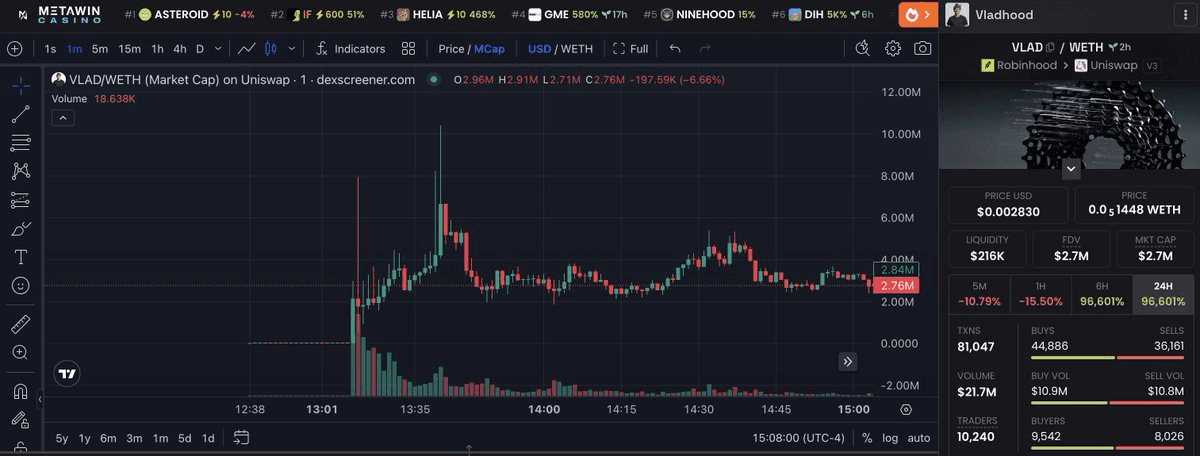
Robinhood CEO Vlad Tenev's X account was compromised Thursday, with hackers using it to promote a fraudulent memecoin on Robinhood's recently launched blockchain. **Key Details:** - The promoted "Vladhood" token was falsely marketed as the mascot of Robinhood Chain - Despite the CEO's platform, the scam token only reached a $10M market cap - The deleted post represents the latest fraud targeting the network Robinhood's blockchain launched July 1 with the goal of moving stocks onchain. However, the network has become dominated by memecoins rather than traditional securities. The incident highlights ongoing security challenges in crypto, where high-profile account compromises remain a common vector for token scams.
CLARITY Act Odds Jump to 47% After White House Ethics Deal
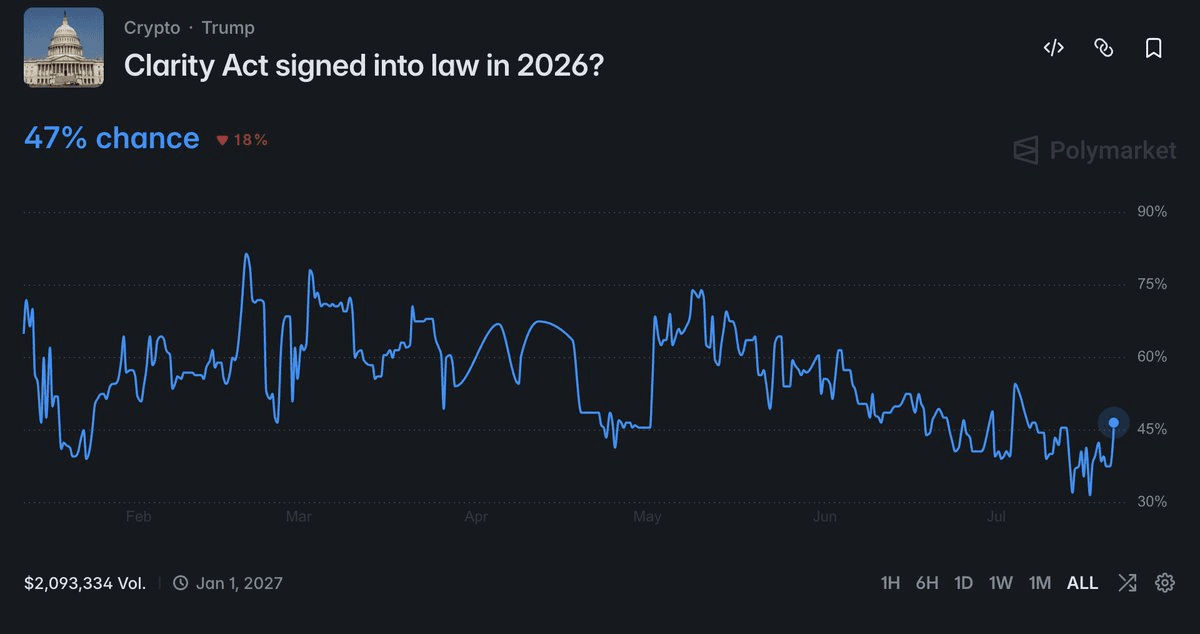
**Market Update on Crypto Legislation** The CLARITY Act's chances of becoming law have surged to **47% on Polymarket**, marking a significant recovery after hitting historic lows earlier this month. **Key Developments:** - Odds jumped from 21% (lowest since market began) to 47% in just over a week - White House agreed to **ethics concessions**, breaking the previous deadlock - This represents a dramatic turnaround for the stalled crypto legislation **What This Means:** The ethics compromise appears to have resolved key concerns blocking the bill's progress. While still below 50%, the near-doubling of passage odds suggests renewed momentum for crypto regulatory clarity in 2026. Prediction markets now show the legislation has nearly even chances of passing, a stark contrast to the pessimism just days ago.
Bitcoin's Uncomfortable Truth: Success Without Usage
**The HODL Problem** Opnet founder Chad Master raises a critical concern about Bitcoin's future: the cryptocurrency may be "a victim of its own success" if users continue to simply hold rather than actively use it. **Key Points:** - Bitcoin faces a fundamental challenge beyond quantum computing threats - The focus on holding (HODLing) rather than transacting could undermine the network's long-term viability - Network utility depends on active usage, not just price appreciation **Why It Matters:** A currency that isn't used for transactions loses its core purpose. While Bitcoin's store-of-value narrative has driven adoption, the lack of everyday usage could create sustainability issues for the network's security model and relevance. The discussion highlights a tension in the Bitcoin community between viewing BTC as digital gold versus a functional payment system.
Separating Speculation from Community: A New Model for Creator Tokens
A proposed solution addresses a fundamental problem in crypto: **speculation crowding out genuine community engagement**. **The Core Issue:** - People confuse speculation with network effects - Traders are not the same as investors - This problem has plagued NFTs, DAOs, memecoins, and creator capital markets **The Proposed Solution:** Separate speculation from community participation by creating two distinct token types: - **Membership tokens** for traders to speculate on - **Governance and dividend rights** reserved exclusively for active community members This model aims to preserve community integrity while still allowing market speculation to occur separately. The approach offers a framework for creator economies that protects engaged participants from being diluted by short-term traders. The post-mortem on creator capital markets reveals this separation could solve recurring issues across multiple crypto experiments. [Source discussion](https://x.com/coinage_media/status/1764737011527647469?s=20)